Does a High SEER Rating Matter for Heating or Just Air Conditioning?
That high SEER rating on your outdoor unit only measures summer cooling efficiency. Discover which HVAC ratings actually impact your winter heating performance.

Your air conditioning is running nonstop, but the house still feels warm by late afternoon. Then, the real frustration hits—you open your latest PG&E statement, and the total stops you in your tracks. If you are tired of paying exorbitant summer utility bills, beating Manteca's peak energy rates with strategic thermostat pre-cooling is one of the most effective strategies you can use. Instead of simply suffering through the heat or turning your system off completely, our team at Climate Care Heating & Air Conditioning regularly helps families take proactive control of how and when their homes consume energy.
Many homeowners in Manteca, CA assume that the only way to lower their cooling costs is to endure uncomfortable indoor temperatures. However, modern utility companies use time-of-use rate structures, which means when you use electricity is just as important as how much you use. By shifting your heavy cooling hours to the cheaper parts of the day, you can maintain a comfortable living space without paying premium prices.
Executing this strategy effectively requires a solid foundation. Your core Air Conditioning equipment must be reliable enough to handle a shifted workload. Pushing a neglected system to run aggressively during the morning can lead to unexpected breakdowns. That is why scheduling a professional Manteca AC Tune-Up is the crucial first step before implementing any advanced thermostat scheduling. Once your equipment is optimized, you are ready to start outsmarting the peak rate window.
To successfully lower your utility bills, you first need to understand exactly how you are being charged. Under the standard PG&E Time-of-Use (TOU-C) rate plan, electricity prices fluctuate based on overall grid demand. The most expensive block of time is the 4 PM to 9 PM peak rate window. During these five hours, the cost of every kilowatt-hour you consume spikes dramatically.
The reason behind the spike: Utility companies charge more during these late afternoon and evening hours because that is when the electrical grid experiences maximum strain. Across the region, people are returning home from work, turning on ovens, running laundry machines, and simultaneously dropping their thermostats to combat the lingering heat. To manage this massive surge in demand, utilities incentivize homeowners to use less power by raising the price.
The financial impact of running your HVAC system at full capacity during this specific window is severe. Air conditioners are typically the largest consumers of electricity in any home. If your system is battling the hottest part of the day exactly when rates are at their absolute highest, your bill will multiply rapidly.
• Before 12 PM — PG&E Rate Status: Off-Peak (Lowest Cost) — Grid Demand: Low — HVAC Strategy: Maintain normal baseline comfort
• 12 PM to 4 PM — PG&E Rate Status: Off-Peak (Lowest Cost) — Grid Demand: Moderate — HVAC Strategy: Super-cool the home's structure
• 4 PM to 9 PM — PG&E Rate Status: Peak (Highest Cost) — Grid Demand: Maximum — HVAC Strategy: Coast on higher thermostat settings
• After 9 PM — PG&E Rate Status: Off-Peak (Lowest Cost) — Grid Demand: Decreasing — HVAC Strategy: Recover to normal sleeping temperatures
The secret to managing these costs is shifting your mindset. The goal is not necessarily "cooling less" overall, but rather "cooling at the right time." By front-loading your energy consumption into the cheaper off-peak hours, you can coast through the expensive window with minimal mechanical effort.
To understand why pre-cooling works, you have to look beyond the air inside your living room. A home is made up of solid materials: drywall, hardwood floors, heavy furniture, cabinetry, and framing. In residential construction, these heavy materials are known as "thermal mass." During the intense July peak summer heat, this thermal mass acts like a giant sponge, absorbing the heat that penetrates your roof and windows.
As the afternoon progresses, those solid materials heat up and begin radiating that trapped warmth back into your living space. When our technicians are out on late-afternoon service calls, we frequently see systems struggling because homeowners waited until 5 PM to turn on the air conditioner. At that point, the system isn't just cooling the air—it is fighting hours of stored, radiant heat baking out of the walls and floors. This forces the compressor to run continuously during the most expensive part of the day.
The pre-cooling advantage: By dropping the indoor temperature significantly before the extreme heat peaks, you are actively pulling absorbed heat out of the home's physical structure. You are chilling the drywall, cooling the floors, and lowering the core temperature of your furniture. A chilled thermal mass acts like a giant block of ice inside a cooler. It will slowly absorb the incoming afternoon heat, keeping the home comfortable for hours even after you raise the thermostat setting.
HVAC systems are highly effective at cooling the air quickly. You can often feel a difference in air temperature within fifteen minutes of the system turning on. However, cooling the physical structure takes sustained, continuous effort over several hours.
If your walls are hot, the air conditioner will cycle on, cool the air, and shut off—only to turn right back on minutes later as the hot walls instantly warm the air back up. Pre-cooling solves this by removing the deep, structural heat before the peak pricing window even begins, allowing your system to rest when electricity is most expensive.
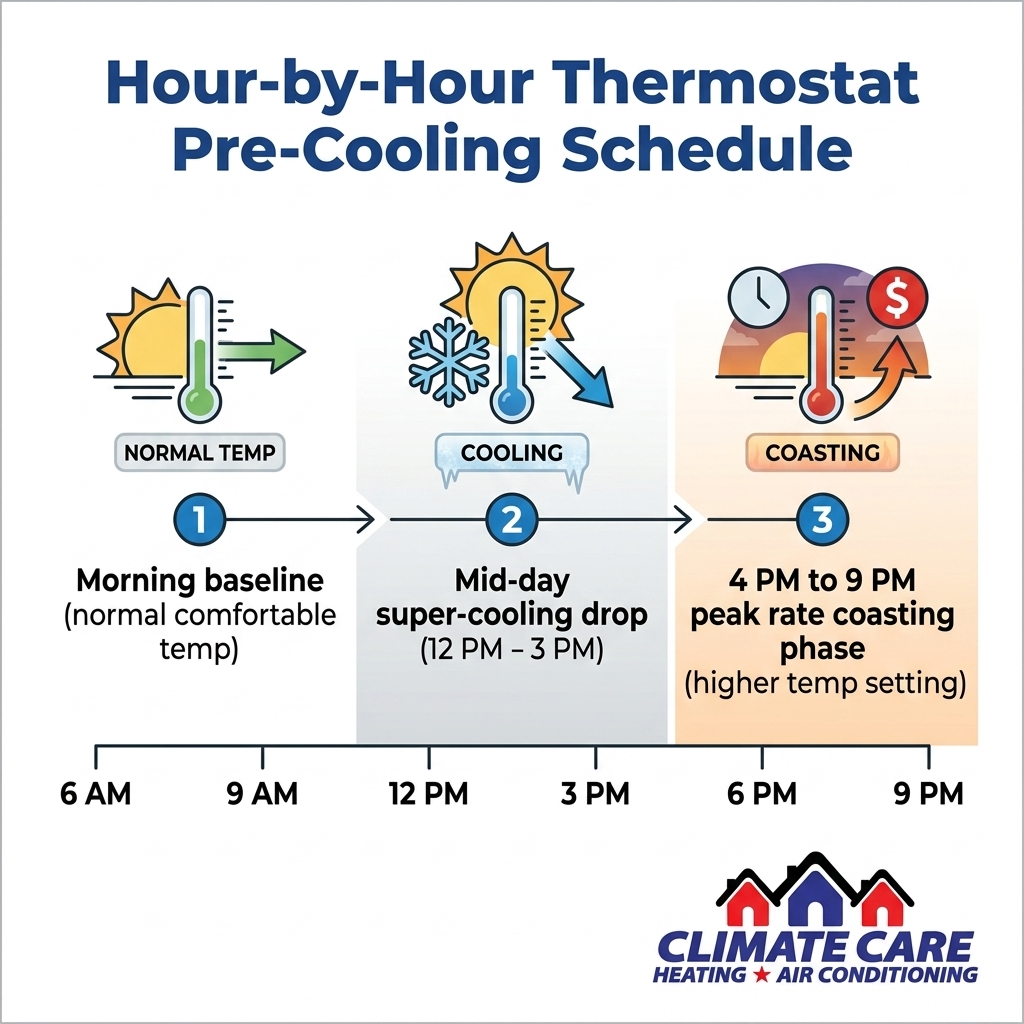
Knowing the science is only half the battle; executing it requires a precise, hour-by-hour plan. To effectively beat the 4 PM to 9 PM peak rate window, you need to program your thermostat to do the heavy lifting while you are either away at work or enjoying the cheaper mid-day rates. Here is the exact schedule our team recommends following to maximize your savings:
• Morning baseline (Wake up to 12 PM): Set the thermostat to your normal, comfortable baseline temperature (typically around 74 to 76 degrees). Let the system maintain this easily while the outside air is still relatively mild.
• Mid-day super-cool (12 PM to 4 PM): Drop the thermostat three to five degrees below your normal setting (down to 70 or 71 degrees). This forces the system to run continuously, aggressively chilling the home's thermal mass while electricity rates are still in the cheap off-peak tier.
• Peak rate coasting (4 PM to 9 PM): Exactly at 4 PM, program the thermostat to jump up to a higher, energy-saving setting (typically 78 to 80 degrees). Because your walls and floors are deeply chilled, the house will slowly warm up over these five hours, often staying entirely comfortable without the system needing to turn on at all.
• Evening recovery (After 9 PM): Once the peak window closes and rates drop back down, return the thermostat to your normal baseline or preferred sleeping temperature.
This pre-cooling strategy is particularly powerful for homeowners in Manteca, CA because of our unique regional climate. In our years of keeping Central Valley homes comfortable, we've learned how to leverage our significant diurnal temperature shifts. We regularly see cool, breezy mornings that eventually give way to punishing 100-plus degree afternoons.
Running your air conditioning compressor in the late morning or early afternoon is mechanically much easier on the equipment. Air conditioners work by absorbing heat from inside your home and dumping it outside. It takes far less electrical energy to dump heat into 85-degree outside air at 1 PM than it does to force heat into 105-degree outside air at 5 PM. By shifting the workload to the earlier part of the day, your system draws fewer amps and operates at a higher efficiency rating.
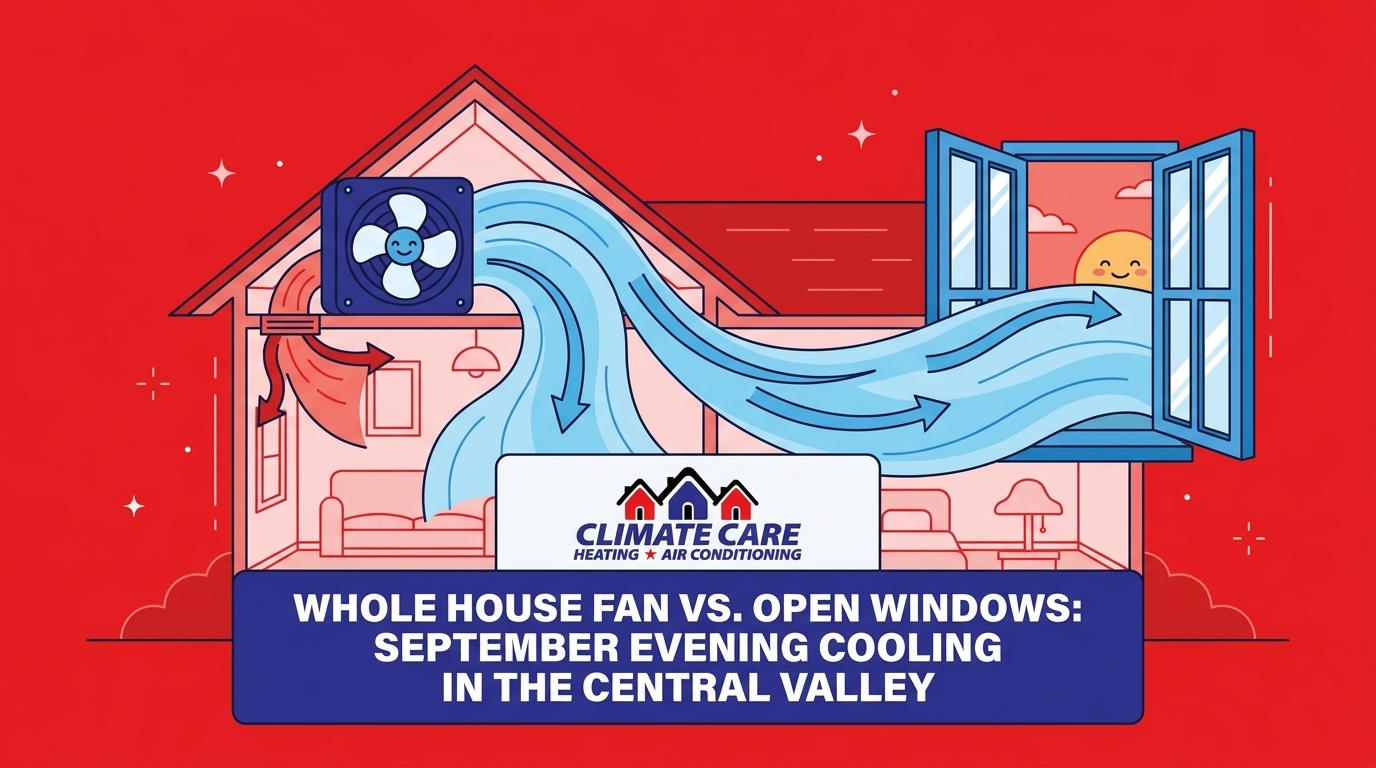
You can also use supplementary strategies to assist this morning cooling process. Utilizing Whole House Fans early in the morning is an incredible way to flush out stale, trapped heat and pull in the crisp outdoor air before the sun intensifies. Once the house is flushed with cool air, you close the windows and let the AC take over the super-cooling phase.
Preserve your progress: To make sure your morning cooling efforts aren't wasted, you must block out the afternoon sun. Close your blinds, pull the heavy curtains, and drop the exterior shades on south- and west-facing windows. Blocking the solar heat gain prevents the sun from immediately warming up the thermal mass you just paid to cool down.
While the financial benefits of pre-cooling are significant, the strategy does place a specific type of demand on your equipment. Pre-cooling requires the air conditioning system to run continuously for several hours during the mid-day stretch. If your system is compromised, this strategy will not yield the results you want.
We see it every July: a neglected system struggling with dirty condenser coils, a clogged air filter, or low refrigerant levels will consume excess energy just trying to operate. When airflow is restricted, the compressor has to work twice as hard to move the same amount of heat. If your system is running inefficiently during the super-cooling phase, you will end up burning through any potential TOU savings before the peak window even starts.
This is where proactive care becomes an investment rather than an expense. As a locally owned provider, our team at Climate Care understands exactly how hard local systems work during extreme heat waves and knows how to optimize them for these specific time-of-use strategies. Enrolling in a comprehensive Maintenance Plan ensures your equipment can handle the sustained morning workload without overheating or breaking down.
What maintenance does for pre-cooling:
• Maximizes airflow: Clean blowers and fresh filters allow the system to chill the thermal mass much faster.
• Optimizes electrical draw: Tightened connections and calibrated capacitors ensure the system uses the minimum required amperage during its long run cycles.
• Prevents mid-day freezing: Proper refrigerant charges prevent the evaporator coil from turning into a block of ice during continuous operation.
Keeping your system in peak condition protects your home's ability to execute these advanced energy-saving strategies flawlessly.
Mastering your thermostat schedule is a powerful way to manage daily costs, but long-term energy efficiency often comes down to the hardware itself. If you are currently operating an older, single-stage air conditioner, our installation crews frequently recommend upgrading to a high-efficiency variable-speed system to compound the savings of your pre-cooling efforts.
Variable-speed systems are uniquely suited for pre-cooling because they can run at lower capacities for longer periods, sipping electricity while steadily pulling humidity and heat out of your home's thermal mass. When you combine top-tier equipment with a smart TOU strategy, the reduction in your monthly overhead is substantial.
Furthermore, upgrading your equipment may qualify you for broader utility and federal programs. Generic federal tax credits and local utility incentives are frequently available for qualifying high-efficiency installations. These programs are designed to reward homeowners who take steps to reduce their overall footprint and ease the strain on the regional grid.
Because these programs frequently update their requirements and qualification standards, we always advise readers to consult with professionals to verify current programs before making a purchase. If you are interested in learning more about how to offset the cost of a new, highly efficient system, we highly recommend reading our guide on PG&E Rebates for Central Valley Homeowners to explore your long-term efficiency upgrade options.
You pre-cool your house by dropping the thermostat setting 3 to 5 degrees below your normal comfort level starting around noon. This forces the air conditioner to run continuously during cheaper off-peak hours, deeply chilling the walls, floors, and furniture. Once the peak pricing window begins, you raise the thermostat setting back up, allowing the chilled structure to keep the house cool without the AC running.
Under the standard TOU-C rate plan, PG&E peak hours are from 4 PM to 9 PM every day. During this five-hour window, the cost of electricity is at its highest due to maximum strain on the power grid. Shifting your heavy AC usage outside of these specific hours is the best way to lower your summer bills.
Yes, running the AC in the morning is mechanically more efficient because the outside air is cooler. Air conditioners use less electrical energy to expel heat into 80-degree morning air than they do battling 105-degree afternoon heat. While you are using energy earlier in the day, you are doing so at a lower cost and with less strain on the equipment.
Pre-cooling is highly effective in the Central Valley due to our significant diurnal temperature swings. Because our mornings are relatively cool, the AC can easily and cheaply chill the home's thermal mass before the intense afternoon heat arrives. This strategy works much better here than it does in humid climates where temperatures remain high around the clock.
It is generally cheaper to practice strategic pre-cooling rather than turning the system off entirely or leaving it at one setting all day. Turning it off completely allows the home's structure to bake, forcing the AC to work aggressively later to recover. Pre-cooling uses cheap mid-day energy to store cooling in the home's structure, allowing you to safely turn the thermostat up (coasting) during the expensive peak times.
You do not have to choose between a comfortable home and reasonable utility bills. By combining a clear, actionable thermostat schedule with routine maintenance, you can effectively coast through the late afternoon heat. Schedule your tune-up today to ensure your system is ready to handle the demands of strategic pre-cooling.
Our customers love our service and support.

Had Climate Care inspect our HVAC before summer. Christopher Hayes was polite, knowledgeable, and efficient. Great service from the office team—highly recommend!
Alex Corona did a thorough furnace check-up today, showing before-and-after photos and answering all my questions. I’m happy with his work and highly recommend him. Great job—happy customer!
Alan C. serviced my furnace today and gave me a courtesy call before arriving. He was very professional, provided great service, and shared lots of pictures. Definitely a five-star experience—I’ll use them again!
On 02/19/2025, Alan inspected my furnace and did a great job explaining everything. He was professional, hardworking, and focused on customer satisfaction. Highly recommend requesting him!