Does a High SEER Rating Matter for Heating or Just Air Conditioning?
That high SEER rating on your outdoor unit only measures summer cooling efficiency. Discover which HVAC ratings actually impact your winter heating performance.
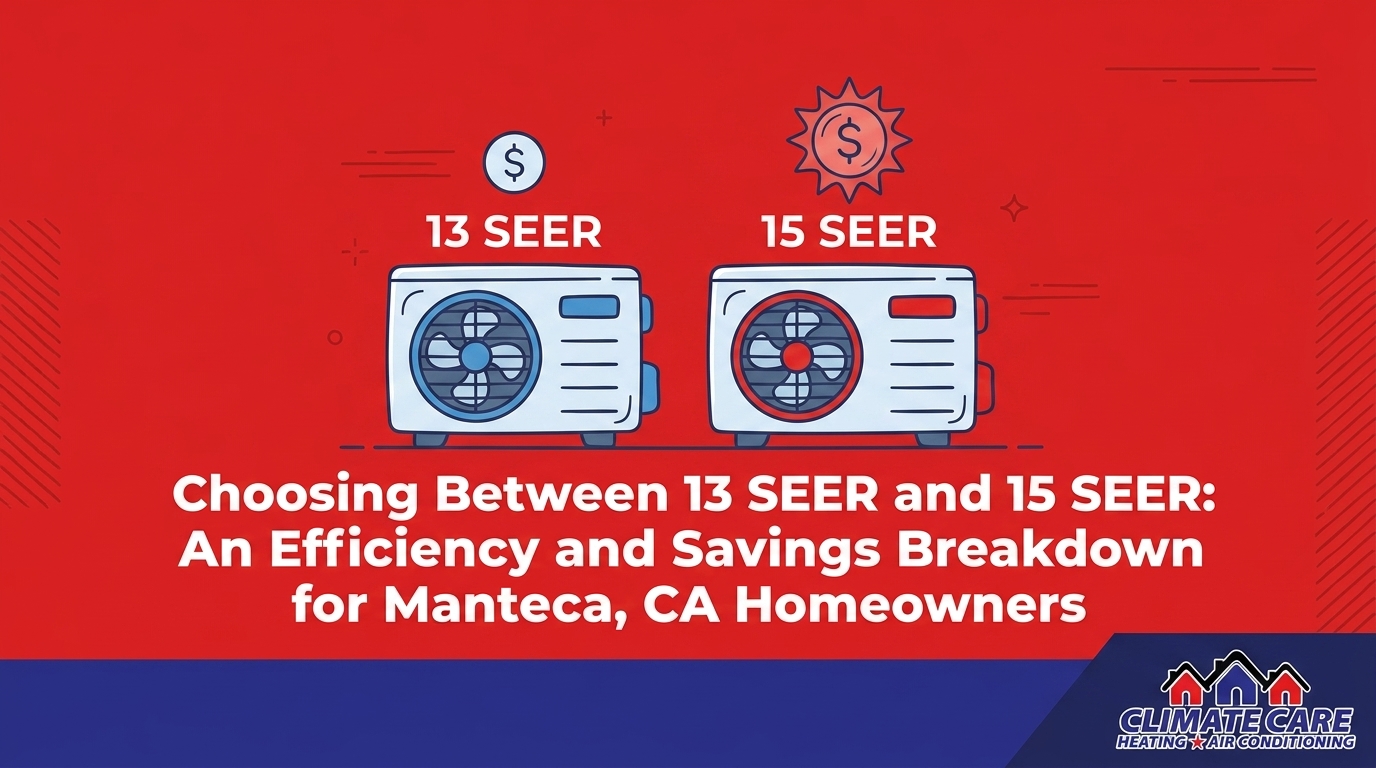
Are you staring at two different air conditioning replacement quotes, wondering if the jump to a higher efficiency unit is actually worth the investment? At Climate Care Heating & Air Conditioning, Choosing Between 13 SEER and 15 SEER: A Cost-Benefit Breakdown for Manteca Homeowners is a conversation our team has almost every day with local families. It is easy to look at the upfront numbers and feel tempted to stick with the baseline option. However, standard efficiency calculations often fail to account for the intense reality of our local climate, where standard systems are forced to run constantly just to keep your living room comfortable.
Here is the thing: assessing the true value of an AC upgrade requires looking past generic national averages and focusing on long-term percentage savings based on local utility rates. A slight bump in efficiency translates to massive workload reductions when the heat hits triple digits. If you are ready to explore comprehensive air conditioning solutions or want to review flexible HVAC financing options, understanding these ratings is your first step toward making a confident financial decision.
The short answer is that SEER stands for Seasonal Energy Efficiency Ratio. It measures how much cooling your air conditioner delivers for every unit of electrical energy it consumes over a typical cooling season. You can think of it like miles per gallon for your car—the higher the SEER rating, the more cooling you get for the same amount of electricity. However, the standard testing conditions used to determine these ratings do not always reflect the harsh reality of a Central Valley summer.
Laboratory tests for SEER ratings typically assume an outdoor temperature of around 82°F. Anyone living in Manteca knows that 82°F is barely a warm spring afternoon. By the time July arrives, we regularly see weeks where the temperature hovers near or above 100°F. Under these extreme conditions, your air conditioning system is pushed to its absolute limits. Our technicians see first-hand every summer how a system that performs adequately in a mild coastal climate will struggle against the relentless heat of the valley.
When our crews are dispatched during peak July heat, we consistently see that it is completely normal for HVAC systems in Manteca to run for 10 to 14 hours every single day. This extended runtime exponentially increases the importance of a higher SEER rating. When your system is cycling on and off for just a few hours a day, the efficiency difference might seem negligible. But when the compressor is grinding away from noon until long after the sun goes down, every single percentage point of efficiency compounds into significant energy usage. A higher SEER rating means the system does not have to work as hard to extract heat from your home, reducing the electrical strain during those grueling 14-hour marathons.
Most homeowners do not realize that the rules surrounding air conditioning efficiency changed significantly recently. If you are replacing an older system, you are likely pulling out a unit rated at 10 to 13 SEER. Today, a 13 SEER unit is no longer a viable option for a brand-new installation in our state. The Department of Energy updated its guidelines in 2023, introducing a more stringent testing protocol known as SEER2.
The transition to SEER2 was designed to better reflect real-world operating conditions, specifically accounting for the static pressure of typical home ductwork. Here is how this impacts your decision:
1. New Regional Minimums: The Department of Energy divided the country into regions. California falls into the Southwest region, which has some of the strictest requirements due to our heavy cooling demands.
2. The 14.3 SEER2 Standard: Any new residential split-system air conditioner installed in California must now meet a minimum of 14.3 SEER2. In the older rating system, this is roughly equivalent to a traditional 15 SEER unit.
3. Phasing Out Older Tech: Manufacturers can no longer produce or sell traditional 13 SEER split systems for use in our region. That rating represents the outdated technology of the failing system you are currently replacing, not a modern choice.
When you look at modern AC installation and replacement, a 15 SEER (or 14.3 SEER2) unit should not be viewed merely as a luxury upgrade. It is the new, compliant baseline designed to handle modern energy standards. Your old 13 SEER unit served you well over its 10-year lifespan, but replacing it with current technology ensures you meet state regulations while benefiting from a decade of engineering advancements.
To truly understand the value of upgrading, we have to compare the operational differences directly. In our experience replacing older Central Valley units, upgrading from an aging 13 SEER system to a modern 15 SEER unit generally reduces your cooling energy consumption by roughly 13% to 15%. While 15% might sound like a modest improvement on paper, it scales massively when applied to the heavy workload of a Central Valley summer.
The efficiency gain is not just a math trick; it is driven by better internal components. Older 13 SEER units typically rely on single-stage compressors. These compressors operate at only one speed: 100% capacity. Every time the thermostat calls for cooling, the system blasts at full power until the target temperature is reached, then shuts off entirely. This constant start-and-stop cycle consumes a massive amount of electricity.
Many modern 15 SEER units incorporate advanced airflow management and more refined compressor technology. While some are still single-stage, their internal coils are larger, and their fan motors are significantly more efficient, allowing them to move heat out of your home with far less electrical effort.
• Energy Consumption — Older 13 SEER System: Baseline usage, heavily strained under high heat — Modern 15 SEER (14.3 SEER2) System: Roughly 13-15% lower energy consumption
• California Compliance — Older 13 SEER System: Obsolete for new split-system installations — Modern 15 SEER (14.3 SEER2) System: Meets current 2023 DOE Southwest mandates
• Compressor Efficiency — Older 13 SEER System: Basic technology, high electrical draw on startup — Modern 15 SEER (14.3 SEER2) System: Optimized coils and efficient fan motors
• Ideal Climate Application — Older 13 SEER System: Mild, temperate zones with short summers — Modern 15 SEER (14.3 SEER2) System: Built to handle 10-14 hour daily runtimes
When your system runs for 14 hours a day in July, that 15% reduction in energy consumption fundamentally changes how much power your home draws from the grid. This reduction in raw electrical demand sets the stage for the financial return on your investment.

Translating technical efficiency into actual financial relief requires looking closely at how electricity is billed in our area. National average electricity rates are often used to calculate generic payback periods, but those numbers are virtually meaningless here. PG&E utilizes tiered pricing and Time-of-Use (TOU) rates that heavily penalize high consumption during late afternoon and early evening hours—exactly when your air conditioner is working its hardest.
Because PG&E's summer peak electricity rates are significantly higher than the national average, the financial benefit of a 15% reduction in energy use is magnified. If you are pushing into top-tier electricity rates during peak summer billing cycles, every kilowatt-hour you save is worth substantially more than it would be in a state with cheap, flat-rate power. The higher the utility rate, the faster a high-efficiency unit pays for its own upgrade cost.
As a local, brother-owned company, we deal with the reality of Central Valley utility bills every day. We understand the shock of opening that August statement. That is why we focus on honest ROI assessments based on local realities, rather than inflated promises. Generating real PG&E bill savings requires a system that avoids pushing your home into those expensive top-tier usage brackets.
The efficiency reality check: A 15 SEER rating is a measurement of potential, not a permanent guarantee. To actually capture those savings year after year, the system must remain clean and calibrated. During our routine summer service calls, we frequently notice that dust buildup on the condenser coils, a clogged air filter, or a slight refrigerant imbalance will force a 15 SEER unit to consume power like an old 13 SEER unit. Scheduling a regular Manteca AC tune-up ensures the equipment continues to operate at peak efficiency, protecting your monthly savings.
When deciding on an HVAC replacement, the smartest approach is to view the equipment as a decade-long utility investment rather than a one-time retail purchase. To make a confident choice, you need to evaluate the payback period—the amount of time it takes for your monthly utility savings to offset the initial difference in installation costs.
A pattern we see often in Manteca is homeowners hesitating to upgrade, choosing instead to continually repair an aging 13 SEER system. The problem is that old equipment loses efficiency as it degrades. You end up paying twice: once for the frequent repair bills and again through inflated energy consumption. Furthermore, our emergency dispatch logs show that aging systems are most likely to fail entirely during the hottest weeks of the year when they are under maximum stress.
The cause of the accelerated payback in our area is the combination of extreme usage and premium power costs. In mild climates, a 15 SEER upgrade might take 12 to 15 years to pay for itself, making it a questionable investment. However, over a standard 10-year lifespan in Manteca, the math changes completely. The combination of running the system 10 to 14 hours a day and paying premium PG&E rates means the savings accumulate rapidly.
Upgrading to a compliant, modern 15 SEER system resolves both the reliability issue and the efficiency drain. The system almost always pays for itself well within its expected 10-year lifespan due to the sheer volume of energy it saves during our long summers. Plus, you gain the peace of mind that comes with reliable cooling, drastically reducing the likelihood that you will need to call for 24-hour HVAC repair in Manteca during a July heatwave.
Upgrading from a 13 SEER to a 15 SEER system typically reduces your cooling energy consumption by roughly 13% to 15%. This percentage represents the reduction in electrical power required to produce the same amount of cooling inside your home. During a Central Valley summer, when systems run for hours on end, this 15% reduction prevents your household from pulling excessive power during peak billing hours. Over an entire cooling season, this efficiency gap translates into a noticeably lower energy footprint.
As of 2023, the Department of Energy requires all new residential split-system air conditioners in California to meet a minimum rating of 14.3 SEER2. This updated testing metric is roughly equivalent to the traditional 15 SEER rating on older scales. Because California is categorized in the Southwest region, our regulations are stricter than northern states to account for our heavy cooling demands. Therefore, you cannot legally install a new 13 SEER split system in Manteca today.
Yes, a 15 SEER unit is almost always worth the investment in our specific region. Because local PG&E electricity rates are significantly higher than the national average, the financial return on energy savings accumulates much faster. When you factor in the extreme heat that forces your system to run constantly, the monthly utility savings quickly offset the initial upgrade costs. Over the lifespan of the equipment, the higher efficiency unit proves to be the much smarter financial choice.
A modern 15 SEER air conditioning unit is generally expected to last between 10 and 15 years. However, this expected 10-year lifespan is heavily dependent on regular professional maintenance. Because these units handle massive workloads during the summer, keeping the coils clean and the airflow unrestricted is mandatory for longevity. Neglecting basic upkeep will force the compressor to overwork, which can significantly shorten the life of even the highest-rated systems.
SEER is strictly a measurement of energy efficiency, not a measurement of cooling speed or raw power. A 3-ton 13 SEER unit and a 3-ton 15 SEER unit will both output the same total volume of cooling. However, because modern 15 SEER units often feature superior blower motors and better airflow management, they can distribute that conditioned air more evenly throughout your home. This improved distribution can make the house feel comfortable more quickly, even though the total cooling capacity remains the same.
Understanding the technical differences between efficiency ratings is helpful, but the best way to project your actual PG&E bill savings is through a custom, in-home assessment. Every house has unique ductwork, insulation levels, and sun exposure that influence how hard a new system will have to work. You need guidance tailored to your specific property, not just a generic brochure.
As a brother-owned local team, Climate Care Heating & Air Conditioning is dedicated to providing transparent, pressure-free advice that makes sense for your budget and our climate. We will walk you through the upfront costs, explain the expected payback timeline, and help you find the perfect balance between performance and value. Contact us today to schedule your estimate and explore your options for a new, compliant 15 SEER system.
Our customers love our service and support.

Had Climate Care inspect our HVAC before summer. Christopher Hayes was polite, knowledgeable, and efficient. Great service from the office team—highly recommend!
Alex Corona did a thorough furnace check-up today, showing before-and-after photos and answering all my questions. I’m happy with his work and highly recommend him. Great job—happy customer!
Alan C. serviced my furnace today and gave me a courtesy call before arriving. He was very professional, provided great service, and shared lots of pictures. Definitely a five-star experience—I’ll use them again!
On 02/19/2025, Alan inspected my furnace and did a great job explaining everything. He was professional, hardworking, and focused on customer satisfaction. Highly recommend requesting him!