The Financial Reality of Delaying Your AC Replacement Until Winter
The Financial Reality of Delaying Your AC Replacement Until Winter
The True Cost of Waiting: Should You Replace Your AC Now or Later?
Is your air conditioner actually broken, or is it just struggling to keep up with the brutal late-summer August heat? As the back-to-school season ramps up and afternoon temperatures peak, many homeowners find themselves facing a frustrating dilemma. When an aging cooling system starts making strange noises or blowing warm air, you have to make a tough choice: do you pay for a temporary band-aid repair to limp through the rest of the year, or do you invest in a brand-new system immediately?
The financial reality of delaying your AC replacement until winter is that waiting often creates a false sense of savings. While it might seem logical to delay a major purchase until the off-season, the compounding hidden costs of running a dying system frequently erase any perceived benefits. Before you pour more money into failing equipment, it pays to understand how modern air conditioning systems operate and why immediate action is often the smartest financial move you can make for your home.
When you are staring down a hefty repair estimate in the middle of a heatwave, the instinct is to find the cheapest, fastest way to restore comfort. However, a purely reactive approach ignores the long-term financial mechanics of home cooling. By stepping back and evaluating the true cost of ownership—including energy waste, repeated service calls, and impending price hikes—you can make an objective decision that protects your household budget.
The Sunk Cost Trap of Late-Summer Band-Aid Repairs
One of the most common financial pitfalls homeowners in Manteca fall into is the sunk cost fallacy. This occurs when you continue to pour money into an aging, failing system simply because you have already invested heavily in past repairs. You might think, "I just replaced the capacitor in June, so I should just fix the blower motor now and ride it out until November." Unfortunately, this mindset often leads to a cycle of escalating emergency service calls.
The physical toll that continuous operation in extreme heat takes on an aging compressor cannot be overstated. When a system is already compromised, every additional day of heavy thermal load increases the likelihood of a catastrophic failure. If your AC is no longer cooling properly, it usually points to deeper, systemic wear and tear that a simple part replacement will not permanently resolve.
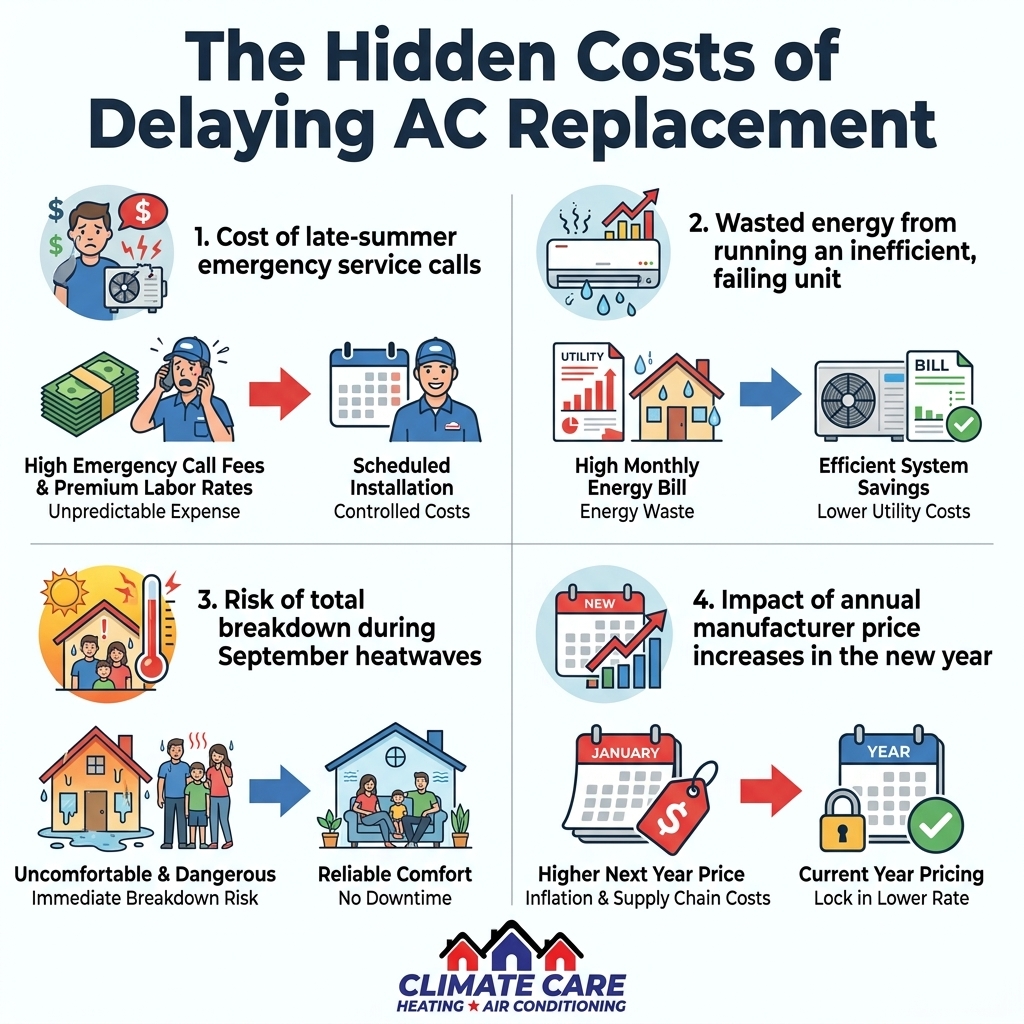
The hidden costs of limping an old unit along include:
• Emergency service fees: Breakdowns rarely happen on a convenient schedule, meaning you are often paying premium rates for weekend or after-hours emergency dispatches.
• Wasted energy consumption: A struggling unit runs longer cycles, drawing significantly more electricity to achieve the same indoor temperature as a healthy system.
• Refrigerant leaks: Older systems relying on outdated, phased-out refrigerants face exorbitant recharge costs if a leak develops.
• Collateral component damage: When one part fails, it forces other components to work harder, accelerating the deterioration of the entire system.
• Loss of warranty coverage: Band-aid fixes on out-of-warranty equipment offer zero financial protection if the unit breaks down again the following week.
Paying for these temporary fixes adds absolutely no long-term value to your home. You are essentially renting a few more weeks of unreliable comfort, only to face the exact same replacement decision a few months down the road.
The Hidden Costs of Delaying AC Replacement
Why the Local Cooling Season Extends Well Beyond August
A major flaw in the "wait until winter" strategy is a misunderstanding of regional weather patterns. It is tempting to look at the calendar in late August and assume that summer is effectively over. However, historical weather data proves that the need for reliable cooling does not magically vanish on September 1st.
In the Central Valley, and specifically in Manteca, residents experience intense, sustained heat well through August and deep into September. It is not uncommon to see strings of 90-degree or even 100-degree days just as the official start of autumn approaches. Relying on a failing AC unit during this extended late-summer August heat is highly risky.
When an older unit is forced to battle these late-season heatwaves, the strain on the compressor reaches its absolute peak. If you try to stretch a compromised system across another month of heavy usage, you are gambling with a total breakdown. A lack of air conditioning during these late-season spikes is more than just uncomfortable; it can quickly become unsafe for vulnerable family members, pets, and even your home's interior finishes.
The reality of extended heat: By the time the weather actually cools down enough to comfortably turn off your air conditioner, you have already forced your failing unit through hundreds of hours of grueling operation. If it survives, you have paid a premium in electricity and repair costs. If it fails, you are forced into an emergency replacement scenario anyway, entirely defeating the purpose of waiting.
Applying the 50% Rule to Aging Equipment
When you are unsure whether to repair or replace your system, industry experts rely on a neutral, objective framework known as the 50% rule. This guideline helps homeowners in Manteca separate their emotional attachment to their current equipment from the stark financial realities of mechanical degradation.
The rule is straightforward: if the cost of a necessary repair approaches or exceeds half the remaining value of the system—and the unit is nearing the end of its expected lifespan—replacement is the far superior financial choice. Investing heavily into obsolete machinery yields a terrible return on investment.
To make the best decision for your household, consider these evaluation steps:
1. Assess the system's age: Most standard central air conditioners have a functional lifespan of 10 to 15 years. If your unit is in this window, major component failures are a sign of end-of-life deterioration.
2. Calculate the true repair cost: Multiply the age of the equipment by the estimated cost of the repair. If the resulting number exceeds the cost of a new system, the repair is not financially viable.
3. Factor in efficiency loss: Older air conditioners lose significant efficiency over time. A unit that was rated at 13 SEER a decade ago may only be operating at a fraction of that efficiency today, forcing it to consume far more electricity.
4. Evaluate refrigerant type: Systems that utilize phased-out refrigerants are incredibly expensive to recharge and service. Upgrading eliminates this ongoing liability.
5. Research available incentives: Generic, widely available energy rebates and federal tax credits for high-efficiency installations can significantly offset the initial investment of a new system, provided you upgrade to qualifying equipment.
Wasted energy translates directly to higher monthly utility bills. Every dollar you spend overpaying your utility company is a dollar you could have invested in a reliable, high-efficiency system. When you factor in the energy savings and the elimination of repair fees, exploring AC replacement services now is often much more economical than waiting.
Will Waiting Actually Secure Better Off-Season Pricing?
One of the most pervasive myths in home improvement is that buying an air conditioner in December yields massive, unbeatable discounts. The logic seems sound on the surface: contractors are less busy during the winter, so they must slash prices to secure work, right? Unfortunately, the modern HVAC supply chain tells a very different story.
While it is true that a contractor's schedule might be more flexible in the off-season, the cost of the equipment itself rarely drops. In fact, equipment manufacturers typically roll out their annual price increases at the start of the new year. These hikes are driven by inflation, raw material costs, and updated federal efficiency regulations.
Comparing the Myth vs. Reality of Off-Season Replacement:
• Equipment Costs — The Winter Discount Myth: Manufacturers discount old inventory to clear warehouses. — The Supply Chain Reality: Manufacturers implement annual price increases every January, raising the baseline cost of all new units.
• Labor Rates — The Winter Discount Myth: Contractors slash labor rates drastically to keep crews busy. — The Supply Chain Reality: Minor seasonal labor discounts are often entirely negated by the rising cost of the equipment itself.
• Repair Expenses — The Winter Discount Myth: You save money by not buying a new unit right now. — The Supply Chain Reality: You waste money paying for late-summer emergency repairs just to keep the old unit running until winter.
• Energy Bills — The Winter Discount Myth: Delaying the purchase keeps cash in your pocket. — The Supply Chain Reality: Running an inefficient unit through the late-summer heat drains your budget via exorbitant utility bills.
As the table illustrates, any minor off-season labor discount you might find is almost always negated by new-year equipment price hikes. Paying for a late-summer repair just to wait for a winter discount that might not even exist is a fundamentally flawed financial strategy. You are exposing yourself to the late-summer August heat with a failing unit, only to pay the same—or potentially more—for a new system a few months later.
Managing Cash Flow: Why Immediate Replacement is Financially Viable
If the math clearly favors replacing a failing system immediately, why do so many homeowners delay? The answer almost always comes down to sticker shock. An unexpected total system replacement is a significant investment, and the prospect of draining a savings account to cover a lump-sum expense is daunting for any family in Manteca.
However, the narrative around home comfort upgrades has shifted dramatically. You no longer need to view an AC replacement as an insurmountable upfront cash burden. Modern payment solutions allow you to treat a new, high-efficiency system as a highly manageable monthly operating expense.
By spreading the cost of the equipment over time, you can upgrade your home's comfort immediately without derailing your household budget. This approach allows you to stop pouring cash into a dying unit and start enjoying the lower utility bills and reliable performance of a modern system right away. Exploring HVAC financing options is the key to bridging the gap between an unexpected breakdown and a smart, long-term home improvement.
Leveraging Promotions and Payment Plans
Structured payment plans eliminate the stress of an emergency replacement. Instead of settling for a lower-tier, inefficient unit because it is all you can afford in cash today, flexible terms allow you to invest in a high-efficiency system that will actively save you money on energy costs every single month.
Furthermore, pairing an immediate installation with current seasonal specials maximizes your overall value. Manufacturers and local dealers frequently run targeted promotions during the late-summer transition to help homeowners upgrade before the final heatwaves hit. By taking advantage of current installation specials, you can lock in favorable terms, secure top-tier equipment, and completely bypass the anxiety of nursing a broken air conditioner through September.
Frequently Asked Questions About AC Repair vs. Replacement Timing
Is it cheaper to replace an AC unit in the winter?
Not necessarily, as annual manufacturer price increases often offset any minor off-season labor discounts you might find. While scheduling might be easier for contractors in December, the baseline cost of the equipment itself typically rises at the start of the new year due to inflation and updated regulatory standards. Furthermore, if you have to pay for expensive repairs just to keep your current unit running through the late-summer August heat, those sunk costs completely erase any potential winter savings. It is almost always more cost-effective to replace a failing unit immediately rather than paying to wait.
Should I repair my AC or wait to replace it?
If the repair cost approaches the 50% rule or the unit uses outdated refrigerant, immediate replacement is generally the smarter financial decision. Continuing to repair an obsolete system is a poor investment because older units suffer from severe efficiency degradation, meaning you are overpaying on your utility bills every month. Investing in new technology provides immediate utility savings and restores your peace of mind. A new system also comes with comprehensive warranty protection, shielding you from future out-of-pocket repair costs.
How long can you limp an old AC along?
While temporary fixes might buy you a few weeks, an older system under heavy thermal load is highly susceptible to sudden, total failure. The components in an aging air conditioner are interconnected; when one part struggles, it forces the compressor and blower motor to work harder, accelerating their demise. Limping a compromised system through a late-season heatwave puts your home at risk of a complete breakdown when you need cooling the most. The discomfort and financial risk of relying on a dying unit rarely justify the few extra weeks of operation.
What is the best month to buy a new air conditioner?
The absolute best time to buy a new air conditioner is before your current system experiences a catastrophic failure, regardless of the month on the calendar. Proactive replacement allows for thoughtful decision-making, giving you time to research high-efficiency models, compare features, and secure favorable payment terms. When you wait for a system to die in the middle of a heatwave, you are forced into a rushed, emergency purchase where your primary concern is just getting the house cool again. Upgrading on your own timeline always yields a better financial outcome.
Do new AC units really save that much on energy bills?
Yes, modern high-efficiency systems consume significantly less electricity to produce the exact same amount of cooling as older models. Advances in variable-speed compressors, improved coil designs, and smarter airflow management mean that today's units operate with incredible precision. If you are upgrading from a system that is 10 to 15 years old, the improvement in energy consumption is immediate and noticeable. Over the lifespan of the new equipment, these monthly utility savings help offset the initial investment of the installation.
Making a Smart Financial Decision for Your Home's Comfort
The hidden costs of waiting—compounding repair fees, severe energy inefficiency, and the looming risk of a total breakdown—rarely justify delaying a necessary cooling upgrade. While the initial sticker shock of an unexpected replacement can be intimidating, a clear, objective breakdown of these factors reveals that immediate action is often the most financially sound choice you can make for your home.
You do not have to suffer through the rest of the season in Manteca with a struggling, unreliable air conditioner. By evaluating your equipment's true health and exploring manageable payment options, you can upgrade your comfort without derailing your budget. If your system is failing to keep up, reach out to a local expert to schedule a comprehensive inspection and discuss the best path forward for your household.
Had Climate Care inspect our HVAC before summer. Christopher Hayes was polite, knowledgeable, and efficient. Great service from the office team—highly recommend!
Corey W.
Alex Corona did a thorough furnace check-up today, showing before-and-after photos and answering all my questions. I’m happy with his work and highly recommend him. Great job—happy customer!
Ingrid P.
Alan C. serviced my furnace today and gave me a courtesy call before arriving. He was very professional, provided great service, and shared lots of pictures. Definitely a five-star experience—I’ll use them again!
Rolando L.
On 02/19/2025, Alan inspected my furnace and did a great job explaining everything. He was professional, hardworking, and focused on customer satisfaction. Highly recommend requesting him!