Why Understanding How Proper HVAC Maintenance Prevents Mold Growth Could Save Your Home
How proper HVAC maintenance prevents mold growth comes down to one core principle: controlling moisture. Here is a quick breakdown of what that looks like in practice:
1. Replace air filters every 30-90 days to trap mold spores before they circulate
2. Keep indoor humidity between 30-50% to stop spores from colonizing
3. Clear condensate drain lines and drain pans to eliminate standing water
4. Seal and insulate ductwork to prevent hidden condensation buildup
5. Schedule professional inspections twice a year to catch moisture problems early
6. Consider UV lights or whole-home dehumidifiers for an added layer of protection
Mold spores are always floating through the air inside your home. That is completely normal. The problem starts when those spores land on a damp surface — and your HVAC system, with its coils, drain pans, and ductwork, creates exactly those conditions if it is not properly maintained. According to the EPA, indoor relative humidity should stay between 30% and 50% to prevent mold from taking hold. Once humidity climbs past 60%, mold colonies can form within just one to two days.
For homeowners in Manteca and across the Central Valley, this is not a small concern. The region's warm summers push air conditioning systems hard, and that constant cooling cycle generates significant condensation. A neglected HVAC system does not just struggle to cool your home — it can quietly become a mold source that spreads spores through every room every time the fan runs.
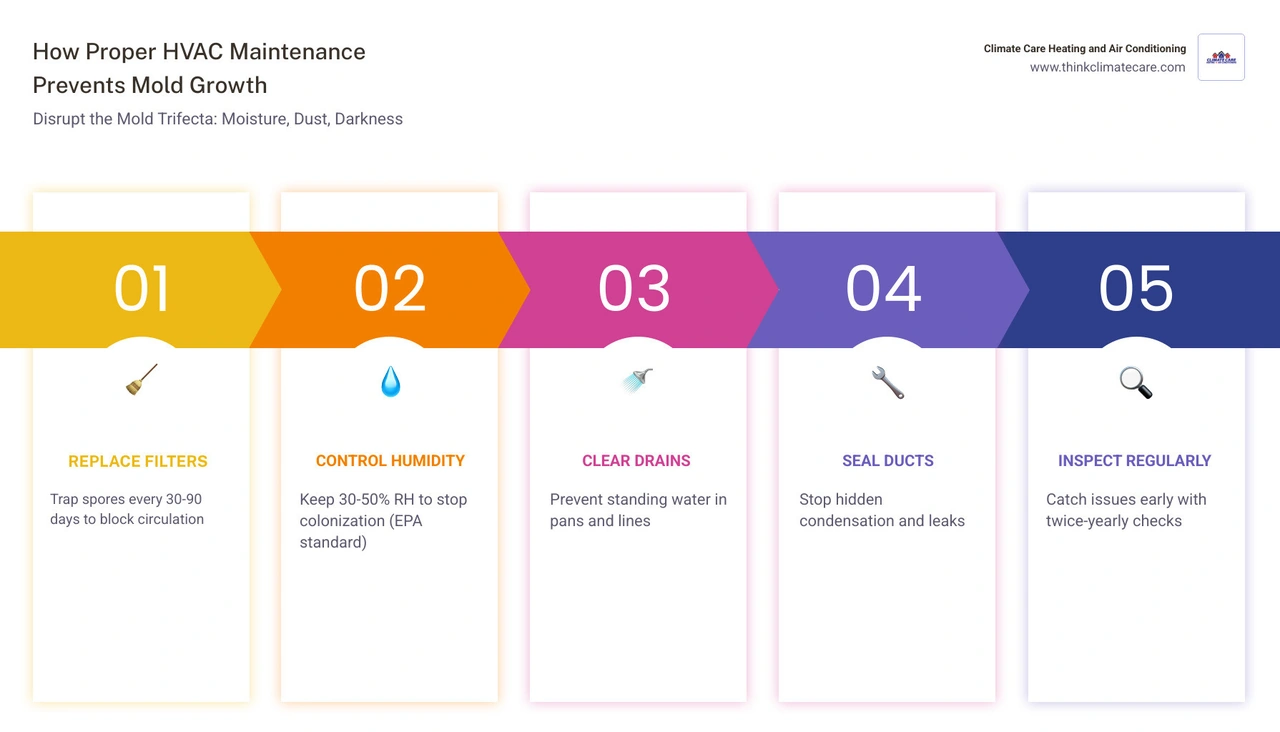
How Proper HVAC Maintenance Prevents Mold Growth
At Climate Care Heating and Air Conditioning, we have seen how a little neglect can lead to a big, fuzzy, green (or black) problem. The primary reason how proper hvac maintenance prevents mold growth is by disrupting the "mold trifecta": moisture, food (dust), and a dark place to grow.
When your air conditioner runs, the evaporator coil gets very cold. As warm air from your home passes over this coil, moisture in the air condenses into liquid water—much like the sweat on a cold glass of iced tea in a Modesto summer. In a well-maintained system, this water drips into a pan and flows away. However, if the system is dirty or poorly adjusted, that water stays put.
Regular AC maintenance ensures that the cooling cycle is balanced and that HVAC leaks are not creating hidden pockets of water damage. By keeping the system clean and calibrated, we ensure that moisture is removed from your air and sent safely down the drain rather than feeding a mold colony.
• 30% - 50% — Mold Growth Risk: Very Low (Optimal) — System Impact: Efficient cooling, comfortable air
• 50% - 60% — Mold Growth Risk: Moderate — System Impact: Potential for growth in dark corners
• 70% + — Mold Growth Risk: High (Hazardous) — System Impact: Rapid colony formation within 24-48 hours

How Proper HVAC Maintenance Prevents Mold Growth via Humidity Control
Humidity is the single most important factor in the mold equation. In April 2026, we are seeing more homeowners using smart technology to track their indoor climate, and for good reason. The EPA sets the gold standard for indoor relative humidity (RH) at 30% to 50%. Once you cross that 60% threshold, you are essentially rolling out the red carpet for spores.
Proper maintenance includes an HVAC tune-up in Elverta or surrounding areas to ensure your system is actually dehumidifying. An oversized AC unit, for instance, might cool your house quickly but shut off before it has a chance to pull moisture from the air. We check for these design flaws and ensure your vapor barriers and insulation are intact. We often recommend using a hygrometer—a simple, inexpensive tool—to monitor these levels daily.
How Proper HVAC Maintenance Prevents Mold Growth with Filter Changes
Think of your air filter as the first line of defense. Its job is to catch dust, pet dander, and—crucially—mold spores. When a filter is clean and has a high MERV rating (typically between 8 and 13), it effectively traps these particles.
However, when you neglect air filter replacement in Sacramento, the filter becomes a "food source" for mold. A dirty filter also restricts airflow. When air can't move freely, the system has to work harder, and the air inside your ducts becomes stagnant and humid. To understand the full scope of the risk, you can read more about what happens when you don't change your HVAC air filters and the impact of dirty filters on AC performance. We recommend checking your filters monthly and replacing them at least every 90 days—or more often if you have pets or allergies.
Managing Condensate Lines and Clogged Drain Pans
If the evaporator coil is where moisture is born, the condensate drain pan is where it lives. This pan must be properly sloped so gravity can pull the water into the drain line. Over time, dust and algae can create a "slime" that clogs these lines. This leads to standing water, turning your HVAC unit into a mold factory.
As part of our HVAC maintenance in Salida, we inspect these pans for standing water and ensure the "deep seal" traps are functioning correctly. A simple DIY tip is to flush your drain line with a cup of vinegar once a quarter to kill early algae growth, but a professional clearing is the only way to ensure there are no deep blockages waiting to cause a flood.
Ductwork Maintenance and Sealing in Modesto
Your ductwork is the highway for your home’s air. If that highway has holes, you have a problem. Leaky ducts in unconditioned spaces (like a hot attic in Stockton or Modesto) pull in humid air. When that humid air hits the cold metal or fiberglass of the duct, it creates condensation—hidden from view, but perfectly placed for mold to thrive.
Ensuring your ducts are sealed and insulated is vital. If you suspect mold is already present, Sacramento duct cleaning may be necessary to remove the buildup. Regular air duct maintenance is one of the smartest investments you can make for your home's health. You can learn more about why duct cleaning is important for indoor air quality to keep your family breathing easy.
Utilizing UV Lights and Advanced IAQ Technology
For homeowners who want the ultimate protection, we often suggest looking into advanced Indoor Air Quality (IAQ) technology. UV-C lights are a game-changer. These lights are installed inside the HVAC system, usually near the evaporator coil. The UVC light penetrates the DNA of mold spores and bacteria, rendering them unable to reproduce or grow.
Combining UV lights with thoroughly cleaning your HVAC system and installing a whole-home dehumidifier creates a hostile environment for mold. Modern smart thermostats can also be programmed to run "dehumidification modes," which slow down the blower fan to pull even more moisture out of the air during those muggy Central Valley afternoons.
Recognizing Signs of Mold and System Failure
How do you know if the spores have already moved in? The most common sign is a "dirty sock" or musty odor coming from your vents when the AC kicks on. You might also notice visible black or green speckles on your supply registers or increased allergy symptoms like sneezing, itchy eyes, and headaches that seem to vanish when you leave the house.
If you notice these warning signs of HVAC system failure, it is time to act. Don't wait for the problem to spread. A professional HVAC system diagnostic can pinpoint exactly where the moisture is coming from and how to stop it.
Professional Solutions for a Mold-Free Central Valley Home
At Climate Care Heating and Air Conditioning, our mission is to keep your home comfortable and your air pure. We serve families from Sacramento down to Turlock, providing the holistic care your system needs to stay mold-free year-round. Whether you need HVAC maintenance in Manteca, a comprehensive guide to maintenance in Tracy, or expert HVAC maintenance in Sacramento, we are here to help.
Don't let your HVAC system become a breeding ground for spores. By scheduling seasonal tune-ups, you aren't just protecting your equipment; you're protecting your family's health. Improve your indoor air quality today by reaching out to our team. We’ll help you keep the air moving, the moisture draining, and the mold far away from your home.