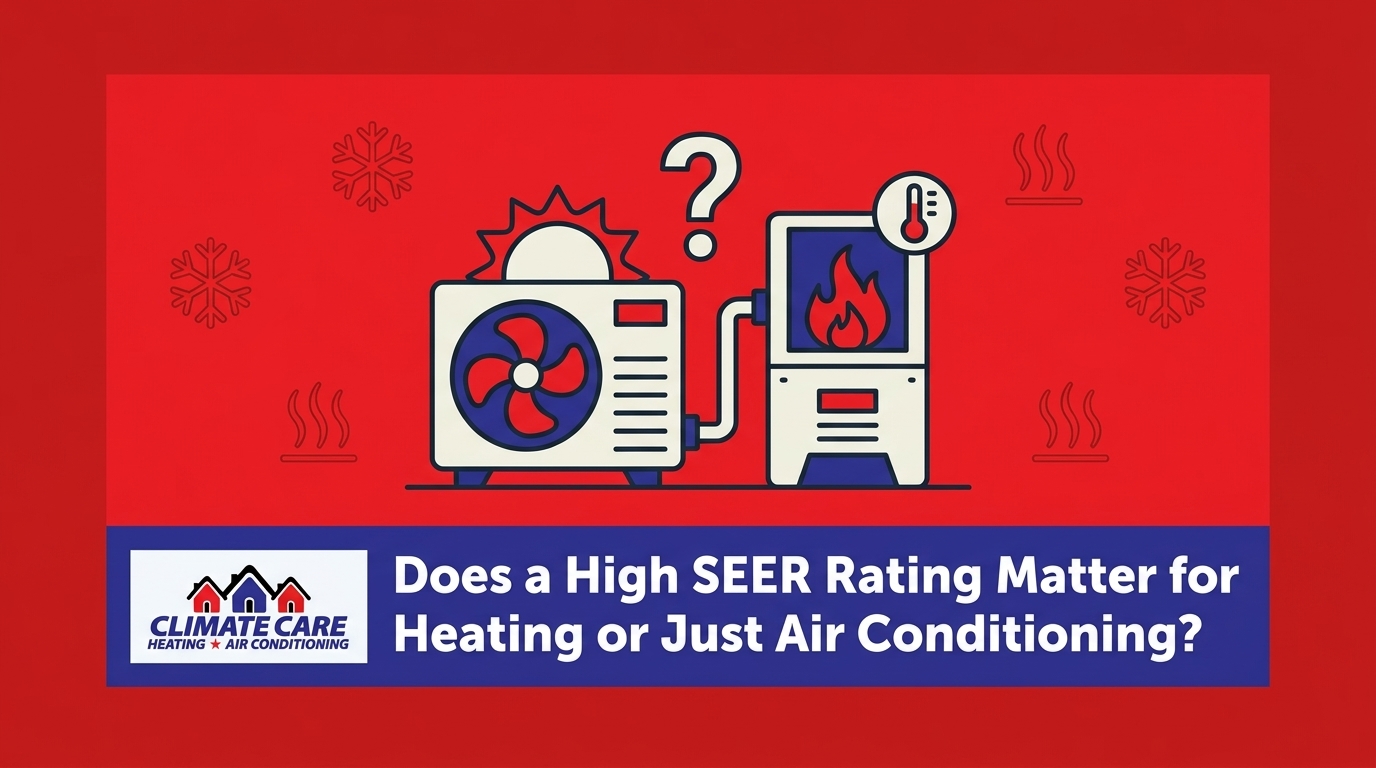
Does a High SEER Rating Matter for Heating or Just Air Conditioning?
That high SEER rating on your outdoor unit only measures summer cooling efficiency. Discover which HVAC ratings actually impact your winter heating performance.
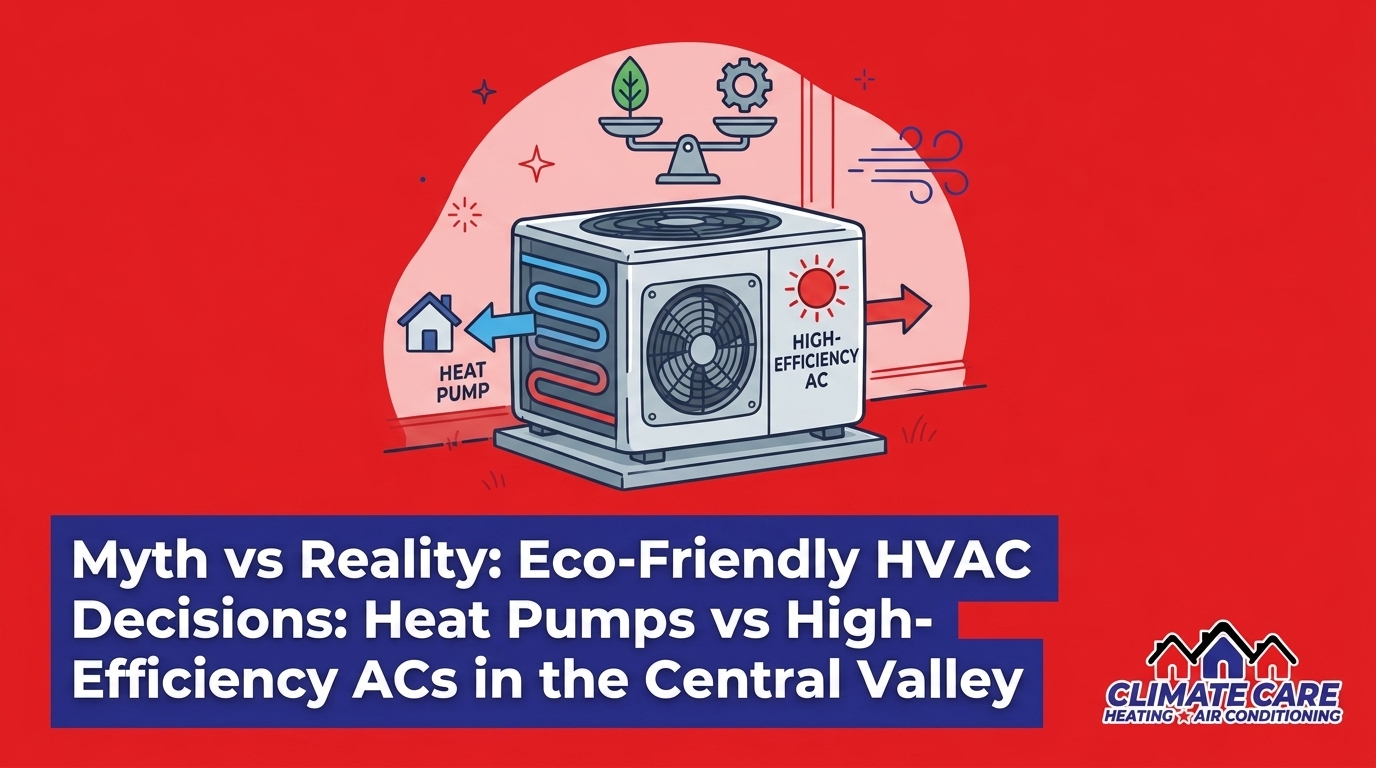
There is a persistent misconception that choosing environmentally conscious technology means sacrificing raw performance, especially when it comes to cooling your home. When you are making Eco-Friendly HVAC Decisions: Heat Pumps vs High-Efficiency ACs in the Central Valley, our team at Climate Care knows the stakes are incredibly high. A failing air conditioning system during July peak summer heat is a concrete emergency, not just a minor inconvenience. Homeowners often share their worries with us that "going green" will leave them sweating through the hottest afternoons, assuming that lower energy consumption equates to weaker cooling output.
The reality we see in the field is exactly the opposite. Modern eco-friendly cooling systems are engineered specifically to handle extreme environmental stress while drawing a fraction of the electricity required by older units. If you are standing at the decision point of replacing a struggling unit mid-summer, understanding the actual capabilities of today's technology is critical. To explore your foundational options, our professional Air Conditioning upgrades provide the bridge between maximum comfort and environmental responsibility.
This guide breaks down the true performance metrics of high-efficiency air conditioners and advanced heat pumps based on our hands-on experience. By analyzing how these systems operate under the crushing weight of a Central Valley summer, you can make a replacement decision that satisfies your eco-conscious goals without ever compromising on the cold air your family needs.
The environmental stress placed on HVAC equipment in Manteca and the Central Valley is uniquely punishing. In our years of servicing local neighborhoods, we've seen how our inland climate frequently delivers prolonged stretches of 100-plus degree days with intense, dry heat, unlike coastal regions where temperatures dip in the evening. This sustained extreme temperature creates a massive "cooling load"—the amount of heat energy a system must continuously remove from a home to maintain a set indoor temperature.
Base-level efficiency systems, typically those meeting only the bare minimum regulatory standards, struggle to keep up with this demand. These standard units operate on single-stage compressors, meaning they blast at 100% capacity, shut off when the thermostat registers the target temperature, and turn back on when the house warms up. During July peak summer heat, the house warms up almost immediately. This constant on-and-off cycling draws massive amounts of startup amperage, putting immense strain on both the equipment's internal components and the local California electrical grid.
As a local provider, our technicians at Climate Care understand exactly how these extreme dry-heat conditions impact system longevity. A pattern we see often every summer is standard equipment burning out and experiencing catastrophic failure right when our customers need it most, simply because the system was working in a constant state of maximum exertion.
Waiting for a breakdown during a heat wave severely limits your options and often forces a rushed decision. Proactive assessments are the best defense against mid-summer failures. For example, one local homeowner recognized the importance of getting ahead of the heat and scheduled an inspection with us during the spring. Our technician Christopher Hayes arrived to perform a thorough, polite, and highly efficient check-up, catching potential vulnerabilities before the extreme summer temperatures arrived. This kind of proactive maintenance ensures that whatever system you rely on is fully prepared for the heavy lifting required from June through September.
When our installation team evaluates traditional cooling replacements, understanding the latest efficiency metrics is non-negotiable. The industry now uses the SEER2 (Seasonal Energy Efficiency Ratio 2) standard, which involves more rigorous, real-world testing conditions than the previous SEER ratings. California enforces strict regional minimum requirements for SEER2, but we frequently advise our customers that simply meeting the minimum is rarely enough to achieve true eco-friendly operation or optimal comfort during a Central Valley heat wave.
High-efficiency air conditioners move beyond basic functionality by incorporating advanced variable-speed or two-stage compressors. Unlike standard units, these systems can adjust their cooling output to match the exact needs of the home at any given moment. During extreme heat, they don't just blast cold air and shut off; they run continuously at lower, energy-sipping speeds. This steady operation removes more humidity, maintains a perfectly even temperature, and drastically reduces the massive power spikes that strain the electrical grid.
To truly grasp the impact of an eco-friendly upgrade, we like to show homeowners the operational gap between a standard high-efficiency unit and an ultra-high-efficiency model.
1. The 15 SEER2 Baseline: In our experience, a 15 SEER2 air conditioner is a solid, reliable piece of equipment that complies with modern standards. Under July peak summer heat, it will cool your home effectively. However, it still relies on relatively traditional compressor technology, meaning its energy draw during continuous afternoon operation remains significant.
2. The 21 SEER2 Ultra-Efficiency Tier: Jumping to a 21 SEER2 system introduces true variable-speed technology. Think of it like a car with cruise control versus a car constantly accelerating and braking in stop-and-go traffic. The 21 SEER2 unit ramps up smoothly, finds the exact capacity needed to overcome the 105-degree heat outside, and holds it there.
3. Carbon Footprint Reduction: The continuous, low-amperage draw of a 21 SEER2 system means it consumes substantially fewer kilowatt-hours over the course of a Central Valley summer. By demanding less electricity from fossil-fuel-burning power plants, higher SEER2 ratings directly and measurably reduce your home's carbon footprint.
One of the most common questions our eco-conscious customers ask us is whether a heat pump can actually handle extreme summer temperatures. The confusion stems from the name itself. Despite being called a "heat pump," this technology is, at its core, a highly advanced air conditioner. During the summer months, a heat pump operates exactly like a traditional AC: it absorbs heat energy from inside your home and pumps it outside.
When it comes to pure cooling power in Manteca and the Central Valley, we can confidently say that modern heat pumps are absolute workhorses. They do not struggle in 100-plus degree weather. In fact, premium heat pumps utilize some of the most sophisticated inverter-driven compressors on the market. This technology allows the system to make micro-adjustments to its cooling output, operating with incredible precision to overcome severe environmental heat loads.
We consistently recommend inverter-driven heat pumps because their summer reliability is unmatched. Standard compressors turn on and off, creating temperature swings and high energy consumption. An inverter-driven heat pump continuously modulates its speed. If the outside temperature spikes from 95 degrees at noon to 108 degrees by 4:00 PM, the heat pump seamlessly ramps up its refrigerant flow to match the exact heat gain of the house.
This continuous, modulated operation means the system never falls behind. It provides relentless, uninterrupted cooling while using significantly less electricity than a standard AC unit. For homeowners prioritizing environmental impact, this is a massive advantage. You get top-tier cooling performance while actively reducing your reliance on the strained summer power grid. To understand more about how these systems benefit our specific region, reviewing the Heat Pump Benefits for Central Valley Homeowners provides excellent context on their year-round efficiency.
When we sit down with homeowners to choose between a high-efficiency AC and a high-efficiency heat pump, the decision often comes down to specific environmental priorities and how the system integrates with the home. Both technologies represent a massive leap forward in eco-friendly cooling, particularly as the industry transitions to low-GWP (Global Warming Potential) refrigerants like R-454B. These next-generation refrigerants have a drastically lower environmental impact if accidentally released into the atmosphere compared to older chemicals.
To make an informed decision during July peak summer heat, it helps to view the core differences side-by-side.
• Cooling Mechanism — High-Efficiency Air Conditioner (18+ SEER2): Removes indoor heat via standard refrigeration cycle. — Inverter-Driven Heat Pump (18+ SEER2): Removes indoor heat via reversible refrigeration cycle.
• Peak Summer Grid Strain — High-Efficiency Air Conditioner (18+ SEER2): Low. Variable-speed models significantly reduce startup power spikes. — Inverter-Driven Heat Pump (18+ SEER2): Ultra-Low. Inverter technology provides the smoothest power draw available.
• Refrigerant Type — High-Efficiency Air Conditioner (18+ SEER2): Transitioning to modern Low-GWP standards (eco-friendly). — Inverter-Driven Heat Pump (18+ SEER2): Transitioning to modern Low-GWP standards (eco-friendly).
• Cooling Reliability in 105°F+ — High-Efficiency Air Conditioner (18+ SEER2): Excellent. Designed specifically for high-load, continuous summer operation. — Inverter-Driven Heat Pump (18+ SEER2): Excellent. Modulates capacity to easily overcome extreme exterior temperatures.
• Zoning Flexibility — High-Efficiency Air Conditioner (18+ SEER2): Requires traditional ductwork and mechanical zone dampers. — Inverter-Driven Heat Pump (18+ SEER2): Highly adaptable; pairs perfectly with Ductless Systems for targeted room cooling.
Both systems offer incredible cooling power, but our team notes that heat pumps often edge out traditional ACs in homes looking to eliminate fossil fuel usage entirely, as they run strictly on electricity and integrate flawlessly with solar panel arrays.

The push for eco-friendly HVAC solutions isn't just about individual home comfort; it is a critical component of stabilizing the California electrical grid. During prolonged heat waves in Manteca and the Central Valley, the sheer volume of aging, inefficient air conditioners turning on simultaneously pushes the grid to its absolute limits. By upgrading to a high-efficiency AC or a modern heat pump, you are actively participating in reducing this dangerous peak demand.
Because grid stabilization is a major priority for both the state and federal governments, there are numerous generic incentive programs designed to encourage homeowners to make these eco-friendly upgrades. Replacing an entire core system often qualifies for generic federal tax credits and local utility rebates. Keep in mind that updating your core infrastructure (which naturally updates your Heating Services capabilities for later in the year) is frequently a requirement to qualify for certain whole-home energy efficiency programs.
Navigating these incentives can be complex, as program requirements frequently change based on SEER2 ratings, equipment types, and local utility guidelines. We strongly advise consulting with our Climate Care professionals during your replacement estimate. We can help identify which specific eco-friendly system architecture maximizes your potential generic incentives while delivering the exact cooling load your home requires.
Yes, in our experience, modern heat pumps are highly effective at cooling even in extreme temperatures. They utilize the exact same refrigeration principles as a standard air conditioner to absorb heat from inside your home and reject it outside. Equipped with advanced inverter compressors, they can easily maintain comfortable indoor temperatures when outside thermometers cross the 100-degree mark during July peak summer heat.
Both can achieve high SEER2 ratings, but specific efficiency depends heavily on the model and its variable-speed capabilities. A top-tier high-efficiency AC and a premium heat pump will have very similar energy draws in cooling mode. However, we often find that heat pumps with advanced inverter technology provide slightly smoother capacity modulation, which can edge out traditional ACs in overall seasonal energy savings.
Our technicians generally recommend aiming for 18 SEER or higher for an optimal balance of comfort and energy savings during prolonged heat waves. While a 15 SEER2 system meets basic requirements, stepping up to an 18 to 21 SEER2 unit ensures you get variable-speed technology. This is crucial for managing the intense, sustained heat loads we experience without causing massive spikes in your summer electricity consumption.
While base models meet the state's minimum regional requirements, we strongly recommend high-efficiency units to manage grid strain and reduce personal energy consumption. The extreme summer climate demands equipment that can run continuously without burning excessive power. Investing in high-efficiency technology protects your home from temperature swings and insulates you against rising energy costs.
Systems utilizing low-GWP refrigerants and variable-speed compressors offer the lowest environmental impact. Fully electric heat pumps are widely considered the most eco-friendly option, especially when paired with residential solar panels, as they completely eliminate on-site fossil fuel combustion while delivering exceptional, low-amperage cooling power.
When facing extreme temperatures in Manteca and the Central Valley, our team at Climate Care wants you to know that you do not have to choose between saving the environment and keeping your family comfortable. Both high-efficiency air conditioners and modern heat pumps are excellent, eco-friendly choices capable of conquering the most severe summer heat. The right choice depends entirely on your home's specific layout, your current ductwork, and your long-term energy goals.
Do not wait for your aging system to fail during the next major temperature spike. Take control of your comfort and your carbon footprint today. Schedule a professional consultation with us to evaluate your home's unique cooling load, and let our experts help you determine the perfect eco-friendly fit. Reach out now to request an estimate for a high-performance Heat Pump or high-efficiency AC installation.
Our customers love our service and support.

Had Climate Care inspect our HVAC before summer. Christopher Hayes was polite, knowledgeable, and efficient. Great service from the office team—highly recommend!
Alex Corona did a thorough furnace check-up today, showing before-and-after photos and answering all my questions. I’m happy with his work and highly recommend him. Great job—happy customer!
Alan C. serviced my furnace today and gave me a courtesy call before arriving. He was very professional, provided great service, and shared lots of pictures. Definitely a five-star experience—I’ll use them again!
On 02/19/2025, Alan inspected my furnace and did a great job explaining everything. He was professional, hardworking, and focused on customer satisfaction. Highly recommend requesting him!