
Does a High SEER Rating Matter for Heating or Just Air Conditioning?
That high SEER rating on your outdoor unit only measures summer cooling efficiency. Discover which HVAC ratings actually impact your winter heating performance.
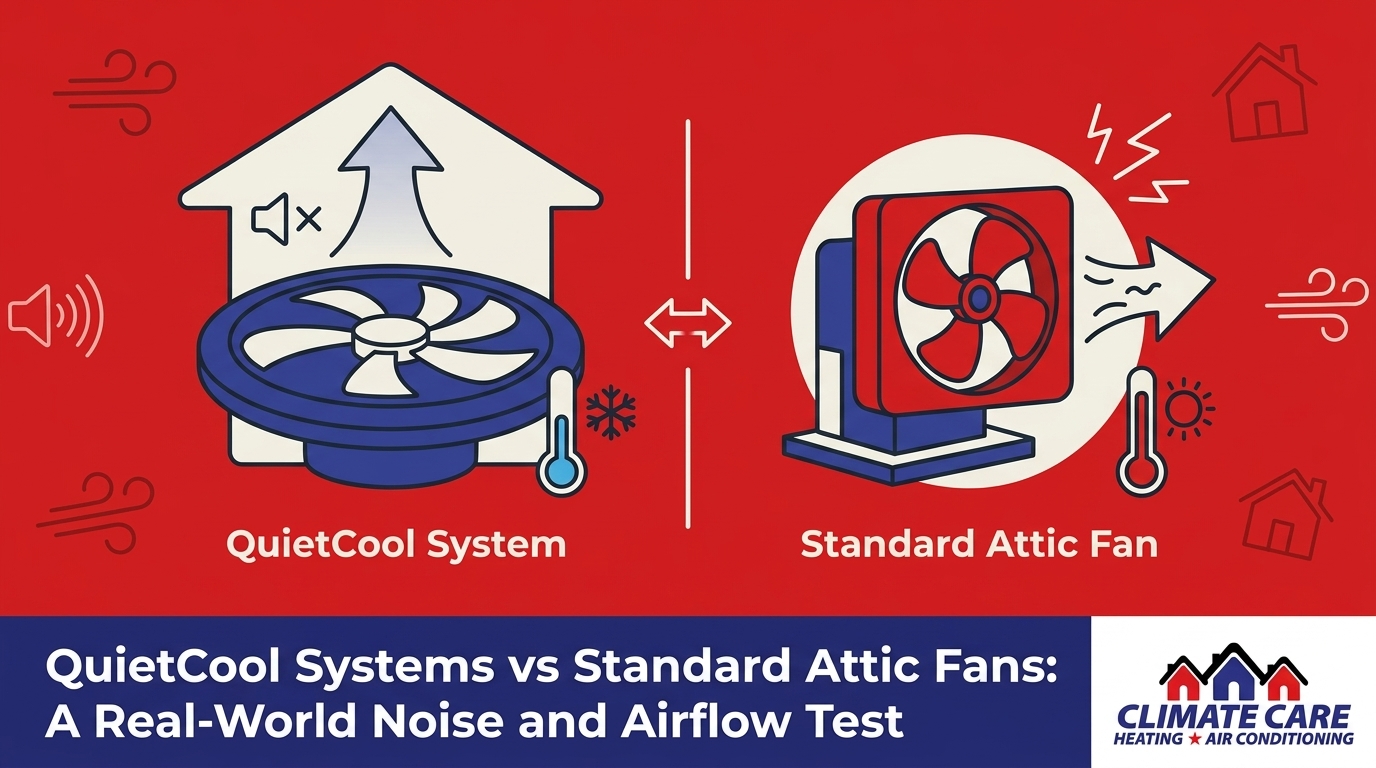
Your air conditioner has been running relentlessly all day, but as the sun finally dips below the horizon, the inside of your house still feels like an oven. You flip the switch on your traditional ventilation fan hoping for some immediate relief, and instantly, the ceiling starts vibrating with a mechanical roar. When diving into a QuietCool Systems vs Standard Attic Fans: A Real-World Noise and Airflow Test, the most immediate and glaring difference you will encounter is exactly that massive acoustic disruption. Trying to cool down a stifling house before bed shouldn't require you to shout over the sound of your own home comfort equipment.
This is a common frustration, especially during August late-summer evenings and the back-to-school transition when the outdoor temperature finally drops, but your indoor air remains stubbornly trapped at eighty degrees. The decision point for many homeowners comes down to whether they should continue tolerating an aging, rattling standard attic fan or upgrade to a modern, high-efficiency system designed for actual living space comfort. Achieving true evening comfort requires a delicate balance: you need a massive volume of air exchange to drop the temperature quickly, but you need it to happen with minimal acoustic disruption so your family can actually sleep.
As a brother-owned local HVAC company, our team at Climate Care Heating & Air Conditioning does not just read manufacturer brochures; we have tested these systems in our own Manteca homes. We know exactly what it takes to cool down comfortably when the end-of-season summer heat refuses to quit. To understand the best path forward, we need to skip the basic definitions and look directly at the raw data, the mechanical differences, and the real-world performance of these systems. If you are exploring whole house fan services, understanding the stark contrast between localized exhaust and whole-home air exchange is the first step toward reclaiming your evening comfort.
To understand why a modern system drastically outperforms older technology, you have to look at how each system fundamentally interacts with the air inside your home. In our experience helping Central Valley homeowners upgrade their ventilation, we find that standard attic fans are highly limited in their scope. They are designed exclusively to exhaust trapped, superheated air from the attic space itself. While removing 130-degree air from your attic is beneficial for your roof's lifespan and slightly reduces the radiant heat pressing down on your ceiling, it does very little to actively cool the living areas below where you are actually sitting, eating, and sleeping.
QuietCool systems operate on a completely different mechanical principle. Instead of just venting the attic, they actively pull cool outside air through your open windows, draw it across your living space, pull it up through the ceiling grille, and then push it out through the attic vents. This active pull creates a continuous, refreshing breeze that fundamentally changes the environment inside the home. By moving massive volumes of air, these systems lower the temperature of the actual structure, which significantly reduces the overall workload on your primary air conditioning solutions.
Simply venting the attic is not enough to drop the temperature in bedrooms and living rooms quickly because of a principle called thermal mass. Throughout a hot summer day, your home's walls, floors, drywall, and heavy furniture absorb thermal energy. They act like giant heat batteries, storing warmth and slowly radiating it back into the room long after the sun has gone down.
Passive cooling—or simply relying on an attic fan to lower the ceiling temperature—cannot overcome this stored heat. To actually cool the thermal mass of your home, you need active, high-velocity air movement. You need an aggressive exchange of air that physically sweeps the heat off your furniture and walls and carries it outside. This requires specific CFM (cubic feet per minute) airflow rates that standard attic exhaust fans simply are not engineered to provide for the lower levels of a home.
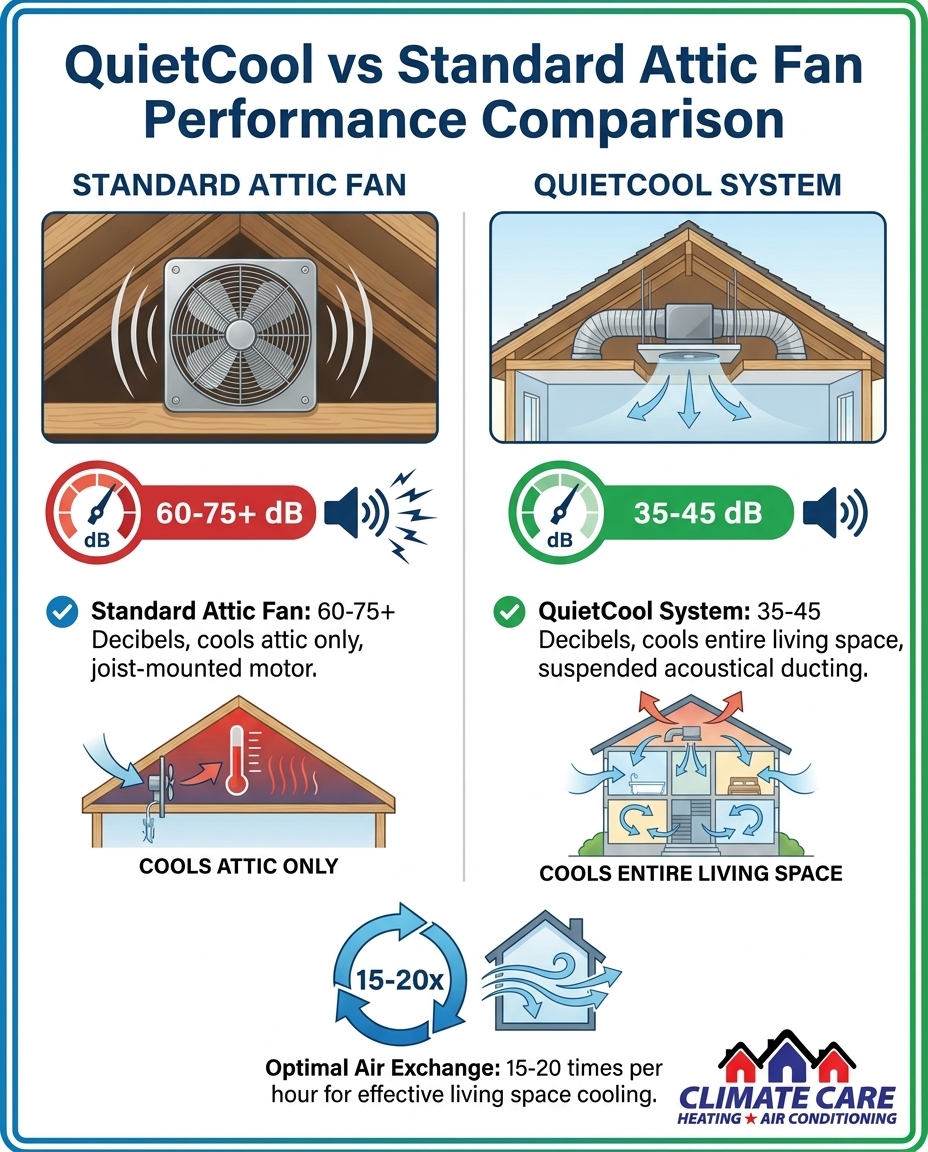
The Problem: Traditional attic fans and older whole-house fans are notoriously loud. When engaged, they typically operate at noise levels ranging from 60 to well over 75 decibels. To put that into perspective, 75 decibels is roughly equivalent to running a vacuum cleaner or standing next to a busy highway. When this equipment is located directly above your hallway or bedroom, the noise pollution makes watching television, having a conversation, or getting a good night's sleep nearly impossible.
The Cause: The extreme noise of traditional systems comes down to their mounting hardware. Standard fans are bolted directly to the wooden ceiling joists of your home. When the large, heavy motor spins up, it creates intense mechanical vibration. Because the motor is hard-mounted to the wood framing, your entire ceiling acts like the body of an acoustic guitar, taking that vibration and amplifying it throughout the drywall and into your living space. You aren't just hearing the fan blades; you are hearing the structural vibration of your own house.
The Solution: QuietCool engineers solved this problem by completely reinventing the mounting system. Instead of bolting the motor to the joists, QuietCool systems utilize a suspended acoustical ducting design. The motor assembly is hung from the upper attic rafters using heavy-duty straps, entirely separating the vibrating equipment from the ceiling drywall. This physical separation prevents structural amplification, resulting in Decibel (dB) noise levels that drop to an astonishing 35 to 45 decibels on lower settings—comparable to a quiet library or a gentle hum.
The physics of structural vibration dictate that any oscillating force directly attached to a rigid, hollow structure will broadcast sound waves efficiently. Older fan models feature large, unrefined metal blades and heavy motors that naturally wobble slightly at high speeds. When bolted to the ceiling joists, every ounce of that wobble is transferred into the sheetrock. This is why turning on a traditional fan often results in a deep, resonant rattling and humming that you can actually feel in the floorboards.
Hanging the motor in the upper attic space absorbs the kinetic energy before it can ever reach the ceiling. But QuietCool goes a step further by connecting the suspended motor to the ceiling grille using specialized acoustical ducting. This ducting is lined with sound-dampening insulation. As the air rushes up through the grille and into the duct, the insulated walls absorb the rushing sound of the airflow itself. By the time the air reaches the fan blades, the noise has been muffled twice: once by the suspension, and once by the ducting material.
To fully appreciate the difference between these ventilation methods, you have to dive into the mathematics of airflow. The effectiveness of any ventilation system is measured in CFM (cubic feet per minute) airflow rates. For rapid evening cooling to be effective, high CFM is not just a luxury; it is a strict mechanical requirement.
Proper living space cooling requires a system capable of exchanging the entire volume of indoor air 15 to 20 times per hour. If your system cannot hit this threshold, it will only cool the air temporarily without extracting the heat stored in your home's thermal mass. Standard attic fans typically offer lower, highly localized CFM designed only for the cubic footage of the attic itself. In contrast, QuietCool systems provide high-volume, whole-home capacity designed to rapidly cycle the air of the entire living space, which also provides massive indoor air quality improvements by flushing out stale air, cooking odors, and indoor pollutants.
Determining the right system size requires a straightforward calculation based on your home's footprint. The standard industry formula for sizing a whole-house ventilation system is to take the square footage of your living space and multiply it by 2 to 3 to find the required CFM.
1. Measure your living space: If you have a 2,000 square foot home, you need to account for all the areas you want to cool.
2. Apply the multiplier: Multiply 2,000 by 2 (for standard ceilings) or 3 (for high ceilings or hotter climates).
3. Identify the target: This home would require a system capable of moving 4,000 to 6,000 CFM.
When an undersized standard fan is used, it fails to create the strong negative pressure required to pull a meaningful breeze through the windows, leaving you with stagnant air and no real relief from the heat.
When evaluating your upgrade options, looking at the objective data side-by-side provides the clearest picture of how these systems diverge in performance. The table below serves as a quick-reference guide for the mechanical and performance differences between traditional technology and modern suspended systems.
• Motor Location — Standard Attic Fan: Bolted directly to ceiling joists — QuietCool System: Suspended from attic rafters
• Decibel (dB) noise levels — Standard Attic Fan: 60 to 75+ dB (Loud/Rattling) — QuietCool System: 35 to 45 dB (Quiet/Humming)
• Cooling Target — Standard Attic Fan: Attic space only — QuietCool System: Entire living space and attic
• Airflow Capacity — Standard Attic Fan: Low to Moderate CFM — QuietCool System: High-Volume CFM (Whole Home)
• Energy Profile — Standard Attic Fan: Standard AC motor usage — QuietCool System: Ultra-efficient ECM motors
Technical data and CFM calculations are important, but after years of installing whole house fans throughout Manteca, our team has seen how these numbers matter most when applied to the specific regional climate reality of the Central Valley. Our local weather patterns provide a unique natural advantage that many other regions do not have: the evening Delta Breeze. During the heat of the summer, it is incredibly common for daytime temperatures to soar well into the triple digits.
However, during August late-summer evenings, a phenomenon occurs where the outdoor temperatures can drop rapidly into the upper 60s as the coastal breeze pushes inland. The problem is that your home, heavily insulated and sealed against the daytime heat, remains trapped at 80+ degrees inside. If you lack the mechanical capacity to pull that cool air indoors, the natural cooling power of the Delta Breeze is entirely wasted on the exterior of your house.
High-CFM QuietCool systems allow homeowners to immediately flush that trapped heat the exact moment the sun goes down and the outside air becomes cooler than the inside air. By opening a few windows and engaging the system, you actively pull the Delta Breeze directly into your bedrooms. The lifestyle benefit is profound: you get to sleep comfortably with fresh, cool air flowing over you instead of running energy-heavy air conditioning compressors all night long. Furthermore, because of the exceptionally low decibel rating, you can run the system continuously through the night without waking the family, maximizing the natural cooling cycle. This is a critical factor when understanding QuietCool whole house fan ROI for Central Valley homeowners.
The short answer is that they target completely different areas of the home. An attic fan is installed in the roof or gable and only exhausts hot air trapped inside the attic itself. A whole house fan is installed in the ceiling of the living space and actively pulls cool outside air through open windows, cooling the people and furniture in the home before pushing that air up into the attic to cool the roof space.
Yes, they operate at significantly lower Decibel (dB) noise levels than traditional fans. Because the motor is suspended from the attic rafters using straps rather than bolted directly to the ceiling joists, the vibration does not transfer into the drywall. Combined with acoustical ducting that muffles the sound of rushing air, the system produces a soft, unobtrusive hum that will not disrupt sleep or conversation.
A general rule of thumb is that you need 2 to 3 CFM (cubic feet per minute) airflow rates for every square foot of living space. For a 2,000 square foot home, you would typically look for a system capable of moving 4,000 to 6,000 CFM to achieve the necessary 15 to 20 air exchanges per hour required to adequately cool the home's thermal mass.
Modern whole house fans utilize highly efficient ECM (Electronically Commutated Motors) that draw a fraction of the electricity required to run a central air conditioning compressor. By utilizing the fan to pull in cool evening air instead of running the AC all night, homeowners can significantly reduce their overall electrical consumption during the peak cooling months.
Absolutely, provided the outdoor temperature remains cooler than the indoor temperature. Running the system continuously through the night is actually the best way to deeply cool the walls, floors, and furniture—the thermal mass of the home. Because modern systems operate at such low decibel levels, leaving them on a low setting overnight will provide a constant, quiet breeze without waking anyone up.
True evening comfort requires a system that delivers both massive airflow and absolute acoustic peace. As the objective Decibel (dB) noise levels and CFM data clearly prove, modern suspended systems offer a vastly superior experience compared to the rattling, ineffective standard fans of the past. You do not have to settle for a noisy home just to get some relief from the late-summer heat.
If you are tired of listening to a jet engine in your hallway and want to actually capture the cool evening breezes our region offers, it is time to evaluate your home's ventilation needs with a professional. Explore how QuietCool whole house fans can transform your indoor environment, lower your reliance on traditional air conditioning, and finally let you sleep in quiet comfort.
Our customers love our service and support.

Had Climate Care inspect our HVAC before summer. Christopher Hayes was polite, knowledgeable, and efficient. Great service from the office team—highly recommend!
Alex Corona did a thorough furnace check-up today, showing before-and-after photos and answering all my questions. I’m happy with his work and highly recommend him. Great job—happy customer!
Alan C. serviced my furnace today and gave me a courtesy call before arriving. He was very professional, provided great service, and shared lots of pictures. Definitely a five-star experience—I’ll use them again!
On 02/19/2025, Alan inspected my furnace and did a great job explaining everything. He was professional, hardworking, and focused on customer satisfaction. Highly recommend requesting him!