The Standard Efficiency vs High Efficiency HVAC Comparison Every Central Valley Homeowner Needs to See
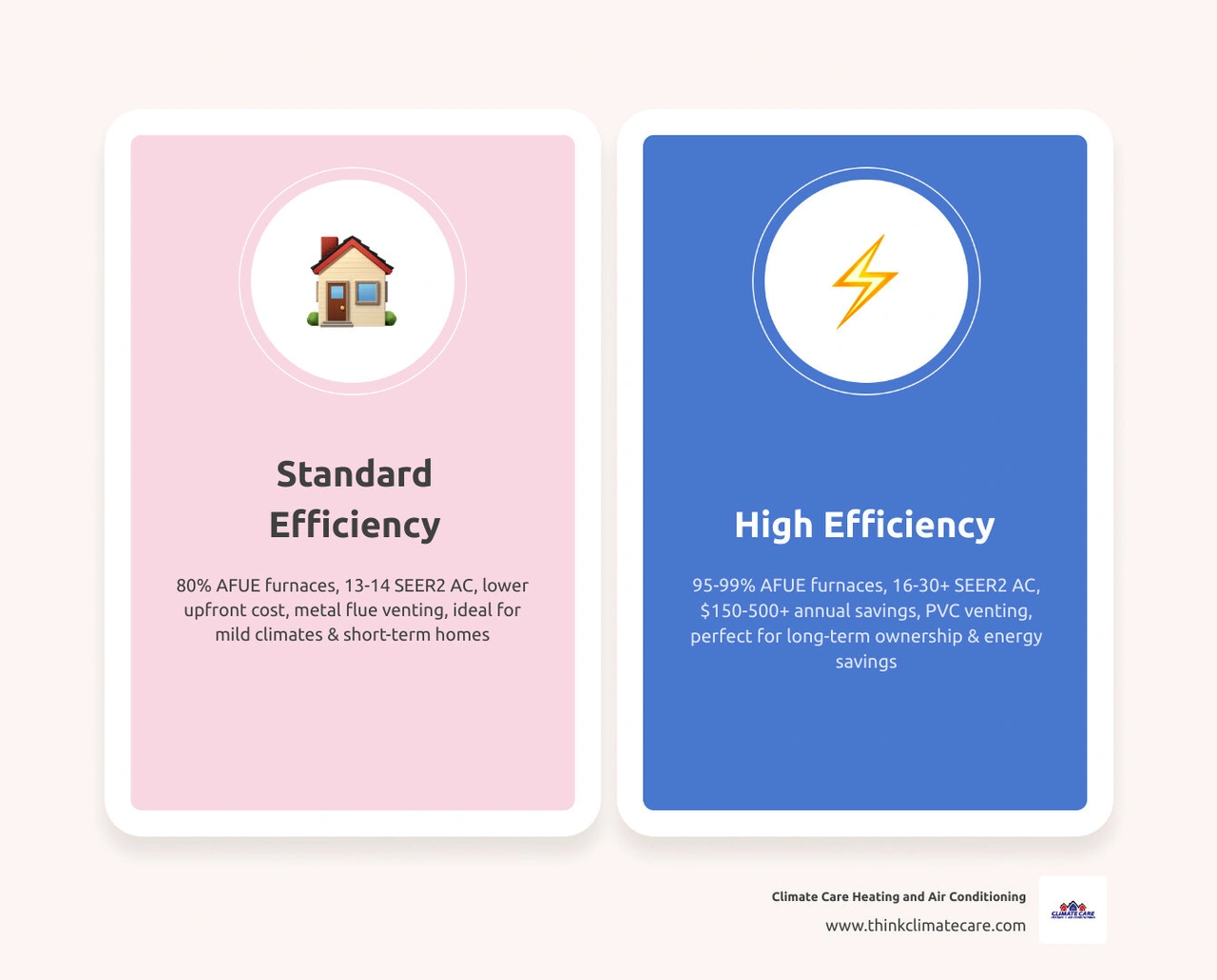
The standard efficiency vs high efficiency hvac comparison comes down to a simple trade-off: lower upfront cost versus lower long-term energy bills. Here's a quick breakdown to help you decide:
• Furnace AFUE — Standard Efficiency: ~80% — High Efficiency: 95–99%
• AC Rating (SEER2) — Standard Efficiency: 13–14 — High Efficiency: 16–30+
• Upfront Cost — Standard Efficiency: Lower — High Efficiency: Higher
• Annual Energy Savings — Standard Efficiency: Baseline — High Efficiency: $150–$500+
• Venting — Standard Efficiency: Metal flue — High Efficiency: PVC pipe
• Ideal For — Standard Efficiency: Mild climates, short-term ownership — High Efficiency: Cold climates, long-term ownership
• Payback Period — Standard Efficiency: N/A — High Efficiency: 5–10 years
If you heat your home every winter in Manteca and plan to stay for several years, a high-efficiency system will almost certainly save you money over time. If you're in a milder situation or working within a tight budget, a standard-efficiency unit can still get the job done reliably.
Here's the bigger picture for Central Valley homeowners. Summers in the Sacramento and Modesto areas push air conditioners hard for months at a time. Winters, while milder than northern states, still demand consistent, dependable heating. That means your HVAC system isn't just a comfort tool — it's one of the biggest drivers of your monthly utility bill.
Choosing between a standard and high-efficiency system is one of the most important decisions you'll make for your home. Get it right and you could cut your energy costs significantly for the next 15 to 20 years. Get it wrong and you might overpay upfront for savings that never fully materialize — or underspend and watch your utility bills climb year after year.
This guide breaks down exactly how these systems differ, when each one makes sense, and what Central Valley homeowners should weigh before making a decision.
Standard Efficiency vs High Efficiency HVAC Comparison: Key Technical Differences
When we talk about the standard efficiency vs high efficiency hvac comparison, we are looking at how much energy is actually used to keep you comfortable versus how much is wasted. In May 2026, the industry standards have evolved, making it more important than ever to understand the "alphabet soup" of HVAC metrics.
Efficiency is primarily measured by three ratings:
• AFUE (Annual Fuel Utilization Efficiency): Used for furnaces to measure how much fuel is converted into heat.
• SEER2 (Seasonal Energy Efficiency Ratio 2): Measures cooling efficiency over a typical season.
• HSPF2 (Heating Seasonal Performance Factor 2): Measures the heating efficiency of heat pumps.
A standard system typically meets the Department of Energy’s (DOE) minimum requirements. For example, a standard furnace might have an 80% AFUE, meaning 20 cents of every dollar you spend on gas literally goes up the chimney. On the other hand, high-efficiency systems utilize advanced technology like variable-speed motors and secondary heat exchangers to push those ratings much higher.
For a deeper dive into how these numbers impact your home, check out our guide on HVAC System Efficiency and What No One Tells You About Your HVAC Unit's SEER.
Understanding Standard Efficiency vs High Efficiency HVAC Comparison in Furnaces
The biggest mechanical difference in a furnace standard efficiency vs high efficiency hvac comparison is the heat exchanger. A standard furnace has one heat exchanger. It burns gas, extracts heat, and sends the hot exhaust gases out a metal flue.
High-efficiency furnaces are "condensing" models. They feature a secondary heat exchanger that captures extra heat from the exhaust gases. This process cools the exhaust so much that the water vapor condenses into a liquid (which drains away via a condensate line). Because the exhaust is cool, these units use PVC venting instead of metal flues.
Another major advantage is sealed combustion. High-efficiency units pull air for combustion from outside via a dedicated pipe, rather than using the air inside your home. This is safer and prevents drafts. Look for these 5 Signs Your HVAC System is Energy Efficient to see where your current unit stands.
Cooling Performance and the Standard Efficiency vs High Efficiency HVAC Comparison
In places like Sacramento and Modesto, the summer heat is relentless. A standard-efficiency AC unit typically operates like a light switch: it is either 100% on or 100% off. This leads to "cycling," where the system turns on and off frequently, causing temperature swings and higher wear and tear.
High-efficiency air conditioners often feature two-stage or variable-speed compressors. Instead of blasting at full speed, a variable-speed motor can drop down to 15% or 50% capacity to maintain a steady temperature. This results in:
• Superior Humidity Control: By running longer at lower speeds, the system removes more moisture from the air.
• Noise Reduction: Variable-speed units are whisper-quiet because they rarely need to run at full blast.
• Energy Savings: Every SEER2 point increase represents a significant reduction in electricity use.
Learn more about the benefits of Energy Efficient HVAC for those sweltering Central Valley afternoons.
Heat Pumps and Advanced Climate Solutions
Heat pumps are becoming the "gold standard" in the standard efficiency vs high efficiency hvac comparison. Unlike a furnace that creates heat, a heat pump moves heat from one place to another. In the summer, it moves heat out of your house. In the winter, it pulls heat from the outside air and moves it inside.
Modern high-efficiency heat pumps are incredibly effective in our region. Even in Modesto winters, they can provide efficient heating without the need for gas. Many homeowners opt for dual-fuel systems, which pair a high-efficiency heat pump with a gas furnace backup for the coldest nights.
To see if this technology is right for you, explore the Heat Pump Advantages Over Traditional HVAC and find out Are Heat Pumps Efficient in Hot Dry Climates like ours.
Making the Right Choice for Your Central Valley Home
Choosing between these systems isn't just about the unit itself; it’s about your home's "envelope." If your home in Stockton has poor insulation or leaky ductwork, even the most expensive high-efficiency system won't reach its full potential.
Before deciding, we recommend reviewing our HVAC System Design Guide and Mastering the Art of HVAC Sizing and Selection. A system that is too big or too small for your square footage will be inefficient regardless of its rating.
When Standard Efficiency is the Practical Option
Despite the buzz around high efficiency, a standard-efficiency system is sometimes the smarter choice. We often recommend standard units for:
• Short-term Ownership: If you plan to sell your home in Lathrop or Ripon within the next 2–3 years, you likely won't recover the extra cost of a high-efficiency unit through energy savings.
• Mild Usage: For a guest house or a home in a very mild coastal-influenced pocket where the AC rarely runs, the "payback period" for high efficiency might exceed the lifespan of the equipment.
• Budget Constraints: When an unexpected breakdown happens and the priority is restoring comfort quickly and affordably, standard systems offer a reliable, lower-cost entry point.
The Long-Term Benefits of High-Efficiency Upgrades
If you plan to stay in your home for 5 to 10 years or more, high efficiency is almost always the winner. The long-term benefits extend far beyond just the monthly bill:
1. Rebates and Incentives: Many local utilities in the Sacramento and San Joaquin counties offer significant rebates for high-efficiency upgrades. Additionally, federal tax credits can help offset the initial investment.
2. Indoor Air Quality: Because high-efficiency units with variable-speed motors run more consistently, they provide better air filtration and more stable humidity levels.
3. Environmental Impact: Using less energy means a smaller carbon footprint for your household.
4. Resale Value: A modern, high-efficiency HVAC system is a major selling point for savvy homebuyers in 2026.
Check out the latest California Energy Rebates for HVAC Upgrades to see how much you can save on a new installation.
Conclusion: Expert Guidance from Climate Care Heating and Air Conditioning
At Climate Care Heating and Air Conditioning, we believe in holistic HVAC care. Whether you are in Manteca, Modesto, Stockton, or Sacramento, our goal is to find the system that fits your specific needs, budget, and home goals.
The standard efficiency vs high efficiency hvac comparison isn't about which system is "better" in a vacuum — it's about which one is better for you. We take into account everything from your home's insulation to your local energy prices to ensure you make an informed investment.
To keep your system running at peak efficiency (standard or high), we offer comprehensive membership plans that include:
• Priority Scheduling: Get help when you need it most.
• Precision Tune-Ups: Prevent breakdowns before they happen in the peak of summer or winter.
• Discounted Repairs: Save money on parts and labor.
• Extended Lifespan: Regular care can help your system last 15–20 years.
Ready to upgrade your home comfort or need a professional opinion on your next system? We serve the entire region, including Elk Grove, Lodi, Tracy, and Turlock.
Learn more about professional HVAC solutions at Climate Care