
Does a High SEER Rating Matter for Heating or Just Air Conditioning?
That high SEER rating on your outdoor unit only measures summer cooling efficiency. Discover which HVAC ratings actually impact your winter heating performance.
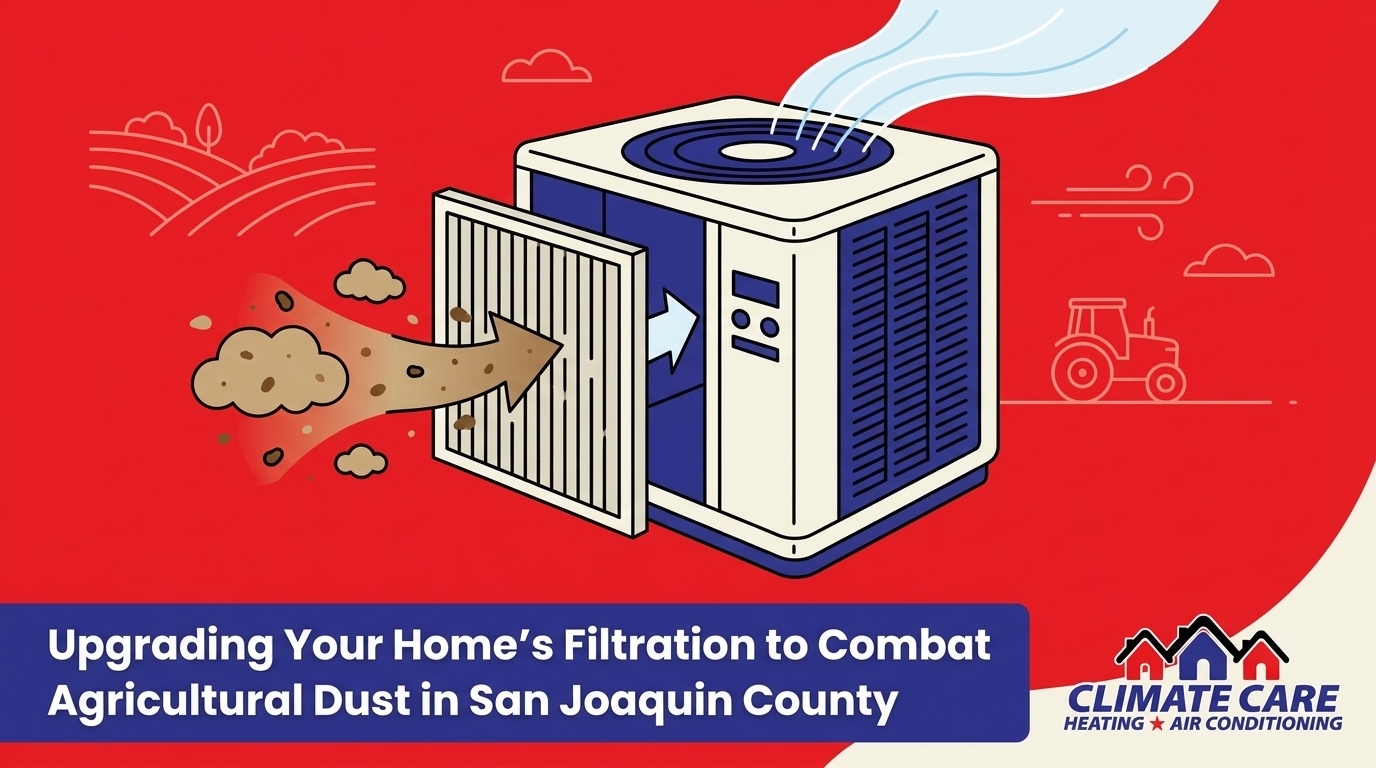
Your air conditioner is running nonstop to beat the triple-digit heat, but the house still feels stuffy, and a fine layer of dirt keeps settling on your furniture just days after you cleaned. If you are tired of breathing heavy air, upgrading your home's filtration to combat agricultural dust in San Joaquin County is the most effective step you can take to protect both your lungs and your cooling equipment.
As August late-summer harvesting kicks into high gear across the Central Valley, local indoor air quality takes a massive hit. The specific combination of 100-degree heat and bone-dry conditions allows loose soil and plant debris to travel miles and linger in the air for days. For homeowners relying on standard 1-inch fiberglass or pleated filters, this season quickly turns into a frustrating cycle. You swap out a fresh filter, only to find it completely caked in thick brown dirt less than a week later.
This puts you at a critical decision point: you can either keep fighting a losing battle by constantly replacing standard filters that cannot handle the load, or you can invest in a permanent, high-capacity filtration solution designed for our specific environment. Improving your indoor air quality requires a strategy that goes beyond basic maintenance. By exploring professional air quality services, you can stop treating the symptoms of harvest season and actually fix the problem at the source.
Standard HVAC advice often treats all household dust the same, assuming it consists mostly of pet dander, dead skin cells, and lint. However, the debris generated by heavy agricultural machinery is fundamentally different, heavier, and far more abrasive. When tractors and harvesters churn up dry fields, they release massive volumes of organic and inorganic matter into the atmosphere.
Because the San Joaquin Valley acts geographically like a large bowl, it naturally traps these particulates. Without strong cross-winds to clear the atmosphere, the pollution settles over residential neighborhoods. Data from the San Joaquin Valley Air Pollution Control District consistently shows severe seasonal particulate surges during the harvest months, meaning the air outside your home is heavily saturated with contaminants looking for a way inside.
For residents in Manteca and surrounding San Joaquin County agricultural zones, this heavy exposure requires specialized defenses. A standard residential filter is simply not designed to process industrial levels of soil, dried pesticide residue, and pulverized plant matter.
To understand why farm dust is so difficult to manage, you have to look at the size of the particles involved:
• PM10 (Coarse Particles): This is the visible dust that you see settling on your dining table, countertops, and television screens. It includes larger fragments of soil and plant debris. While annoying to clean, PM10 is generally caught by the mucous membranes in your nose and throat before it reaches your lungs.
• PM2.5 (Fine Particles): These are invisible, microscopic particles that pose a much greater threat. Generated by diesel harvesting equipment and pulverized organic matter, PM2.5 particles bypass your body's basic biological defenses. They travel deep into the lungs and can even enter the bloodstream. Standard 1-inch filters are notoriously bad at capturing PM2.5, allowing it to cycle continuously through your ductwork.
When homeowners notice an influx of dust, the most common reaction is to visit the hardware store and buy the most expensive, highest-MERV 1-inch filter on the shelf. While this seems like a logical solution, it introduces a severe mechanical risk to your cooling system.
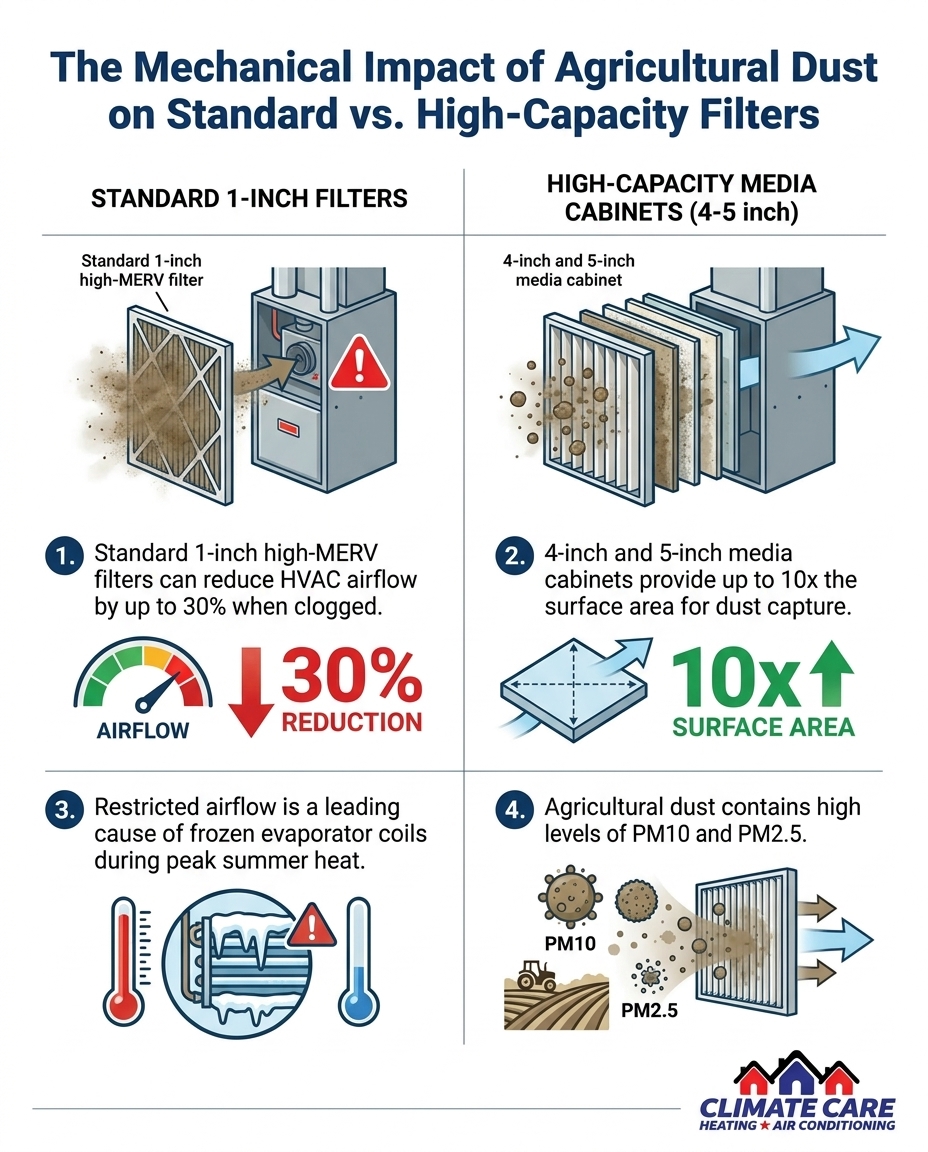
The Problem: High-MERV 1-inch filters achieve their filtration power by packing fibers very tightly together. Even when brand new and completely clean, these dense filters restrict the amount of air that can pass through them.
The Cause: When you expose one of these dense filters to the heavy debris of August late-summer harvesting, the tiny gaps between the fibers clog almost instantly. The filter effectively turns into a solid wall of dirt, choking off the air supply to your HVAC system.
The Solution and Consequence: Central air conditioning systems require a very specific volume of airflow to function safely. If the blower motor cannot pull enough warm air from your house over the indoor evaporator coil, the refrigerant inside that coil gets too cold. Condensation on the coil quickly freezes into a solid block of ice, shutting down your cooling entirely. This creates a dangerous dual threat: the peak heat of the season requires maximum AC airflow at the exact same time the peak dust requires heavy filtration. A 1-inch high-MERV filter forces you to sacrifice one for the other.
To safely capture large volumes of agricultural dust without choking your air conditioner, you need a solution that relies on surface area rather than just dense fibers. This is exactly what high-capacity 4-inch or 5-inch media filter cabinets provide.
Unlike a standard filter slot that holds a flimsy 1-inch cardboard frame, a media cabinet is a large metal housing installed directly into your ductwork. It holds a deeply pleated, thick filter that fundamentally changes how your system breathes.
• Surface Area — Standard 1-Inch Filter: Minimal (clogs rapidly under heavy load) — 4-Inch / 5-Inch Media Cabinet: Up to 10x more surface area due to deep pleating
• Airflow Restriction — Standard 1-Inch Filter: High (especially with higher MERV ratings) — 4-Inch / 5-Inch Media Cabinet: Very Low (allows the system to breathe easily)
• Particle Capture — Standard 1-Inch Filter: Struggles with PM2.5 fine particulates — 4-Inch / 5-Inch Media Cabinet: Effectively traps both PM10 and PM2.5
• Harvest Lifespan — Standard 1-Inch Filter: Often requires weekly replacement — 4-Inch / 5-Inch Media Cabinet: Can typically last the entire harvest season
The physics behind a media cabinet are simple but highly effective. By folding the filter material into deep, accordion-like pleats, manufacturers can pack exponentially more filtration media into the same cross-section of your ductwork. This massive increase in surface area means the filter can capture pounds of agricultural dust before the airflow becomes restricted. Your air conditioner gets the clear, unrestricted airflow it needs to prevent freezing, and your home gets hospital-grade filtration.
Upgrading to high-capacity 4-inch or 5-inch media filter cabinets is not a simple filter swap. It is a permanent structural enhancement to your home's air handling system that requires professional installation. Because it involves altering the sheet metal of your ductwork, this is never a do-it-yourself project. Here is how a licensed professional handles the upgrade:
1. System Static Pressure Assessment: Before any metal is cut, a technician must measure your system's total external static pressure. This ensures your existing blower motor has the capacity to push air through the new, wider housing without burning out.
2. Ductwork Modification: The technician will carefully cut into the return air drop—the large duct that brings air from your house back to the furnace or air handler. They will fabricate custom sheet metal transitions to fit the wide media cabinet perfectly into the airstream.
3. Sealing and Calibration: Once the cabinet is mounted, all seams are heavily sealed with mastic to ensure no unfiltered attic or garage air can bypass the new filter. The system is then turned on and airflow is tested to verify optimal performance.
4. Immediate Results: The installation usually takes just a few hours. Homeowners typically notice a drastic reduction in airborne dust and improved airflow through their vents on the very first day.
The standard industry advice to "replace your filter every 90 days" completely falls apart during August late-summer harvesting. If you try to stretch your maintenance intervals during this heavy-load period, you risk severe equipment damage. To protect your system, you need a more aggressive, proactive approach.
Follow this checklist to keep your system running smoothly when the dust is flying:
• Visually inspect the outdoor unit weekly: The condenser coil on your outside unit acts like a giant vacuum. Check it frequently for a blanket of dirt or dried leaves that could block heat transfer.
• Clear the immediate perimeter: Keep weed-whacking, mowing, and sweeping at least two feet away from the outdoor unit to prevent kicking up extra debris directly into the fan.
• Check indoor filters bi-weekly: Even if you have a media cabinet, check the filter visually. If it looks bowed or heavily caked, it is time for a replacement.
• Schedule a targeted harvest tune-up: Heavy dust easily bypasses standard filters and coats the indoor blower wheel. A professional tune-up ensures the blower wheel is cleaned and the indoor coil is washed, restoring lost efficiency.
Staying ahead of the dust is the best way to prevent emergency breakdowns. Enrolling in a routine HVAC maintenance plan ensures a professional is regularly monitoring your system's vital signs during the most stressful time of the year.
While a media cabinet acts as the primary defense for your HVAC system, keeping agricultural dust out of your living space requires a multi-layered approach. The less dust that enters your home, the less work your filter has to do.
First, behavioral adjustments make a significant difference. Pay attention to local wind patterns and keep your windows tightly closed during active harvesting or high-wind days. Rely entirely on your filtered mechanical cooling during these surges. Second, check your home's envelope. Worn weatherstripping around doors and degraded caulking around windows act as open highways for fine particulates. Properly sealing these gaps prevents dust infiltration before it starts.
For homes with sensitive occupants, advanced supplementary technologies can be added alongside a media cabinet. Whole-home air scrubbers actively send neutralizing ions into your living space to pull contaminants out of the air, rather than waiting for them to cycle through the return ducts. When combining these technologies, proper air scrubber UV light maintenance is required to ensure the bulbs remain effective against microscopic threats.
As a locally owned and operated team, Climate Care understands exactly what it takes to keep Central Valley homes clean and breathable during harvest. We experience the same thick air and dusty conditions, which is why we recommend strategies tailored specifically for Manteca and surrounding San Joaquin County agricultural zones.
August aligns with peak late-summer harvesting across the Central Valley. Tractors and harvesting equipment kick up massive amounts of dry soil and organic matter into the air. Because the weather is hot and dry, this dust travels far and gets pulled rapidly into your home's HVAC system, clogging standard filters in a matter of days.
For heavy agricultural dust, a MERV 11 to MERV 13 rating is generally recommended to capture fine PM2.5 particulates. However, you should never use a high-MERV rating on a standard 1-inch filter, as it will restrict airflow. High-MERV ratings should only be used in 4-inch or 5-inch deep-pleated media cabinets.
Upgrading your filter size requires installing a media filter cabinet, which involves cutting and modifying your existing sheet metal ductwork. Because this alters the static pressure and airflow mechanics of your HVAC system, it must be performed by a licensed HVAC professional to ensure your blower motor operates safely.
Yes, agricultural dust can severely damage your air conditioner. If the dust clogs your filter, it chokes off the airflow, which can cause your indoor evaporator coil to freeze solid. If the dust bypasses the filter, it can coat the blower motor and indoor coil, leading to overheating, reduced efficiency, and eventual mechanical failure.
Keep windows and doors tightly closed during active harvest periods and high-wind days. Ensure your home is properly weatherstripped and caulked to seal air leaks. Finally, run your HVAC system with a high-capacity media filter to continuously clean the air that does manage to infiltrate your living space.
Counterintuitively, a thicker 4-inch or 5-inch media filter actually restricts airflow much less than a standard 1-inch high-MERV filter. The deep pleats in a thicker filter provide exponentially more surface area for the air to pass through, allowing the system to breathe easily even as it captures heavy amounts of dust.
Living in an agricultural hub doesn't mean you have to accept a dusty home and a struggling air conditioner. Upgrading your filtration system provides a dual benefit: it drastically improves your indoor air quality by capturing fine particulates, and it protects your expensive AC equipment from the dangers of restricted airflow and frozen coils.
Standard 1-inch filters simply cannot hold up to the demands of Manteca and surrounding San Joaquin County agricultural zones. If you are tired of constantly swapping out dirty filters and dusting your furniture, it is time to look at a permanent solution. Reach out to schedule professional air quality services and let a local expert assess your ductwork to find the right high-capacity filtration system for your home.
Our customers love our service and support.

Had Climate Care inspect our HVAC before summer. Christopher Hayes was polite, knowledgeable, and efficient. Great service from the office team—highly recommend!
Alex Corona did a thorough furnace check-up today, showing before-and-after photos and answering all my questions. I’m happy with his work and highly recommend him. Great job—happy customer!
Alan C. serviced my furnace today and gave me a courtesy call before arriving. He was very professional, provided great service, and shared lots of pictures. Definitely a five-star experience—I’ll use them again!
On 02/19/2025, Alan inspected my furnace and did a great job explaining everything. He was professional, hardworking, and focused on customer satisfaction. Highly recommend requesting him!