Does a High SEER Rating Matter for Heating or Just Air Conditioning?
That high SEER rating on your outdoor unit only measures summer cooling efficiency. Discover which HVAC ratings actually impact your winter heating performance.
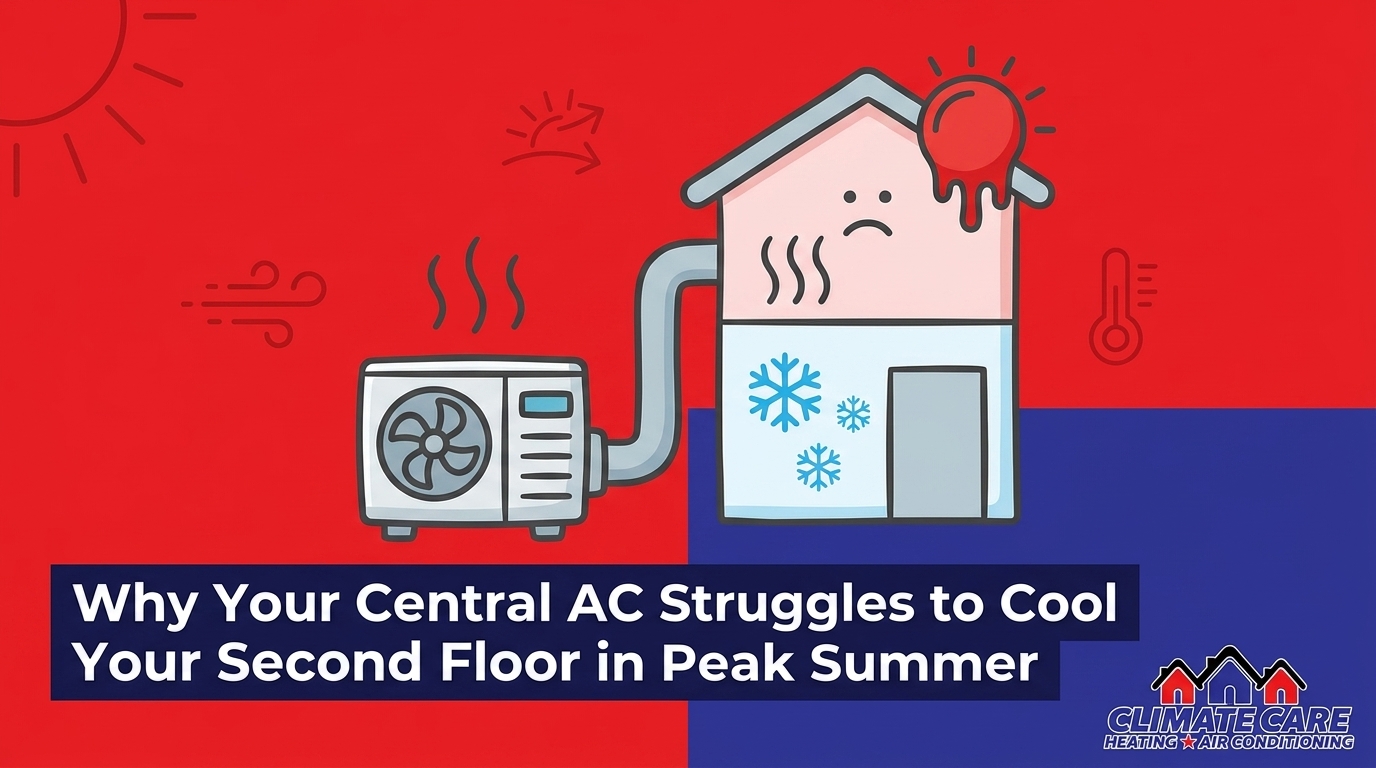
Your downstairs feels perfectly comfortable, but the moment you walk up the stairs, you hit a heavy wall of heat. If you are wondering exactly why your central AC struggles to cool your second floor in peak summer, you are dealing with one of the most common physical challenges in two-story homes. During peak Central Valley summer afternoons, it is incredibly common to experience a frustrating five to ten-degree temperature disparity between your first and second floors. The natural reaction is to walk over to the main thermostat and drop the temperature another three degrees. Unfortunately, cranking the thermostat only freezes your downstairs living spaces and spikes your monthly energy bills, while your upstairs bedrooms remain uncomfortably warm.
Before you assume your cooling equipment is broken, you need to understand that your unit is likely functioning exactly as it was designed to. The real issue stems from a combination of environmental factors, structural layout, and basic physics. If you are tired of sweating through the night, understanding how your central air conditioning systems interact with your home's layout is the first step toward lasting comfort. By addressing the root causes of this temperature disparity, you can finally enjoy a consistently cool home without overworking your equipment.
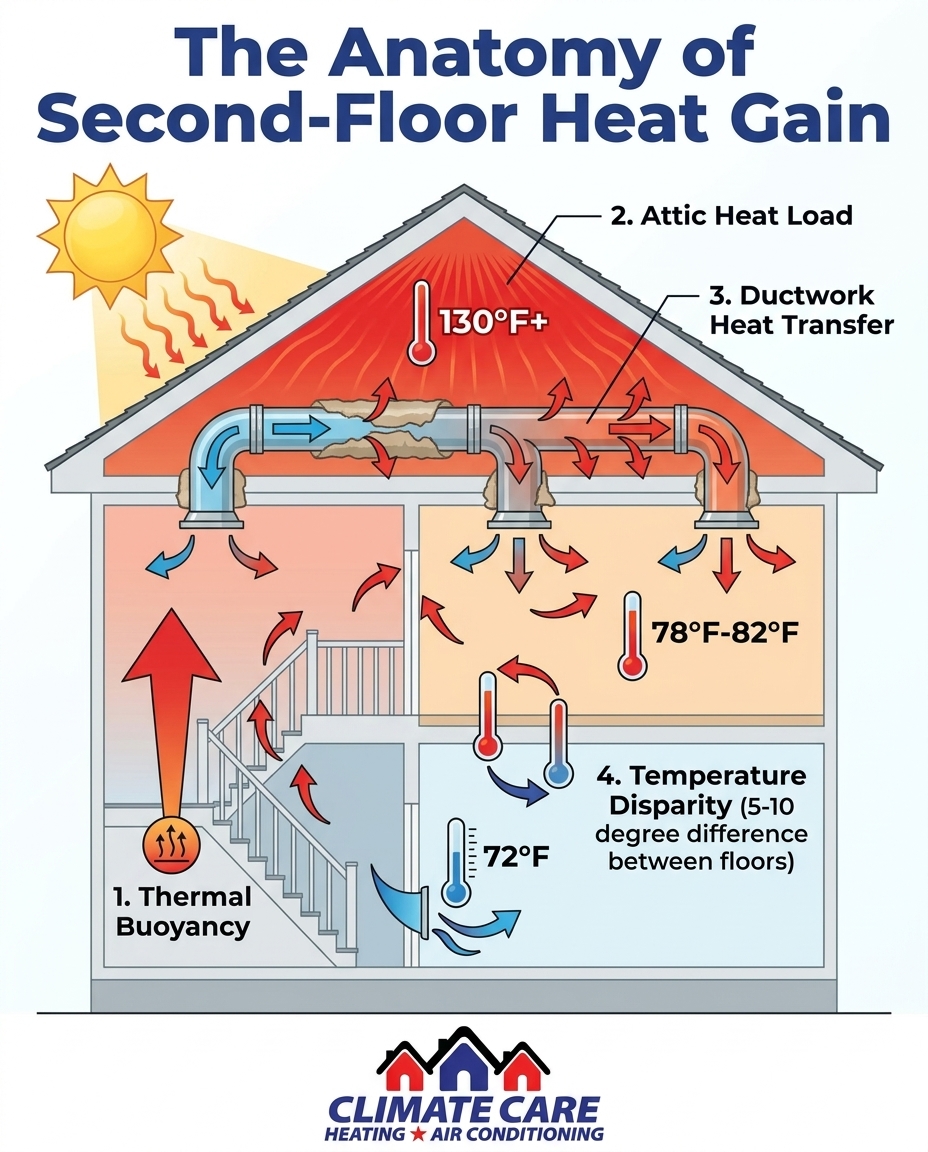
To solve the problem of a hot second floor, we first have to look at the basic laws of physics. The primary force working against your comfort is a principle called thermal buoyancy. In simple terms, warm air is less dense than cold air, which means it naturally rises. Conversely, cold air is heavier and denser, causing it to sink toward the lowest point in your home. This physical reality creates a constant battle for standard HVAC systems.
In a two-story house, thermal buoyancy creates what building scientists call the "stack effect." Your home acts very much like a chimney. As the sun beats down on your roof during peak Central Valley summer afternoons, the ambient heat infiltrates the upper levels of your house. The hot air already inside your home pushes upward, gathering on the second floor and pressing against the ceiling. If you have an open staircase or a two-story foyer, this effect accelerates, providing a massive, unobstructed pathway for cold air to tumble down to the first floor while hot air rushes up to replace it.
Most standard residential homes are built with a single-zone HVAC system. This means one unit and one thermostat control the temperature for the entire house. Because the thermostat is usually located on the first floor, it only measures the air immediately surrounding it. The heavy, cold air pools around the downstairs thermostat, satisfying the cooling requirement very quickly. The system shuts off because it thinks the whole house has reached your desired temperature, leaving the upstairs completely starved of necessary cooling. This is a structural and physical challenge regarding how air moves through a building, not necessarily a mechanical failure of your cooling equipment.
While the stack effect explains why hot air rises, it does not explain why the air blowing out of your upstairs vents often feels much weaker or warmer than the air downstairs. To understand this, we have to trace the journey of the conditioned air as it travels from your indoor blower unit to your bedroom registers. In many two-story homes, the ductwork responsible for delivering air to the second floor is routed through an unconditioned attic space.
Extreme Central Valley dry heat in July turns unconditioned attics into absolute ovens. It is completely normal to measure 130°F+ attic temperatures during the middle of the day. Your ductwork, which is carrying 55°F conditioned air, is sitting directly inside this baking hot environment. Heat naturally moves toward cold. As the cold air travels through the long runs of ductwork, extreme ambient heat transfers radiantly through the thin duct walls.
Even if your ducts are insulated, standard builder-grade insulation degrades over time and often lacks the necessary R-value to fight off 130°F+ attic temperatures. By the time the air reaches the furthest second-floor vents at the end of the duct run, it has absorbed a massive amount of radiant heat. The air that started at 55°F might be 70°F by the time it actually enters your bedroom. Furthermore, if there are any tiny leaks or disconnected joints in that attic ductwork, you are actively pumping expensive, conditioned air straight into the attic while pulling dusty, boiling air back into the system. When this happens, a professional ductwork evaluation and repair is the only way to restore the cooling capacity your system is trying to deliver.
When faced with a freezing downstairs and a boiling upstairs, almost every homeowner tries the exact same DIY trick: walking around the first floor and completely shutting the supply registers. The logical assumption is that by blocking the cold air from entering the first floor, you will force that extra air volume to travel upstairs. Unfortunately, modern HVAC systems do not work this way, and this common myth can cause severe damage to your equipment.
Your central cooling system is carefully engineered to move a very specific volume of air. This requires a delicate balance of static pressure within the ductwork. When you close downstream vents, the air does not magically reroute itself to the second floor. Instead, it hits a dead end, creating a massive buildup of backpressure inside the duct system. The blower motor now has to work significantly harder to push air against this resistance.
Closing your downstairs vents leads to several costly consequences that go far beyond a hot bedroom. The intense backpressure forces cold air out of tiny, microscopic leaks in your ductwork, wasting energy in your walls and inside those 130°F+ attic temperatures. Worse, the restricted airflow means not enough warm return air is passing over your indoor evaporator coil. Without sufficient heat transferring over the coil, the refrigerant inside drops below freezing, causing the condensation on the coil to turn into a solid block of ice. Once the coil freezes, your system stops cooling entirely and the compressor is put at major risk of failure. Instead of blocking vents and risking a breakdown, the correct method for redirecting airflow safely is scheduling a professional air balancing service to calibrate the system properly.
Because the symptoms of a hot upstairs are so frustrating, many homeowners assume their air conditioner is simply too old or too small to get the job done. It is critical to distinguish between a healthy system fighting a losing battle against bad airflow, and a mechanical unit that is genuinely failing. Throwing a larger unit at an airflow problem will not solve your discomfort.
If your system is experiencing an airflow imbalance or severe heat gain, you will typically notice a specific pattern of symptoms. The equipment itself is working hard, but the delivery method is failing.
• Cold air downstairs: The vents on the first floor are blowing strong, ice-cold air.
• Continuous operation: The system runs constantly during peak Central Valley summer afternoons because the upstairs never cools down enough to satisfy the overall home average.
• Weak upstairs pressure: You can barely feel the air coming out of the second-floor bedroom vents.
• Clean filters: You have replaced your air filters, but the temperature disparity remains exactly the same.
Conversely, if the mechanical equipment is failing, the symptoms will be noticeable throughout the entire house, not just on the second floor.
• Warm air from all vents — What It Usually Means: Refrigerant leak or failing compressor.
• Grinding or squealing noises — What It Usually Means: Failing blower motor or worn out internal bearings.
• Short-cycling — What It Usually Means: The system turns on and off every five minutes without cooling the home.
• Unresponsive thermostat — What It Usually Means: Electrical failure, blown fuse, or bad control board.
Automatically upgrading to a larger AC unit without fixing ductwork or airflow issues will likely result in the exact same hot upstairs. An oversized unit will cool the downstairs so rapidly that it "short-cycles," shutting off before it ever has a chance to push air to the second floor. As a brother-owned local HVAC company, we prioritize honest root-cause diagnosis of airflow issues rather than immediately pushing homeowners to buy a bigger, more expensive AC unit. A comprehensive system evaluation, starting with a thorough Manteca AC tune-up, is the best way to find the true bottleneck.
If you are tired of battling the thermostat, there are several highly effective strategies to equalize the temperatures across your home. These solutions range from basic adjustments to advanced system upgrades, all designed to overcome the physics of heat rise and the burden of 130°F+ attic temperatures.
The most foundational step is ensuring your ductwork is properly calibrated. Professional air balancing involves adjusting the internal dampers located inside your ductwork—not the register grilles in your ceiling. A technician uses specialized tools to measure the airflow in every room and adjusts the dampers to properly distribute the correct volume of air to the second floor, overcoming the natural resistance of gravity without damaging the blower motor.
Because attic heat gain is a massive contributor to upstairs discomfort, fortifying your ductwork is essential. A professional can seal all the seams and joints in your attic ducts using specialized mastic sealant to stop cold air from escaping. Following the sealing process, upgrading the R-value of the insulation wrapped around the ductwork prevents the extreme ambient heat from warming the conditioned air before it reaches your bedrooms.
For the ultimate level of control, converting a single-zone system into a multi-zone system is the most permanent solution. This involves installing motorized dampers inside the main duct trunks and adding a secondary thermostat on the second floor. The system can then independently direct cooling exactly where it is needed. If the upstairs gets hot, the system sends air exclusively to the second floor without freezing out the downstairs living room.
Sometimes, the most efficient way to cool a second floor is to actively exhaust the trapped heat rather than just pumping in more cold air. Highlight that in the dry heat climate of Manteca, utilizing whole house fans in the evening is a highly effective, energy-efficient way to purge trapped heat from the second floor and attic. By pulling cool evening air through your windows and blowing the stagnant, hot air out through the attic vents, you drastically reduce the cooling load on your central AC for the following day.
Why is my second floor so hot when the AC is on?
Your second floor gets hot primarily due to thermal buoyancy, which causes hot air to rise and cold air to sink. Additionally, the ductwork feeding the second floor often runs through unconditioned attic spaces that bake in the summer heat. By the time the conditioned air reaches your upstairs vents, it has absorbed significant radiant heat, leaving your bedrooms uncomfortably warm.
How do I fix the temperature difference between floors?
Fixing the temperature disparity requires addressing airflow and heat gain rather than simply lowering the thermostat. The most effective solutions include professional air balancing, sealing and insulating attic ductwork, or installing an HVAC zoning system. Using supplementary ventilation, like a whole-house fan, can also help purge trapped heat from the upper levels.
Does closing downstairs vents help cool upstairs?
Closing your downstairs vents does not help cool the upstairs and can actually damage your HVAC system. Shutting registers restricts the designed airflow, creating severe backpressure inside the ductwork. This strains the blower motor, increases duct leakage, and can cause your indoor evaporator coil to freeze solid, ultimately stopping the cooling process entirely.
Will a bigger AC unit cool the upstairs better?
Installing a larger AC unit will not fix a hot upstairs if the root cause is poor airflow or uninsulated ductwork. An oversized unit will cool the first floor too quickly and shut off before the cold air ever reaches the second floor. This process, known as short-cycling, leaves the upstairs hot, humid, and uncomfortable while increasing wear and tear on the equipment.
How much does attic temperature affect my home's cooling?
Attic temperatures play a massive role in your home's cooling efficiency, especially if your ductwork runs through that space. During peak summer, attics can exceed 130°F, turning the space into an oven that actively warms the cold air traveling inside the ducts. Proper attic ventilation and high R-value duct insulation are critical to preventing this extreme heat transfer.
Understanding exactly why your central AC struggles to cool your second floor in peak summer empowers you to make smart decisions about your comfort. Instead of constantly fighting the thermostat and spiking your energy bills, focus on a logical, physics-based approach. By addressing airflow imbalances, insulating your ductwork, and utilizing targeted solutions like zoning, you can finally enjoy a consistently comfortable home on every level.
Our customers love our service and support.

Had Climate Care inspect our HVAC before summer. Christopher Hayes was polite, knowledgeable, and efficient. Great service from the office team—highly recommend!
Alex Corona did a thorough furnace check-up today, showing before-and-after photos and answering all my questions. I’m happy with his work and highly recommend him. Great job—happy customer!
Alan C. serviced my furnace today and gave me a courtesy call before arriving. He was very professional, provided great service, and shared lots of pictures. Definitely a five-star experience—I’ll use them again!
On 02/19/2025, Alan inspected my furnace and did a great job explaining everything. He was professional, hardworking, and focused on customer satisfaction. Highly recommend requesting him!