Does a High SEER Rating Matter for Heating or Just Air Conditioning?
That high SEER rating on your outdoor unit only measures summer cooling efficiency. Discover which HVAC ratings actually impact your winter heating performance.
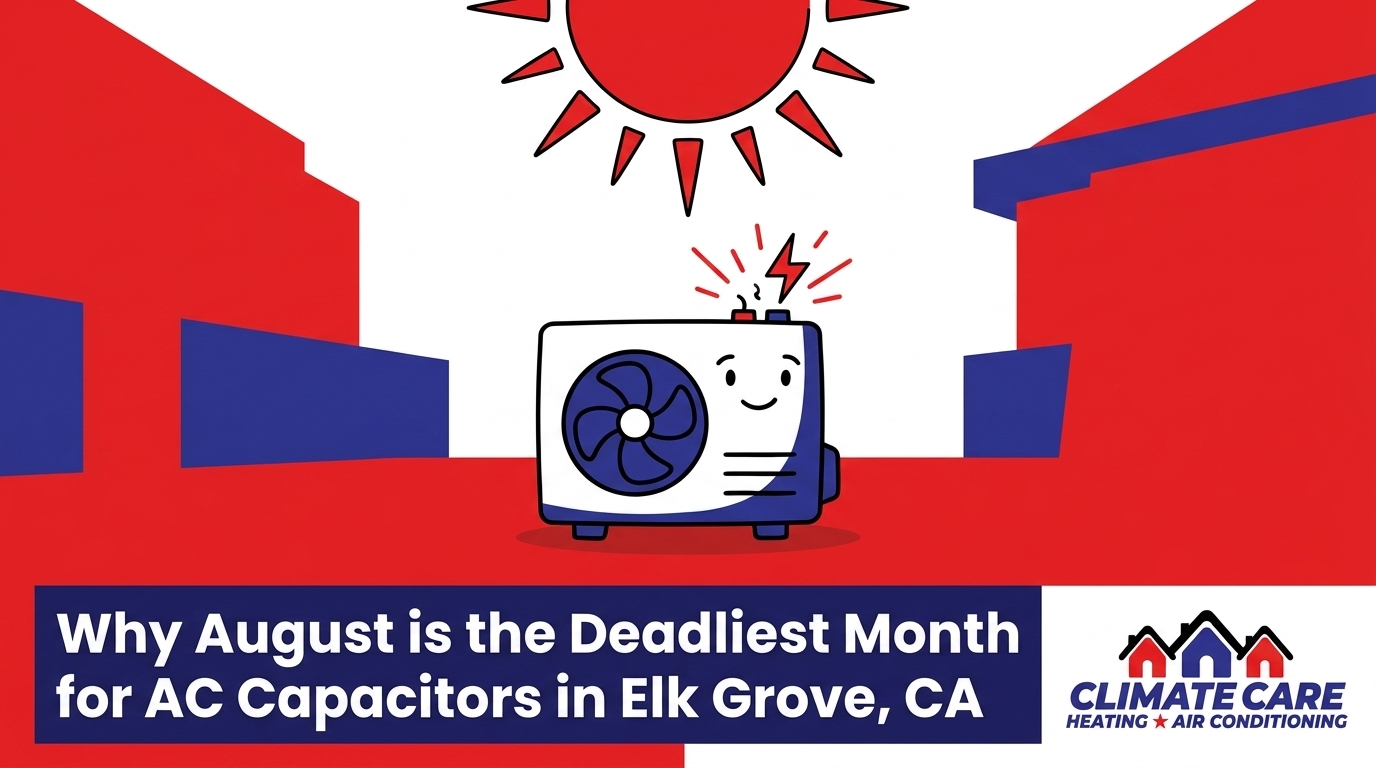
By the time the late-summer August heat settles over the Central Valley, our technicians at Climate Care Heating & Air Conditioning find that your air conditioner has already run a marathon. The cooling season begins with mild demands, but as the weeks drag on, the continuous strain on your system compounds. If you are wondering why August is the deadliest month for AC capacitors in Elk Grove, the answer comes down to cumulative thermal fatigue. Surviving the early summer heat is one thing, but when the house starts getting warm just as the peak temperatures arrive, the stress of a sudden breakdown is entirely valid.
For many homeowners, the sudden loss of cold air feels like a random, unpredictable catastrophic failure. In our experience, the reality is usually much more specific. Recognizing the early symptoms of electrical component fatigue is the key to preventing severe, irreversible damage to your entire cooling system. If your system is struggling to keep up with the heat, learn more about our air conditioning services or schedule professional AC repair today.
To understand why these specific breakdowns happen, you have to look inside the outdoor condenser unit. The most common point of failure is the dual-run AC capacitor. This small, cylindrical metal component acts as a massive, high-voltage battery for your air conditioner. Its primary job is to store electricity and deliver a massive jolt of power to start the heavy motors inside your system.
Air conditioners require significantly more energy to start up than they do to keep running. When your thermostat calls for cooling, the compressor and the outdoor fan motor need a tremendous surge of torque to overcome inertia and begin spinning. Your home's standard electrical grid cannot deliver this instantaneous surge on its own. The dual-run AC capacitor bridges this gap, sending a precise, high-voltage phase shift to the motors to get them moving.
Once the motors are running, the capacitor continues to supply a steady, regulated flow of electricity to keep them spinning at the correct speed. Because it handles both the heavy lifting of the startup and the continuous strain of the run cycle, this specific part is absolutely critical to the overall operation of the outdoor condenser unit. Without a functioning capacitor, the motors simply cannot operate, no matter how new or efficient the rest of your system might be. As we tell all our customers, maintaining this component is non-negotiable for reliable summer cooling.
A failed dual-run AC capacitor rarely breaks overnight due to a sudden manufacturing flaw. Instead, the failure is usually the final result of months of continuous thermal stress. By tracking the progression of the cooling season, the breakdown becomes entirely predictable.
1. June: The Accumulation Begins. The cooling season officially kicks off. Temperatures are warm but manageable. Your system starts accumulating operational hours, running in relatively short cycles. The internal components are functioning well within their design limits, but the baseline wear and tear has commenced.
2. July: The Heavy Load Period. As the deep summer heat arrives, the system is pushed to run at maximum capacity for extended durations. The air conditioner might run for 10 to 14 hours a day. By the end of this month, the system has logged over 500 hours of heavy operation. The internal fluids inside the electrical components begin experiencing sustained thermal stress, and the chemical composition starts to slowly degrade.
3. August: The Breaking Point. By the time the late-summer August heat waves hit and families are prepping for the back-to-school transition, the system has logged well over 1,000 hours of heavy operation. A pattern we see often is that the cumulative wear is maximized right now. The capacitor has been baked by ambient outdoor heat, direct sunlight, and its own internal operational heat for months. The internal pressure reaches a critical threshold, leading to swelling, bulging, and eventual complete failure.
Understanding this timeline helps shift the perspective from panic to preparation. The component did not fail to spite you; it simply reached the end of its physical tolerance after months of relentless work.

The specific regional climate plays a massive role in the lifespan of your cooling equipment. Elk Grove and the surrounding Central Valley frequently experience prolonged heat waves with temperatures exceeding 100°F throughout July and August, creating ideal conditions for thermal fatigue. To understand the mechanical failure, we have to look at the engineering standards of the equipment.
According to ASHRAE equipment standards, residential HVAC capacitors are typically rated for maximum internal operating temperatures around 158°F (70°C). While that sounds incredibly high, our team routinely sees the reality of a Central Valley summer easily push the equipment past this limit.
• Outside Ambient Heat — Impact on Condenser Cabinet Temperature: Establishes a baseline of 100°F+ before the system even turns on.
• Direct Sunlight Exposure — Impact on Condenser Cabinet Temperature: Radiant heat bakes the metal cabinet, adding 20°F to 30°F to the internal ambient temperature.
• Operational Motor Heat — Impact on Condenser Cabinet Temperature: The compressor and fan generate intense heat while running, pushing the internal cabinet temperature well past the 158°F threshold.
When the environment inside the cabinet exceeds the design limits, the internal mechanics of the dual-run AC capacitor begin to break down. These components are filled with a specialized dielectric fluid that helps dissipate heat and insulate the electrical charge. Under sustained extreme heat, this fluid boils and turns into a gas. Because the metal cylinder is sealed, the expanding gas causes the top of the component to swell, bulge outward like a domed mushroom, or even burst entirely.
This relentless nature of the local climate creates the perfect storm. The component is forced to work its hardest at the exact moment the environmental conditions are actively destroying it.
When a breakdown happens in late-summer August, the immediate fear we hear on service calls is often that the entire air conditioner is dead and requires a massive replacement. Fortunately, recognizing the specific symptoms of a swollen capacitor can provide peace of mind. These warning signs are distinct and indicate an electrical delivery issue rather than a total mechanical failure.
• A distinct humming or clicking sound: You may hear a loud buzz or hum coming from the outside unit, but the fan blades remain completely still. This sound is the motor trying to draw power to start, but failing because the capacitor cannot deliver the necessary jolt.
• Warm air from the vents: The indoor blower fan might still be circulating air through the house, but because the outdoor compressor cannot start, no actual cooling takes place. If your AC not cooling properly is a sudden development, an electrical failure outside is a prime suspect.
• Hard starting and short-cycling: The air conditioner may struggle violently to turn on, causing the lights in the house to dim momentarily. It might run for a few minutes and abruptly shut off, or repeatedly trip the dedicated circuit breaker at your electrical panel.
• Visual swelling: While you should never open the electrical panel yourself, our technicians will often find that the flat top of the silver cylinder has domed upward, clearly indicating that the internal fluid has expanded.
These alarming symptoms are highly disruptive, but they are often just a targeted component issue. Catching these signs early prevents the problem from escalating.
While a failed dual-run AC capacitor is a straightforward fix for a licensed professional, ignoring the symptoms or attempting to resolve the issue yourself carries severe risks. The dangers fall into two categories: mechanical damage to the system and physical danger to the homeowner.
The Mechanical Problem: When a capacitor fails, the compressor motor is left without the electrical torque needed to start spinning. However, the thermostat is still demanding cooling, so the motor continuously tries to force itself to start. This pulls a massive amount of electricity—known as Locked Rotor Amps (LRA). If the system is left running in this state, the compressor will rapidly overheat, baking its own internal electrical windings. What began as a simple component swap can quickly escalate into catastrophic, irreversible compressor failure if ignored.
The Physical Danger: It is critical to strictly warn against DIY diagnosis or replacement. These components are literally designed to store lethal amounts of high-voltage electricity. Even when the power is completely shut off at the breaker and the disconnect box is pulled, a capacitor can hold a dangerous electrical charge for days. Touching the wrong terminals can result in severe shock or worse.
The Solution: Opening the condenser cabinet without proper training and specialized discharge tools is highly dangerous. As a local, brother-owned HVAC company, Climate Care Heating & Air Conditioning has firsthand experience tracking this exact late-summer breakdown pattern across Elk Grove and Manteca, providing safe, rapid solutions. A licensed professional has the multimeters, discharge tools, and safety training required to safely test and replace the component, protecting both your safety and your equipment.
The best way to handle a late-summer August breakdown is to prevent it from happening in the first place. Routine inspections can catch the early stages of micro-swelling and electrical drop-offs long before the component completely fails on a 105-degree afternoon.
During a professional tune-up, our technicians do more than just clean the coils. We use specialized multimeters to test the microfarad readings of every electrical component. A microfarad is the unit of measurement for electrical capacitance. If a capacitor is rated for 45 microfarads but tests at 38, it is actively failing and will likely leave you stranded during the next major heat wave. Catching this degradation early allows for proactive replacement of a weakened part, which is far less stressful than an emergency weekend breakdown.
Adopting a dedicated upkeep schedule is the most effective way to maintain system resilience against the Central Valley climate. By enrolling in an HVAC maintenance plan, you ensure that your system's electrical tolerances are verified before the heavy load period begins, drastically reducing the risk of mid-summer failures.
High ambient temperatures combined with internal operational heat cause the internal dielectric fluid to degrade. When the fluid breaks down, it expands into a gas, causing the metal casing to swell and the electrical connections to fail. The hotter the summer, the faster this degradation occurs.
While the final failure might seem sudden, it is usually a cumulative process of thermal fatigue over weeks or months. The component sustains micro-damage every time it operates outside its temperature tolerance, eventually culminating in a complete failure during peak heat.
You will typically hear a distinct humming, buzzing, or clicking sound coming from the outdoor condenser unit. This sound is often accompanied by the outdoor fan blades remaining completely stationary, even though the system is supposed to be running.
The motor is actively trying to draw power from the grid to start spinning, which creates the humming noise. However, because the capacitor has failed, the motor cannot receive the necessary high-voltage electrical jolt to overcome its resting inertia.
No, a hum without cooling is frequently a dual-run AC capacitor issue, which is a much simpler professional fix than a compressor replacement. However, leaving the unit humming without fixing the electrical delivery can eventually cause the compressor to burn out.
Extreme regional heat can significantly shorten their lifespan compared to milder climates. While they might last a decade in cooler regions, the relentless triple-digit heat in the valley makes annual testing vital, as early replacement is often necessary to prevent larger system damage.
Surviving the Central Valley summer requires a cooling system that can handle the relentless strain of triple-digit temperatures. August breakdowns are often the direct result of predictable, cumulative heat fatigue taking its toll on your equipment. Understanding that a sudden loss of cooling is frequently tied to a swollen dual-run AC capacitor brings peace of mind, confirming that you are likely dealing with a common heat-fatigue issue rather than a catastrophic whole-system failure.
However, recognizing the symptoms is only the first step. Because of the high-voltage risks and the potential for severe compressor damage, professional intervention is the only safe path forward. If your system is humming in the late-summer August heat without delivering cold air, the right next step is to shut the system off at the thermostat and schedule a professional inspection to restore your comfort safely and efficiently.
Our customers love our service and support.

Had Climate Care inspect our HVAC before summer. Christopher Hayes was polite, knowledgeable, and efficient. Great service from the office team—highly recommend!
Alex Corona did a thorough furnace check-up today, showing before-and-after photos and answering all my questions. I’m happy with his work and highly recommend him. Great job—happy customer!
Alan C. serviced my furnace today and gave me a courtesy call before arriving. He was very professional, provided great service, and shared lots of pictures. Definitely a five-star experience—I’ll use them again!
On 02/19/2025, Alan inspected my furnace and did a great job explaining everything. He was professional, hardworking, and focused on customer satisfaction. Highly recommend requesting him!