Does a High SEER Rating Matter for Heating or Just Air Conditioning?
That high SEER rating on your outdoor unit only measures summer cooling efficiency. Discover which HVAC ratings actually impact your winter heating performance.
At Climate Care Heating & Air Conditioning, we know that managing indoor humidity when the San Joaquin Valley heat spikes is a frustrating challenge, especially when peak July extreme heat in the San Joaquin Valley leaves your air conditioner running non-stop. You walk through your front door expecting a refreshing blast of cool air. The air blowing from your vents is undeniably cold, but something feels terribly off. Your skin feels sticky, the hardwood floors feel slightly damp, and the overall atmosphere inside your house is heavy and uncomfortable. You are experiencing the classic "cold but clammy" effect, a highly specific form of indoor discomfort that plagues homeowners during severe summer weather.
If you are struggling to balance your home's temperature and moisture levels, learning about indoor air quality is the first step, but you may ultimately need professional air conditioning services to fully resolve the issue.
The unique regional challenge: The unique rapid daytime heat spikes in the San Joaquin Valley put sudden, immense load on residential AC systems. When the outdoor temperature climbs twenty or thirty degrees in a matter of hours, your home's thermal envelope absorbs that heat rapidly. Your air conditioning system is forced to work overtime to keep up with the thermostat setting. However, proper cooling involves much more than simply blasting cold air into a room. True comfort requires a delicate balance of temperature reduction and moisture removal.
Most homeowners assume that if the house feels uncomfortable, the logical solution is to walk over to the thermostat and drop the temperature a few more degrees. Unfortunately, when dealing with a cold but clammy house, lowering the temperature usually makes the problem worse. To understand why this happens, and how to actually fix it, we have to look at exactly how your air conditioner processes the air inside your home.
To fix a clammy house, you first need to understand the mechanical difference between cooling the air and removing humidity. Your air conditioning system performs two entirely different jobs at the exact same time: sensible cooling and latent cooling. When these two functions fall out of sync, you end up with a thermostat reading 70°F or 72°F but indoor humidity remaining uncomfortably high.
Sensible cooling is the process you are most familiar with. This is the actual dropping of the temperature in the room. When you set your thermostat to 72°F, the thermostat measures the sensible heat in the air. Once the air temperature hits that exact number, the thermostat tells the system to shut off. Sensible cooling happens relatively quickly, especially if you have a powerful air conditioner.
Latent cooling, on the other hand, is the extraction of moisture from the air. Warm indoor air holds a significant amount of invisible water vapor. As your system's blower motor pulls this warm, humid air through your return vents, it passes over the freezing cold evaporator coil inside your indoor unit. When warm air hits cold metal, condensation forms—just like water droplets forming on the outside of a cold glass of iced tea on a summer day. This moisture drips off the coil, falls into a drain pan, and is safely piped outside your home.
• Sensible Cooling — What It Does: Lowers the actual temperature of the room. — How It Is Measured: Thermostat temperature reading. — Time Required: Happens quickly (10-15 minutes).
• Latent Cooling — What It Does: Removes invisible water vapor from the air. — How It Is Measured: Indoor relative humidity percentage. — Time Required: Requires longer run times (20+ minutes).
The Environmental Protection Agency (EPA) and ENERGY STAR recommend keeping your indoor relative humidity between 30% and 50% for optimal comfort and health. The critical thing to remember is that latent cooling takes significantly more time than sensible cooling. The air conditioner must run long enough for the condensation process to occur continuously. If the system shuts down too soon, the temperature drops, but the moisture stays trapped inside.
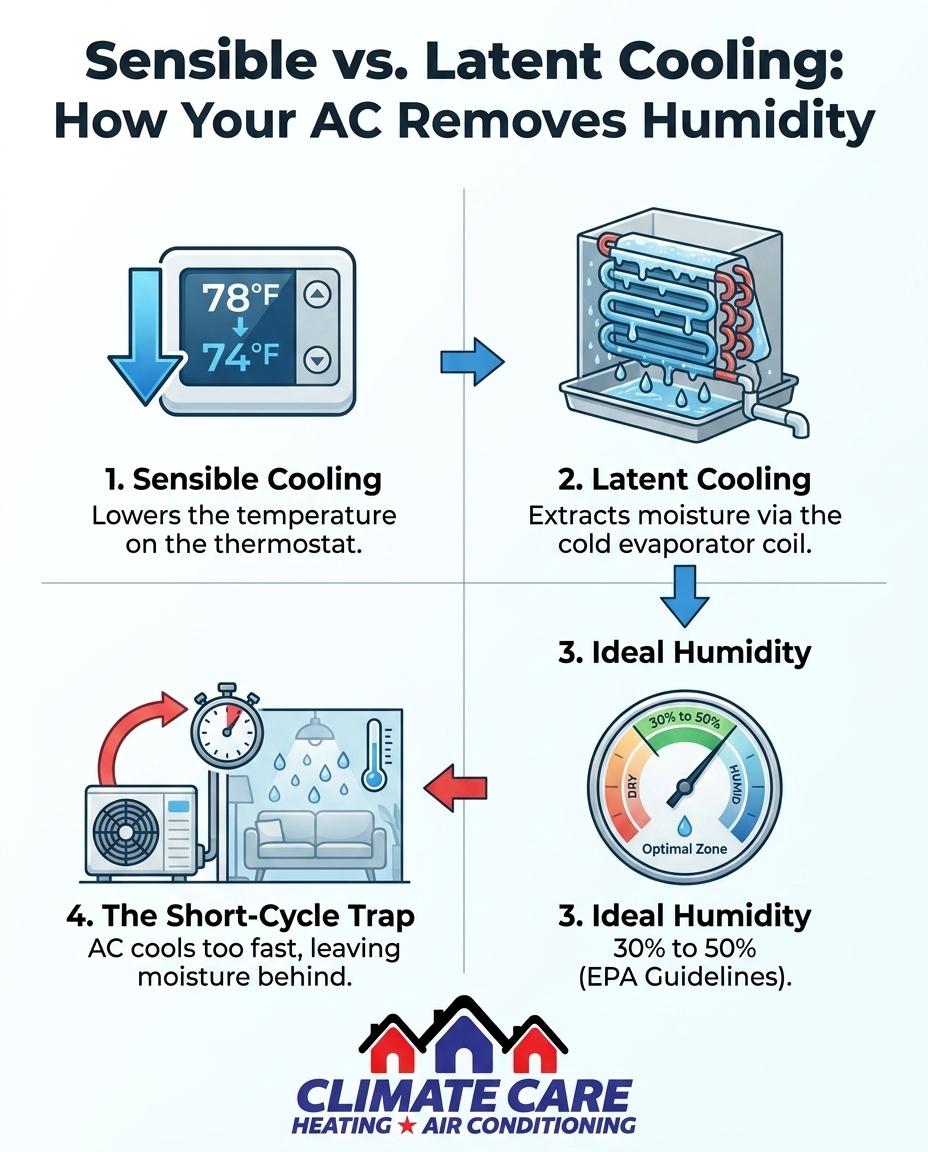
In our years of repairing AC systems across Manteca, CA, our team typically sees homeowners make one understandable but counterproductive mistake. When you are sitting on your couch feeling sticky and miserable, your natural reaction is to turn the thermostat down even further. You might drop it from 72°F to 68°F, hoping the extra blast of cold air will finally dry out the room. In reality, you are likely pushing your system into a frustrating mechanical trap known as short-cycling.
Short-cycling occurs when your air conditioner cools the air too rapidly, satisfying the thermostat's temperature setting before the evaporator coil has had enough time to extract the necessary humidity. In Manteca's intense summer climate, oversized AC units are particularly prone to short-cycling because they blast massive volumes of cold air into the home far too quickly. The thermostat registers the sudden drop in sensible heat and shuts the compressor off after just ten or fifteen minutes.
Because latent cooling takes longer than sensible cooling, this rapid shut-off leaves your home's air cold but still completely saturated with moisture. You end up with a house that feels like a damp cave. Worse, dropping the thermostat exacerbates the problem. The system kicks on, blasts cold air, shuts off quickly, and repeats this cycle dozens of times a day.
Signs your system is caught in a short-cycling trap:
• Frequent starts and stops: The compressor turns on and off every 10 to 15 minutes instead of running in long, steady cycles.
• Uneven temperatures: Some rooms feel freezing cold while others remain warm and stuffy.
• Spiking energy bills: Air conditioners use the most electricity during startup; frequent cycling drives your utility costs through the roof without improving your comfort.
• Excessive indoor condensation: You may notice condensation forming on your interior windows or around your air vents.
This exact scenario leads to much higher energy bills and excessive wear and tear on your equipment. If you notice these symptoms, it often masks itself as a different problem entirely, leaving homeowners thinking their AC not cooling properly is a refrigerant issue, when it is actually a humidity extraction failure.
Before you call a professional, there is a safe, immediate, and completely non-mechanical step you can take to dramatically improve your home's dehumidification process. It all comes down to one single switch on your thermostat: the fan setting. Many homeowners do not realize how heavily this one switch impacts indoor moisture, especially when dealing with a thermostat reading 70°F or 72°F but indoor humidity remaining uncomfortably high.
Most standard thermostats have two fan settings: "ON" and "AUTO." Understanding the difference between these two modes is the golden rule of summer humidity control.
Why the "ON" setting ruins humidity control:
1. When you set the fan to "ON," the blower motor runs constantly, 24 hours a day, regardless of whether the outdoor compressor is actively cooling the air.
2. During a cooling cycle, the indoor evaporator coil gets freezing cold and pulls moisture out of the air, leaving the metal coil dripping wet.
3. When the cooling cycle ends, the outdoor compressor shuts off, but the indoor fan keeps blowing.
4. That continuous stream of unconditioned air blows directly over the wet evaporator coil, evaporating the water and pushing all that trapped moisture straight back into your living space.
The immediate fix: Always set your thermostat fan to "AUTO" during the summer months. In AUTO mode, the blower motor only runs when the compressor is actively cooling. When the cooling cycle finishes, the fan shuts off immediately. This allows the moisture on the evaporator coil to safely drip down into the condensate drain pan and flow outside your home, rather than being blown back into your face. This simple switch can dramatically reduce the clammy feeling in your home within just a few hours, requiring absolutely no professional repair.
While adjusting your thermostat fan is a crucial first step, there are several supplemental ways to manage indoor humidity and improve air circulation without altering your air conditioner's mechanical components. Every home in Manteca, CA, generates its own internal humidity, and managing these moisture sources is key to staying comfortable.
Your daily activities generate a massive amount of latent heat. Cooking, boiling water, running the dishwasher, and taking hot showers all release heavy water vapor into your indoor air. If this moisture is not actively vented, your air conditioner has to work twice as hard to remove it.
• Run exhaust fans consistently: Always use your bathroom exhaust fans during showers and leave them running for at least 20 minutes afterward. Do the same with your kitchen range hood when boiling water.
• Check your dryer vent: Ensure your clothes dryer is properly exhausting completely outside the home. A disconnected or leaking dryer vent will pump gallons of warm water vapor directly into your living space.
• Seal windows and doors: Heavy, humid outdoor air will aggressively infiltrate your home through worn weatherstripping. Keep windows tightly locked during the heat of the day to prevent moisture intrusion.
Your air conditioner cannot remove moisture if the air cannot physically reach the evaporator coil. Proper airflow is the lifeblood of the dehumidification process.
• Replace dirty air filters: A clogged air filter acts like a wall, severely restricting the volume of air returning to the system. Check and replace your filters monthly during the peak cooling season.
• Unblock your vents: Walk through your home and ensure that rugs, heavy curtains, or furniture are not blocking your supply registers or return vents.
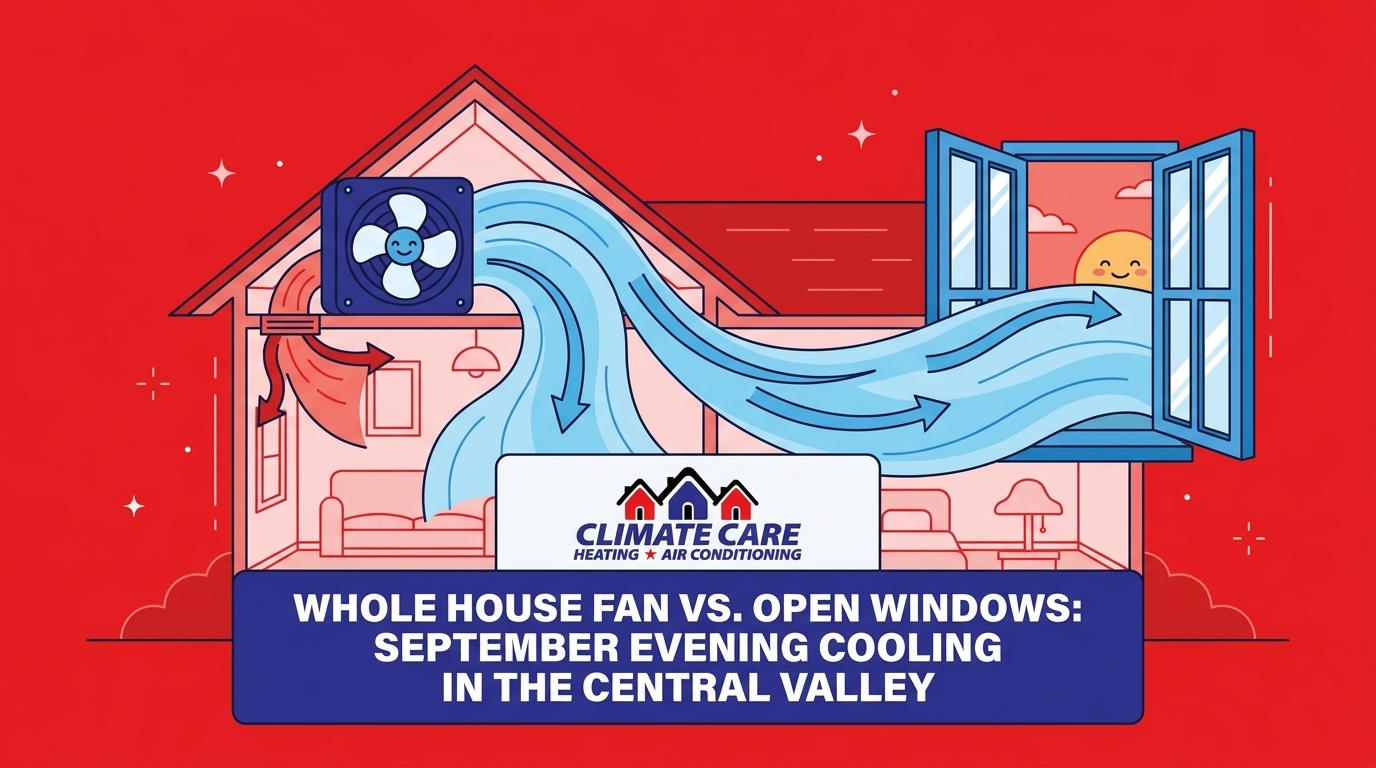
• Utilize evening ventilation: Evening temperature drops in the Central Valley make supplemental ventilation highly effective once the sun goes down. Using whole house fans is a powerful strategy to quickly exhaust stale, humid indoor air and pull in cool, dry evening breezes, giving your AC a much-needed break.
If you have set your fan to AUTO, replaced your air filters, managed your indoor moisture sources, and your home still feels like a swamp during peak July extreme heat in the San Joaquin Valley, it is time to call in a professional. Persistent humidity issues often point to underlying mechanical problems that our technicians encounter daily, which cannot be solved with DIY troubleshooting.
Improper refrigerant charge: Your air conditioner relies on a precise amount of chemical refrigerant to absorb heat and moisture. If your system is leaking refrigerant, the evaporator coil cannot get cold enough to condense water vapor effectively. The air blowing out of your vents might feel slightly cool, but the system loses its ability to remove latent heat. Handling refrigerant requires specialized gauges, EPA certification, and professional training.
Dirty evaporator coils: Over time, dust and debris can bypass your air filter and blanket the indoor evaporator coil. This layer of grime acts as an insulator, preventing the warm indoor air from physically touching the cold metal. The moisture never condenses, and the humidity stays in your home. Cleaning these internal coils requires disassembling the indoor cabinet, which is strictly a job for a licensed HVAC technician.
System sizing issues: As mentioned earlier, an oversized unit will perpetually short-cycle. A pattern we see often in local homes is improperly sized equipment installed years ago. A professional assessment can determine if your current system is simply too large for your home's square footage and thermal envelope.
As a local Central Valley company, our team at Climate Care understands the specific regional weather challenges and exactly how to optimize HVAC systems for this unique climate. Scheduling an AC tune-up in Manteca allows a certified technician to calibrate your system for peak summer efficiency, ensuring it can handle both sensible and latent cooling loads.
The short answer is that your system may be short-cycling, cooling the air before it can extract moisture. When an air conditioner is oversized or malfunctioning, it drops the room's temperature very quickly and shuts off. Because removing humidity takes significantly longer than lowering the temperature, the moisture is left behind, resulting in a cold but clammy environment. Proper airflow and longer cooling cycles are required to fully dehumidify a space.
No, lowering the thermostat often worsens the problem by causing the AC to shut off too quickly. When you drop the temperature rapidly, the thermostat registers the cold air and stops the cooling cycle prematurely. This leaves the heavy moisture trapped in the air. Instead of lowering the temperature, focus on ensuring your fan is set to AUTO so the system can complete a proper, uninterrupted latent cooling cycle.
The most effective immediate step is to set your thermostat fan to AUTO so moisture isn't blown back into your rooms. Additionally, use exhaust fans in your kitchen and bathrooms to remove moisture at the source. Ensure your air filters are clean to promote maximum airflow over your evaporator coil. If the problem persists in Manteca, CA, we highly recommend having a professional check your system's refrigerant levels and overall sizing, as this is a common root cause we encounter in the field.
The ideal indoor relative humidity should be maintained between 30% and 50%, according to EPA guidelines. When humidity drops below 30%, the air becomes excessively dry, leading to irritated skin and static electricity. When it rises above 50%, the air feels heavy, clammy, and uncomfortable, which also creates a prime environment for dust mites and poor indoor air quality.
Yes, a dirty air filter severely restricts airflow, which prevents the evaporator coil from efficiently pulling moisture out of the air. When the blower motor cannot pull enough warm, humid air across the cold coils, the condensation process slows down dramatically. Changing your air filter every 30 to 60 days during peak summer usage is one of the easiest ways to support your system's dehumidification capabilities.
A cold but clammy house is a clear sign that your air conditioning system's dehumidification cycle is struggling to keep up with the weather. When peak July extreme heat in the San Joaquin Valley pushes your equipment to its limits, ignoring high indoor humidity will only lead to higher energy bills and a miserable living environment. Dropping the thermostat is not the answer.
Remember that proper thermostat settings—specifically keeping the fan on AUTO—and routine professional maintenance are the safest, most effective ways to restore total comfort to your living space. If you have tried the basic troubleshooting steps and your home still feels sticky and damp, do not wait for the system to break down completely. Reach out to our team for professional air conditioning services to ensure your equipment is properly calibrated, fully charged, and ready to handle whatever the rest of the summer brings.
Our customers love our service and support.

Had Climate Care inspect our HVAC before summer. Christopher Hayes was polite, knowledgeable, and efficient. Great service from the office team—highly recommend!
Alex Corona did a thorough furnace check-up today, showing before-and-after photos and answering all my questions. I’m happy with his work and highly recommend him. Great job—happy customer!
Alan C. serviced my furnace today and gave me a courtesy call before arriving. He was very professional, provided great service, and shared lots of pictures. Definitely a five-star experience—I’ll use them again!
On 02/19/2025, Alan inspected my furnace and did a great job explaining everything. He was professional, hardworking, and focused on customer satisfaction. Highly recommend requesting him!