Does a High SEER Rating Matter for Heating or Just Air Conditioning?
That high SEER rating on your outdoor unit only measures summer cooling efficiency. Discover which HVAC ratings actually impact your winter heating performance.
If you are researching AC replacements and wondering about 19 SEER vs 21 SEER: When Maximum Efficiency Upgrades Don't Justify the Investment, you must understand that paying for the absolute highest rating rarely guarantees proportional utility savings. Bigger isn't better when it comes to HVAC upgrades, and if you are currently reviewing quotes, you are standing at a critical financial crossroads. The assumption that maxing out your system's rating will automatically erase your summer electricity bills is a common misconception—one that often leads homeowners to overspend significantly on equipment that will never pay for itself.
During the intense peak July heat of the Northern California summer cooling season, it is entirely natural to want the most powerful, efficient system available. When the thermostat is climbing and the old unit is failing, homeowners become understandably desperate for relief, making them highly vulnerable to upselling. Commission-driven salespeople often leverage this urgency to push the absolute highest tier of equipment available.
However, making a smart, long-term decision about your Air Conditioning requires looking past the manufacturer marketing brochures. We need to evaluate actual cooling loads, mathematical efficiency curves, and the real-world performance of these systems under stress. The truth is that while upgrading to a high-efficiency unit is a fantastic investment for your home, pushing that upgrade to the absolute maximum 21 SEER limit often crosses the line from a smart upgrade into unnecessary spending.
Most homeowners don't realize that HVAC efficiency ratings do not scale linearly. Human nature dictates that if a 16 SEER unit is good, and a 19 SEER unit is great, then a 21 SEER unit must be the ultimate solution for home comfort. This "good, better, best" pricing model works wonderfully for retail products, but it completely falls apart when applied to mechanical engineering and thermodynamics. The physical capabilities of residential cooling equipment have a ceiling, and as you approach that ceiling, the cost to squeeze out just a tiny bit more efficiency skyrockets.
To understand why the jump from 19 to 21 SEER is rarely justified, we have to look at the mathematical reality of energy efficiency ratings. The Seasonal Energy Efficiency Ratio (SEER) measures cooling output divided by electrical energy input. But the percentage of energy saved decreases dramatically with each additional SEER point gained. This is the classic law of diminishing returns in action.
When you upgrade an old, failing 10 SEER system to a modern 14 or 16 SEER unit, the efficiency gains are massive. You are often cutting your cooling costs by 30% to 40% immediately. But as you move higher up the scale, the curve flattens out. The mechanical effort and advanced engineering required to jump from 19 SEER to 21 SEER is immense, but the actual reduction in your monthly energy consumption is marginal. You are ultimately facing diminishing returns on monthly utility savings versus the steep upfront premium required to purchase the flagship model.
The conversation around ultra-high efficiency has become even more nuanced with the rollout of the new SEER2 testing standards. The Department of Energy updated their testing protocols to require higher static pressure conditions, which better simulate real-world ductwork environments. Under the old SEER testing, systems were tested under ideal, low-resistance laboratory conditions.
Because SEER2 testing forces the equipment to work harder against realistic airflow resistance, the real-world efficiency gaps between these ultra-high tiers have become even smaller. A unit that previously tested at 21 SEER might now perform much closer to a 19 SEER unit when subjected to the higher static pressure of actual residential ductwork. If you want to dive deeper into how these baseline numbers work, reviewing a comprehensive cost-benefit breakdown of SEER ratings can provide valuable context.
• 10 SEER to 16 SEER — Relative Energy Savings: Massive (approx. 35-40% reduction) — Upfront Cost Premium: Moderate — Real-World ROI Potential: Excellent (Pays for itself quickly)
• 16 SEER to 19 SEER — Relative Energy Savings: Significant (approx. 15-20% reduction) — Upfront Cost Premium: High — Real-World ROI Potential: Good (Strong long-term value)
• 19 SEER to 21 SEER — Relative Energy Savings: Marginal (approx. 5-8% reduction) — Upfront Cost Premium: Extremely High — Real-World ROI Potential: Poor (Payback period exceeds lifespan)
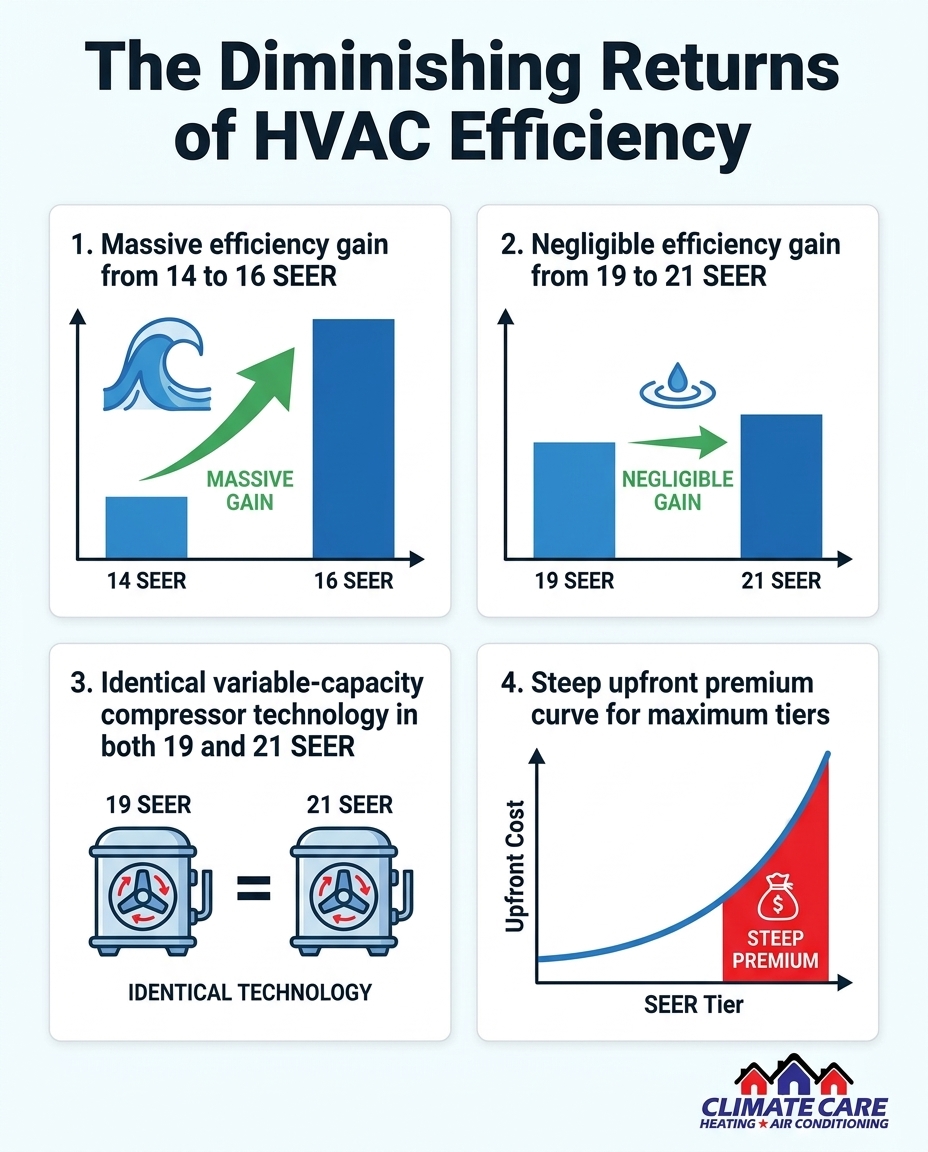
Here is the most critical piece of information that commission-driven salespeople often conveniently omit: the 19 SEER and 21 SEER units from the same manufacturer almost always utilize the exact same compressor technology. When you pay the massive premium for the 21 SEER model, you are not buying "better cooling" or "more comfort." You are buying a slightly larger condenser coil or a marginally tweaked fan motor.
Both of these ultra-high efficiency tiers feature true variable-capacity (also known as inverter-driven) compressors. Unlike traditional single-stage units that blast at 100% capacity and then shut off, or two-stage units that offer a high and low gear, variable-capacity compressors can modulate their output in tiny increments—often anywhere from 25% to 100% of their total capacity. They act like a dimmer switch for your home's climate control, providing exactly the amount of cooling needed to maintain the temperature to the precise degree.
During the intense, dry summers in Manteca, CA and the surrounding Central Valley/Northern California region, air conditioning units are forced to run extended, grueling cycles. Variable-speed technology excels under these exact conditions. Because the system can run continuously at a very low, energy-sipping speed, it constantly circulates air over the indoor coil. This continuous circulation is the absolute best way to maximize dehumidification and eliminate hot and cold spots throughout the house.
Because the 19 SEER unit features this exact same variable-speed technology, it is perfectly suited for local conditions without needing the extra 2 SEER points. As a brother-owned, transparent business, one thing we see often is homeowners being pressured into the highest-priced unit. But honest contractors will always explain that the comfort technology is identical, rather than pushing the higher-tier unit just to secure a larger commission.
The Problem: When manufacturers advertise the money-saving potential of a 21 SEER system, they base their math on national average electricity rates and assumed usage patterns. But real-world ROI must be calculated based on your specific local utility rate structures. In Northern California, utility companies heavily emphasize Time-of-Use (TOU) billing, where electricity costs significantly more during peak late-afternoon and early-evening hours.
The Cause: The electrical grid is under the most strain when everyone comes home from work and turns down their thermostats. TOU rates are designed to punish heavy energy consumption during these peak windows. Even the absolute most efficient 21 SEER unit on the market will still draw a substantial amount of power when fighting a 100-degree afternoon, meaning you are still paying premium peak rates for that electricity.
The Solution: Instead of relying on the slight mechanical edge of a 21 SEER unit, homeowners see far better financial results by pairing a 19 SEER unit with smart thermostat integration. By pre-cooling the home during off-peak hours (when electricity is cheaper) and allowing the variable-speed compressor to simply maintain that temperature at a low speed during peak hours, you can drastically reduce your bills. This strategy leverages the technology of the 19 SEER system perfectly.
When evaluating the diminishing returns on monthly utility savings versus the steep upfront premium, you must factor in the lifespan of the equipment. A high-quality, well-maintained air conditioning system typically lasts 15 to 20 years. If the monthly savings of a 21 SEER unit over a 19 SEER unit only amount to a marginal fraction of your bill, the "payback period" for that initial premium might stretch to 25 or 30 years. This means the equipment will likely need to be replaced again before the 21 SEER upgrade ever actually pays for itself.
If you have the budget for a 21 SEER system and are determined to maximize your home's energy profile, there are much smarter ways to invest those funds than chasing diminishing AC returns. True home efficiency is about the entire building envelope, not just the metal box sitting in your side yard. Before you sign a contract for the most expensive cooling unit on the market, consider these alternative investments that often yield a much higher return:
• Ductwork Sealing and Repair: Putting a 21 SEER air conditioner on leaky, uninsulated ductwork is like putting a hybrid engine in a car with flat tires. According to energy experts, up to 30% of conditioned air can be lost through duct leaks. Investing the price difference into aeroseal treatments or duct replacement will improve your comfort far more than 2 extra SEER points.
• Attic Insulation Upgrades: Keeping the brutal summer heat out of your living space in the first place reduces the load on your AC. Upgrading your attic insulation to modern standards allows a 19 SEER unit to perform incredibly well, often outperforming a 21 SEER unit installed in a poorly insulated home.
• Advanced Heat Pump Technology: Instead of just upgrading your cooling, consider upgrading your entire HVAC strategy. Investing in a high-efficiency heat pump provides exceptional peak-summer cooling and superior indoor air quality, effectively maximizing the impact of your investment under heavy cooling loads.
• Dual-Fuel Configurations: For ultimate control over utility costs in Manteca, CA and the surrounding Central Valley/Northern California region, pairing a high-efficiency heat pump with a gas furnace creates a dual-fuel system. While this provides year-round flexibility, during the brutal July heat, the heat pump acts as a powerhouse air conditioner, allowing your smart thermostat to optimize energy usage and maintain perfect indoor air quality.
The financial reality of ultra-high efficiency HVAC equipment is clear: the upfront premium for maximum efficiency is steep, and the long-term payoff is often an illusion created by diminishing returns. Before you finalize any major home improvement project, you need to protect your investment by objectively evaluating your specific situation.
We recommend walking through this simple checklist before signing any quote for a maximum-tier system:
• How long will you live in the home? If you plan to move within the next 5 to 7 years, you will never see the ROI on a 21 SEER unit. A 19 SEER system still provides excellent resale value without the wasted premium.
• What are your current utility bills? If your summer cooling bills are already relatively manageable, the 5% difference between a 19 and 21 SEER unit will only amount to negligible daily savings.
• Are there local rebates available? Sometimes, utility companies or local municipalities offer specific rebates that apply to 19 SEER units but cap out, meaning the 21 SEER unit doesn't actually earn you any additional incentive value.
• Is the rest of your home efficient? As discussed, ensure your windows, doors, and ductwork are sealed before overspending on the AC unit itself.
Smart financial planning also involves looking at how you pay for the system. Choosing the smarter, slightly lower-tier unit leaves room in the budget for better indoor air quality add-ons or duct repairs. Furthermore, utilizing flexible HVAC financing options can make the smart choice of a 19 SEER unit even more accessible, allowing you to keep your cash on hand while still enjoying premium variable-speed comfort. Never let a commission-driven salesperson dictate the financial limits of your home improvement project.
For the vast majority of residential applications, a 21 SEER air conditioner is not worth the investment. The upfront cost is significantly higher than slightly lower tiers, but the monthly energy savings are mathematically marginal due to diminishing returns. Most homeowners will never recoup the initial price difference over the lifespan of the equipment. A 19 SEER unit provides the exact same variable-speed comfort technology at a much more reasonable price point.
The efficiency gain between a 19 SEER and a 21 SEER system is generally only about 5% to 8% in total energy consumption. While jumping from an old 10 SEER unit to a 16 SEER unit can save you nearly 40%, the higher you go on the scale, the smaller the relative savings become. In real-world value, this small percentage difference often translates to just a marginal amount saved during the cooling season.
Currently, the highest SEER ratings for traditional residential central air conditioning systems peak around 26 to 28 SEER, though these are highly specialized units. Ductless mini-split systems can achieve even higher ratings, sometimes exceeding 30 SEER. However, just because these maximum ratings exist on the market does not mean they represent a practical or financially sound investment for the average residential home.
No, a higher SEER rating does not inherently guarantee a longer equipment lifespan. The longevity of an air conditioning system is determined by the quality of the initial installation, the precision of the ductwork sizing, and strict adherence to annual preventative maintenance. A poorly installed 21 SEER unit will fail much faster than a meticulously maintained 14 SEER unit.
SEER2 testing standards require equipment to be tested under higher static pressure conditions, which much more accurately reflects the airflow resistance found in real-world residential ductwork. Because the equipment is forced to work harder during the test, the real-world performance gaps between ultra-high tiers narrow significantly. This makes the massive price jump to a 21 SEER unit even harder to justify under modern testing protocols.
No, a 21 SEER unit will not cool your home any faster than a 19 SEER unit of the same tonnage. SEER is strictly a measurement of electrical efficiency (how much power the unit consumes), not a measurement of cooling speed or capacity. Furthermore, both 19 and 21 SEER systems utilize identical variable-speed compressor technology, meaning they both deliver the exact same level of precise temperature control and dehumidification.
When the summer heat sets in across Manteca, CA and the surrounding Central Valley/Northern California region, you need a cooling system you can rely on. But you also need a system that respects your household budget. The short answer is that a 19 SEER unit provides absolutely exceptional comfort, elite dehumidification, and outstanding energy efficiency without forcing you to pay the unnecessary, inflated premium of a 21 SEER system.
You deserve the financial and technical confidence to choose the right system for your specific climate without falling victim to high-pressure sales tactics. By understanding the law of diminishing returns and the reality of variable-capacity compressors, you can confidently invest in a system that truly benefits your home. When you are ready to explore your options with a team that prioritizes honest ROI advice over upselling, reach out to schedule your AC installation consultation today. We are here to ensure you get maximum comfort without the maximum price tag.
Our customers love our service and support.

Had Climate Care inspect our HVAC before summer. Christopher Hayes was polite, knowledgeable, and efficient. Great service from the office team—highly recommend!
Alex Corona did a thorough furnace check-up today, showing before-and-after photos and answering all my questions. I’m happy with his work and highly recommend him. Great job—happy customer!
Alan C. serviced my furnace today and gave me a courtesy call before arriving. He was very professional, provided great service, and shared lots of pictures. Definitely a five-star experience—I’ll use them again!
On 02/19/2025, Alan inspected my furnace and did a great job explaining everything. He was professional, hardworking, and focused on customer satisfaction. Highly recommend requesting him!