How Air Scrubbers Remove Allergens Dust and Pollutants Through Advanced Technology
How air scrubbers remove allergens dust and pollutants comes down to one key difference from standard filters: they don't just trap particles — they actively destroy them. Here's a quick breakdown:
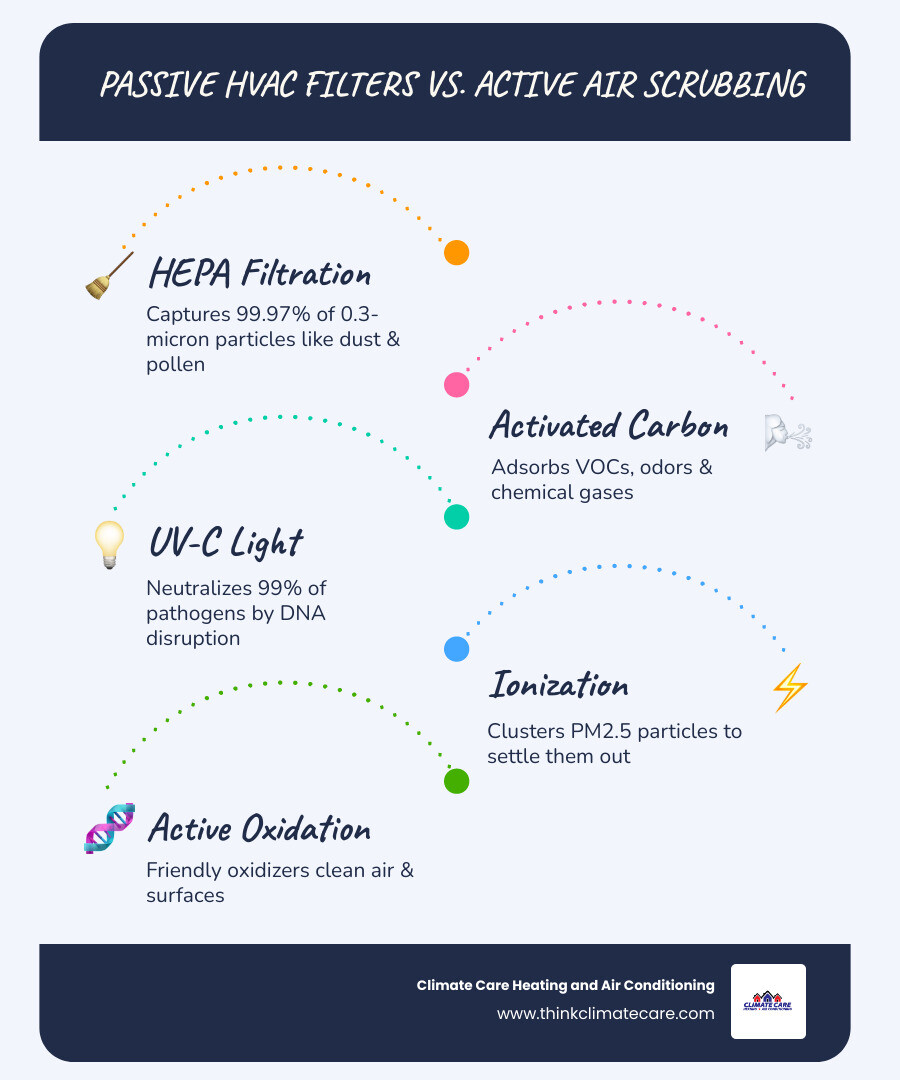
• HEPA filtration captures 99.97% of airborne particles as small as 0.3 microns, including dust, pollen, mold spores, and pet dander
• Activated carbon filters adsorb VOCs, odors, and chemical gases that standard filters miss entirely
• UV-C germicidal light neutralizes up to 99% of airborne pathogens — bacteria, viruses, and mold — by disrupting their DNA
• Ionization releases charged particles into the air that cluster with fine pollutants like PM2.5, causing them to settle out of the breathing zone
• ActivePure technology (in advanced systems) sends oxidizing molecules into the room to clean surfaces as well as the air
If your home in Manteca, CA feels dusty, smells stale, or your family is constantly sneezing, the air inside your home may be the problem. According to the EPA, indoor air can be 2 to 5 times more polluted than the air outside — and in some cases, up to 100 times worse. That's a startling reality for homeowners who assume their four walls are protecting them.
In April 2026, with wildfire seasons growing longer and valley dust a persistent concern across California's Central Valley, the quality of the air you breathe inside your home matters more than ever. Standard HVAC filters help, but they're largely passive — they only catch what flows through them. Air scrubbers go several steps further, actively targeting allergens, fine particles, and biological contaminants throughout your entire home.
When we talk about how air scrubbers remove allergens dust and pollutants, we aren't just talking about a thicker air filter. Air scrubbers are sophisticated devices integrated directly into your HVAC system's ductwork. Unlike a portable air purifier that cleans the air in a single corner of a room, a whole-house air scrubber treats every cubic inch of air that circulates through your home.
One of the most impressive components used in modern systems is ActivePure technology. Originally developed for use on the International Space Station, this NASA-inspired science doesn't wait for pollutants to find the filter. Instead, it creates "friendly" oxidizers—molecules made of hydrogen and oxygen—that are sent out into your living spaces. These molecules actively seek out and neutralize pathogens in the air and on surfaces like countertops, doorknobs, and even your sofa cushions.
This active approach is why air scrubbers are often 50 times more powerful than normal HVAC filtration. In as little as 30 minutes, these systems can reduce over 90% of airborne pathogens. For families in the Central Valley, where dust and pollen are a constant battle, this technology provides a level of protection that a standard pleated filter simply cannot match. You can learn more about how this fits into your home's ecosystem by exploring IAQ with Whole House Air Scrubbers.
The Multi-Stage Process of How Air Scrubbers Remove Allergens Dust and Pollutants
To truly understand how air scrubbers remove allergens dust and pollutants, you have to look at the "filter train." Most high-quality scrubbers use a multi-stage process to ensure nothing gets through.
1. The Pre-Filter: This is the first line of defense, catching large "boulders" like hair, large dust bunnies, and carpet fibers. This protects the more sensitive internal components.
2. HEPA Filtration: This is the gold standard. High-Efficiency Particulate Air (HEPA) filters are rated to trap 99.97% of particles as small as 0.3 microns. To put that in perspective, a human hair is about 50 microns wide. HEPA filters catch things you can't even see, like fine dust and microscopic allergens.
3. Activated Carbon: This stage uses a process called adsorption. Unlike absorption (like a sponge taking on water), adsorption causes gases and odors to stick to the surface of the carbon. This is how air scrubbers remove Volatile Organic Compounds (VOCs) from cleaning products, paints, and "new car" smells, as well as stubborn cooking or pet odors.
By combining these stages, the system ensures that both solid particles and gaseous pollutants are removed. For a deeper dive into the specific contaminants these systems handle, check out our guide on Air Scrubber to Remove Indoor Pollutants.
Neutralizing Pathogens and Mold with UV-C Light
While filters are great at catching "stuff," they don't always kill living organisms. That’s where UV-C germicidal irradiation comes in. Inside the air scrubber, air passes by a specialized UV-C lamp. This specific wavelength of light is lethal to microorganisms like bacteria, viruses, and mold spores.
Instead of just trapping a mold spore in a filter where it could potentially grow, the UV-C light penetrates the organism's cell wall and disrupts its DNA. This renders the pathogen "sterile"—it can no longer reproduce or cause infection. Studies have shown that technology like the Air Scrubber Plus can eliminate up to 99.99% of surface mold. This is a game-changer for homes in more humid parts of our service area or for those dealing with the aftermath of a leak.
For those specifically worried about seasonal illnesses or chronic respiratory issues, UV-C Air Purification for Allergies and Asthma provides excellent insights into this biological defense.
Using Ionization to Target Fine Particulate Matter
Have you ever noticed how dust seems to dance in a sunbeam and never actually land? That's because small particles are often too light to be pulled down by gravity. Air scrubbers use ionization to solve this.
The system releases negatively charged ions into the air. These ions act like tiny magnets, attaching themselves to positively charged particles like smoke, fine dust (PM2.5), and pet dander. As these particles cluster together, they become heavier. Eventually, they either become large enough to be caught by your HVAC filter or they fall out of the air onto the floor where they can be easily vacuumed up.
This is particularly effective during wildfire season in California. Wildfire smoke is made of incredibly fine particles that can penetrate deep into the lungs. By forcing these particles to cluster, the air scrubber makes it much easier to keep your indoor air clear of "the haze." This active management is a key part of Fighting Allergies with Whole House Air Filtration.
Maximizing Home Health with Professional Air Scrubber Integration
An air scrubber is only as good as its installation and maintenance. Because these units are installed directly into your ductwork—usually just above the fan coil—they need to be positioned perfectly to ensure every bit of air is treated before it reaches your vents.
When we integrate a whole-house system, it doesn't just help your lungs; it helps your HVAC system. By removing the dust and "gunk" that usually coats your evaporator coils and blower motor, an air scrubber can actually extend the life of your furnace or air conditioner and improve energy efficiency. A cleaner system doesn't have to work as hard to push air through, which can lead to lower monthly utility bills.
Why Professional Installation is Essential for How Air Scrubbers Remove Allergens Dust and Pollutants
We often get asked if an air scrubber is a DIY project. The short answer is: probably not. Installing a whole-house system requires cutting into your existing ductwork, wiring the unit into your HVAC’s power supply, and ensuring that the airflow isn't restricted.
Furthermore, safety is a major factor. In California, we have strict standards regarding ozone production. You want to ensure your device is CARB-certified (California Air Resources Board), meaning it produces little to no ozone (less than 0.05 parts per million). Professional installers like our team at Climate Care ensure that the unit is safe, sealed, and optimized for your specific home layout. For residents in our core service areas, you can find localized information here: Whole House Air Scrubber Manteca CA.
Signs Your Air Scrubber Needs Immediate Attention
Once your system is up and running, it’s mostly "set it and forget it," but it’s not invincible. You should keep an eye out for a few key signs that things aren't working perfectly:
• Indicator Lights: Most units have a small LED light. If it changes color or goes out, it usually means the UV lamp has reached the end of its life.
• Return of Odors: If you suddenly start noticing that "dog smell" or cooking odors are lingering longer than usual, your carbon filter might be saturated.
• Increased Dust: If you find yourself dusting the furniture every two days again, the ionization or filtration stages may need a check-up.
Regularly checking your system prevents small issues from becoming big problems. If you notice anything unusual, it's worth checking out our guide on Signs Air Scrubber Needs Immediate Attention to troubleshoot the issue.
Long-Term Benefits for Allergy and Asthma Sufferers
For the millions of people who suffer from allergies or asthma, an air scrubber isn't just a luxury—it’s a health necessity. By removing 99.9% of pollen and pet dander, these systems can significantly reduce sneezing, watery eyes, and nighttime coughing.
At Climate Care Heating and Air Conditioning, we take a holistic approach to your home’s health. We don’t just look at the temperature; we look at the "breathability" of your environment. Whether you are in Modesto, Stockton, or Sacramento, our goal is to ensure your home is a sanctuary from the outdoor pollutants of the Central Valley.
Investing in your air quality is an investment in your long-term health. To see how a whole-home approach can change your daily life, read more at Breathe Easier Live Healthier The Benefits of a Whole Home Air Purifier. For a full overview of our air quality services, visit our IAQ page.
Maintenance: Keeping the "Scrub" in Air Scrubber
To ensure your system continues to perform at its peak, a few routine tasks are required. While the air scrubber does the heavy lifting, it does need a little TLC from time to time:
• Pre-Filters: These should generally be checked every 3 to 6 months. If you have multiple pets or live in a high-dust area like Salida or Oakdale, you might need to change them more often.
• HEPA and Carbon Filters: These typically last 6 to 12 months in a residential setting.
• UV Lamps: Even if the light is still "on," UV bulbs lose their germicidal effectiveness over time. Most manufacturers recommend professional replacement every 12 to 24 months.
Keeping up with these replacements ensures that the technology can continue to destroy pathogens effectively. For a detailed schedule, see our post on Whole House Air Scrubber Filter Replacement.
Is an Air Scrubber Right for Your Home?
If you live in an arid climate like ours—stretching from Lodi down to Turlock—dust is an unavoidable part of life. Add in the smoke from periodic wildfires and the high pollen counts of the valley, and your lungs are working overtime.
An air scrubber is particularly beneficial if:
• You have indoor pets that shed dander.
• You are planning a home renovation (which kicks up massive amounts of silica and drywall dust).
• A family member has a compromised immune system or chronic respiratory issues.
• You simply want the peace of mind that comes with breathing the cleanest air possible.
Most homeowners notice a difference in air freshness within 24 to 48 hours of installation, with full benefits (like reduced dust accumulation on surfaces) appearing within a week or two.
Conclusion
Understanding how air scrubbers remove allergens dust and pollutants reveals that these devices are the ultimate "dust busters" for the modern home. By combining the mechanical strength of HEPA filters, the chemical "stickiness" of activated carbon, the biological destruction of UV-C light, and the particle-clustering power of ionization, they provide a 360-degree defense for your indoor air.
At Climate Care Heating and Air Conditioning, we are proud to serve communities from Elk Grove to Patterson and everywhere in between. We believe that everyone deserves to breathe easy in their own home. If you're ready to take control of your indoor environment and say goodbye to dust and allergens, we're here to help you find the perfect air scrubbing solution for your HVAC system.
Ready to transform your home’s air? Visit our IAQ page today to learn more about our professional installation services and how we can help you breathe easier.