Does a High SEER Rating Matter for Heating or Just Air Conditioning?
That high SEER rating on your outdoor unit only measures summer cooling efficiency. Discover which HVAC ratings actually impact your winter heating performance.
When dealing with upstairs bedrooms that stay uncomfortably warm during July peak summer heatwaves despite the AC running nonstop, Demystifying Attic Fans: How Roof Ventilation Actually Lowers Your Indoor Temperature is the first step to reclaiming your comfort. If you are battling this stubborn second-floor heat, you are not alone. As the local experts at Climate Care Heating & Air Conditioning, our team typically sees this exact issue in Manteca homes, prompting homeowners to ask: how does an attic fan work to actually lower the temperature inside your home?
The short answer is that the problem usually is not a lack of cooling power, but an overwhelming amount of radiant heat pushing down through your ceiling. When the sun beats down on your roof all afternoon, that thermal energy has to go somewhere. It accumulates in the unoccupied space above your living quarters, turning your attic into a massive heating element that actively fights your cooling system. You might notice that the downstairs thermostat reads a comfortable 72°F, but the moment you walk up the stairs, you hit a wall of thick, stagnant heat.
Solving this requires looking beyond the thermostat and addressing the structural thermal dynamics of your home. A comprehensive approach to residential cooling often involves pairing your primary Air Conditioning Services with targeted ventilation strategies. By understanding how heat transfers through your roof, you can determine if active mechanical ventilation or systems like Whole House Fans are the missing link in your home comfort strategy.
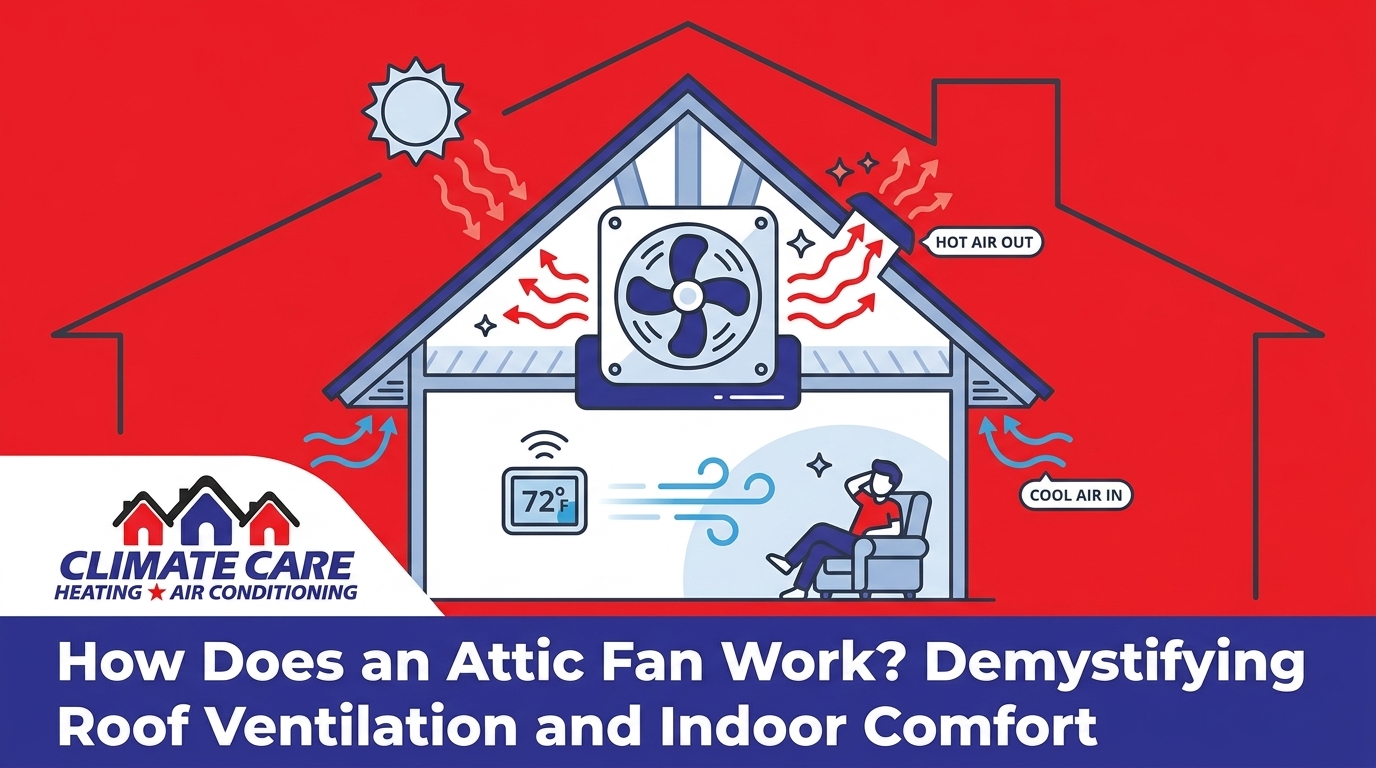
An attic fan works by actively pulling cooler outside air through your soffit vents and mechanically pushing superheated, trapped air out through the roof exhaust. This continuous mechanical airflow breaks the cycle of heat accumulation that natural, passive vents simply cannot handle alone.
Most modern homes are built with passive ventilation systems, typically consisting of intake vents under the eaves (soffits) and exhaust vents at the peak of the roof (ridge vents or gable vents). These systems rely on thermal buoyancy—the natural tendency of hot air to rise—and ambient wind to circulate air. On a mild spring day with a steady breeze, passive ventilation works perfectly fine to keep the air moving.
However, during the intense heat of summer, passive systems hit a wall. When the outside air is stagnant and the sun is relentlessly baking the roof deck, natural convection is far too slow to exhaust the heat as fast as it enters the space. The result is a rapid buildup of thermal energy, frequently leading to 140°F+ peak attic temperatures by mid-afternoon.
This is where active ventilation changes the equation entirely. By introducing a motorized fan into the space, you are no longer waiting for hot air to drift out on its own. The fan forces a high-volume, continuous exchange of air.
• Forced extraction: The fan creates negative pressure in the upper portion of the attic, forcefully expelling the superheated air out into the atmosphere.
• Continuous intake: This negative pressure acts like a vacuum, pulling fresh, ambient air in through the lower soffit vents along the perimeter of the roof.
• Temperature regulation: By constantly cycling the air, the fan prevents the space from reaching extreme, oven-like temperatures, keeping the environment much closer to the outside ambient temperature.
To truly understand why active ventilation is necessary, we have to look at the scientific cause-and-effect of solar radiation on a residential structure. Heat moves in three ways: conduction, convection, and radiation. All three are working against your indoor comfort during a hot afternoon.
The intense, dry solar radiation specific to the Central Valley creates severe thermal gradients between the roof deck and your indoor living space. When the outside temperature reaches 95°F or 100°F, the impact on your roof is magnified dramatically. Here is exactly how that heat transfer happens:
1. Absorption and Conduction: The sun's rays hit your roofing materials directly. Dark asphalt shingles can easily reach temperatures exceeding 150°F. Through conduction, this intense heat transfers directly through the solid roofing materials into the wooden roof deck beneath.
2. Radiation into the Attic: Once the underside of the roof deck gets hot, it acts like a massive radiator, emitting massive amounts of thermal energy into the enclosed air space of the attic.
3. Convection and Trapping: The air inside the attic absorbs this radiated heat. Because the space is enclosed and passive ventilation cannot keep up with the sheer volume of energy entering the space, the air temperature skyrockets, creating a stagnant pocket of extreme heat right above your head.
Homeowners often assume that thick ceiling insulation is enough to stop this heat from entering the house. While insulation is highly effective at slowing heat transfer, it cannot stop it indefinitely. Insulation is rated by its thermal resistance (R-value). If the space above the insulation reaches extreme temperatures and stays there for hours, that thermal resistance is eventually overcome.
Once the fiberglass or blown-in insulation is fully saturated with heat, it begins radiating that energy directly into the living spaces below—specifically your upstairs bedrooms. You feel this as a heavy, oppressive warmth pushing down from the ceiling. Stopping this heat transfer at the roofline by exhausting the hot air is vastly more efficient than trying to cool that heat with your air conditioner once it has already entered your home.

The physics of a hot roof do not just make your upstairs uncomfortable; they actively sabotage your cooling equipment. The relationship between trapped roof heat and an overworked air conditioning system is a direct domino effect that costs homeowners significantly in energy waste and premature equipment failure.
Many homes are designed with HVAC ductwork routed directly through the attic space. This means the very system designed to deliver cold air to your rooms is sitting in the hottest environment in your house.
As a brother-owned local team at Climate Care Heating & Air Conditioning, we frequently inspect ductwork in Manteca neighborhoods and see firsthand the toll this extreme heat takes on residential systems. Even well-insulated flexible ducts have their limits. When exposed to 140°F+ peak attic temperatures, the chilled air traveling inside the ducts absorbs ambient heat before it ever reaches the supply vents. Your system might produce 55°F air at the indoor coil, but by the time it travels through forty feet of superheated ductwork, it might be 65°F or 70°F when it blows into your bedroom.
If your cooling system is losing the battle against radiant heat, you will typically notice several clear warning signs:
• Uneven cooling: The ground floor remains perfectly comfortable while the upper floors are warm and stuffy.
• Continuous operation: The air conditioner runs for hours without cycling off, even after the sun has started to set.
• Weak airflow: The air coming out of the ceiling registers feels lukewarm rather than crisp and cold.
• Spiking utility bills: Your energy consumption jumps drastically because the compressor is running constantly to compensate for the ductwork heat gain.
When the air reaching your rooms is not cold enough to satisfy the thermostat, the air conditioning system is forced to run continuously. This leads to extended run cycles, accelerated wear and tear on moving parts, and a shortened overall lifespan for the equipment.
Mitigating this extreme wear and tear requires a two-pronged approach: lowering the ambient temperature around the equipment with active ventilation, and ensuring the cooling equipment itself is operating at peak efficiency. Scheduling a comprehensive Manteca AC Tune Up ensures your system has the refrigerant charge and airflow necessary to handle the heavy summer load while your ventilation strategy handles the roof heat.
When researching ventilation solutions, homeowners frequently confuse attic fans with whole house fans. While both systems move air and improve comfort, they serve entirely different purposes, are installed in different locations, and operate at different times of the day. Understanding this distinction is critical to choosing the right solution for your home's thermal dynamics.
Here is a detailed breakdown of how these two distinct ventilation strategies operate and interact with your home's cooling load:
• Primary Purpose — Attic Fan (Active Roof Ventilation): Exhausts superheated air from the unoccupied roof space to prevent radiant heat transfer into the home. — Whole House Fan: Draws cool, fresh outdoor air through open windows directly into the living space and up through the roof.
• Location — Attic Fan (Active Roof Ventilation): Installed on the roof deck or in a gable wall, entirely outside the indoor living envelope. — Whole House Fan: Installed in the ceiling of the uppermost floor, directly connecting the living space to the attic above.
• When to Operate — Attic Fan (Active Roof Ventilation): During the hottest parts of the day (e.g., July peak summer afternoons) when solar radiation is highest. — Whole House Fan: During the evening or early morning when the outside temperature is significantly cooler than the indoor air.
• Interaction with AC — Attic Fan (Active Roof Ventilation): Works simultaneously with the AC, reducing the heat load on the ceiling and protecting the ductwork. — Whole House Fan: Used as a direct alternative to the AC; the air conditioner must be turned off when windows are open.
These two systems are not mutually exclusive; in fact, they can work together beautifully for comprehensive thermal management. An active roof exhaust protects your home from solar heat gain during the day, while a whole house system provides rapid, energy-efficient cooling once the sun goes down. For more strategies on leveraging outdoor air, you can explore 10 sure-fire ways to cool your home down naturally.
While most homeowners in Manteca CA and the greater Central Valley install active ventilation to combat intense summer heat, proper roof ventilation provides critical secondary benefits that protect your home year-round. Temperature reduction is only half the story; moisture control is equally vital to the structural integrity of your house and the health of the air you breathe.
Everyday activities inside your home generate a surprising amount of airborne moisture. Cooking, showering, running the dishwasher, and even breathing release water vapor into the air. Because warm air naturally rises, much of this indoor moisture eventually migrates upward, bypassing ceiling drywall and entering the attic space.
During cooler months, or during rapid temperature drops in the evening, this warm, moist air hits the cold underside of the roof deck. Without adequate ventilation to carry the moisture away, it condenses into liquid water. Over time, this trapped humidity creates severe structural and health problems:
• Wood rot: Chronic condensation degrades the wooden rafters and roof decking, compromising the structural integrity of the roof and leading to expensive carpentry repairs.
• Insulation damage: When fiberglass or cellulose insulation gets damp, it loses its thermal resistance (R-value) and clumps together, rendering it ineffective.
• Mold and mildew growth: A dark, damp, poorly ventilated space is the perfect breeding ground for mold spores.
• Roof degradation: Trapped heat and moisture can cause asphalt shingles to blister and age prematurely, forcing you to replace your roof years before its expected lifespan ends.
Once mold takes hold above your ceiling, the spores can easily infiltrate the living spaces below through recessed lighting fixtures or HVAC return leaks, triggering allergies and respiratory issues. Maintaining a healthy, dry, and well-ventilated roof space is a foundational step in improving your overall Indoor Air Quality.
Homeowners often have specific questions about how active mechanical airflow interacts with their existing cooling equipment and insulation. Here are the objective answers to the most common queries we receive about roof ventilation.
It does not blow cold air into the rooms like an air conditioner, but it stops radiant heat from warming the living space. By forcefully exhausting superheated air, it significantly lowers the ceiling temperature. This means the house feels cooler to the occupants, and the primary cooling equipment can finally catch up with the thermostat demand.
Most thermostats for these systems are set to activate between 100°F and 110°F. This specific range prevents the space from reaching extreme, damaging temperatures while conserving energy during milder weather. Once the ambient temperature drops below the setpoint, the system automatically shuts off without any manual intervention.
Yes, by reducing the ambient temperature around attic ductwork and lowering the radiant heat load on the ceiling, it provides immediate relief to your cooling equipment. This allows the air conditioner to run shorter cycles, consume less electricity, and experience less mechanical wear and tear during extreme heatwaves.
Solar fans run entirely on the sun's energy, meaning they operate for free during peak daylight hours and require no hardwiring to your electrical grid. Electric fans are wired directly into the home's power supply and can run based on thermostat demands at any time of day, regardless of cloud cover or shade.
No, ventilation and insulation work as a team and serve completely different functions. Insulation slows the transfer of heat, while ventilation removes the source of the heat entirely; both are required for maximum energy efficiency. Even with 140°F+ peak attic temperatures actively vented away, a thick layer of insulation is still necessary to block the remaining ambient warmth from reaching your living space.
Lowering attic temperatures is a scientifically proven way to improve indoor comfort and protect your cooling equipment from premature failure. When you stop radiant heat at the roofline, you break the cycle of hot ceilings, overworked air conditioners, and stubbornly warm upstairs bedrooms during July peak summer heatwaves.
However, every home is built differently, and matching the right ventilation strategy to your specific roof architecture and existing insulation is critical for success. If you are tired of running your cooling system all day with little relief, it is time to have a professional assess your thermal envelope. Reach out to a local HVAC and ventilation expert today to schedule an inspection, evaluate your ductwork, and find the right airflow solution for your home.
Our customers love our service and support.

Had Climate Care inspect our HVAC before summer. Christopher Hayes was polite, knowledgeable, and efficient. Great service from the office team—highly recommend!
Alex Corona did a thorough furnace check-up today, showing before-and-after photos and answering all my questions. I’m happy with his work and highly recommend him. Great job—happy customer!
Alan C. serviced my furnace today and gave me a courtesy call before arriving. He was very professional, provided great service, and shared lots of pictures. Definitely a five-star experience—I’ll use them again!
On 02/19/2025, Alan inspected my furnace and did a great job explaining everything. He was professional, hardworking, and focused on customer satisfaction. Highly recommend requesting him!