Why Humidity Is the Hidden Force Behind Mold in Your Home
Understanding how humidity control prevents mold in your home is one of the most important things you can do to protect your family's health and your property. Mold doesn't need a flood or a burst pipe to take hold — it just needs moisture in the air and a warm surface to land on. In the Central Valley, where summer temperatures regularly push into the 90s and beyond, that combination is never far away.
Quick answer: How humidity control prevents mold in your home
• Keep indoor relative humidity (RH) between 30% and 50%
• Never let RH stay above 60% — mold spores can begin multiplying within 24 hours at that level
• Dry any wet or damp area within 24 to 48 hours to stop mold before it starts
• Use exhaust fans, dehumidifiers, and a properly sized AC system to manage moisture daily
• Monitor humidity with a hygrometer and check problem areas like bathrooms, basements, and crawl spaces regularly
Mold spores are always present in the air around us — that's simply a fact of nature. You can't eliminate them. But without enough moisture, they can't grow. That's why moisture control, not mold removal, is always the smarter first move. Once mold takes hold, cleanup is difficult, disruptive, and can affect your health. Preventing it costs far less in time, money, and stress.
For homeowners in Manteca, Modesto, Stockton, and Sacramento, the warm climate means humidity management isn't a seasonal concern — it's a year-round responsibility.
How Humidity Control Prevents Mold in Your Home

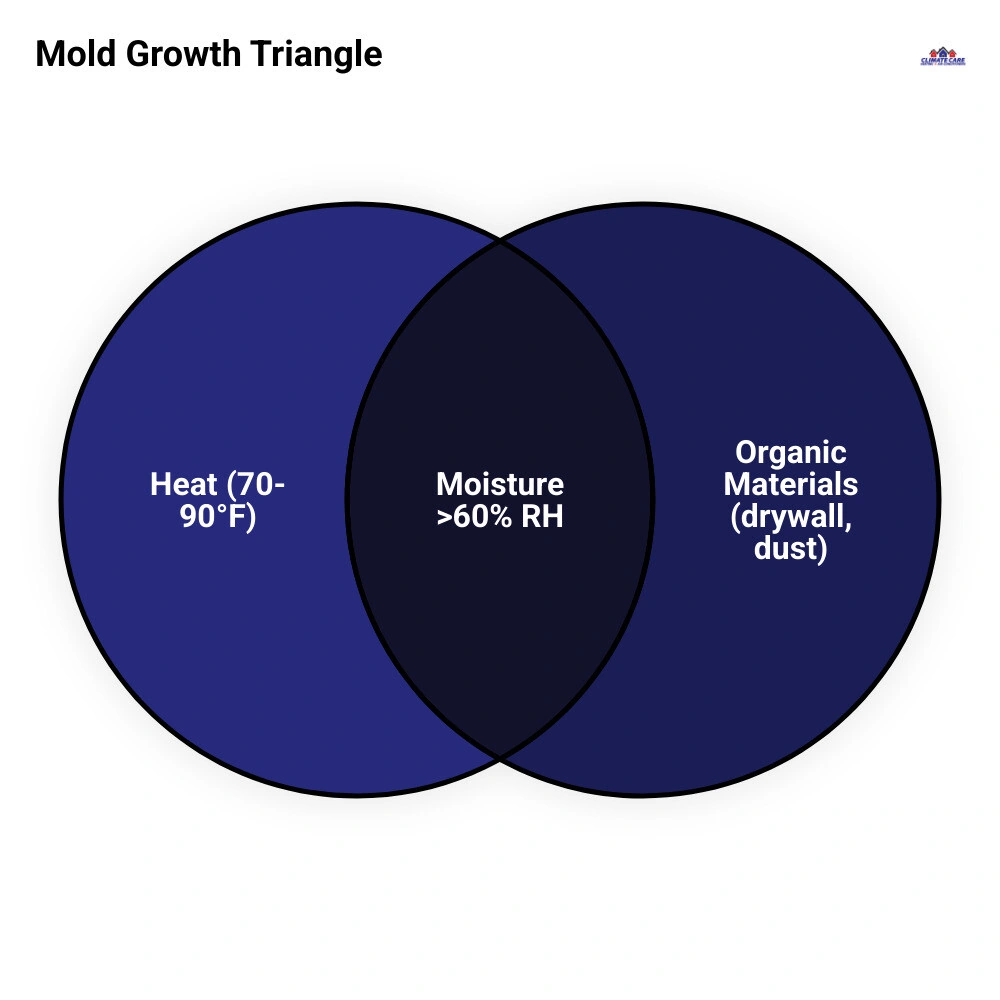
The science behind how humidity control prevents mold in your home is straightforward: mold is a fungus that requires four specific conditions to thrive—food (organic matter like drywall or dust), oxygen, a warm temperature (typically 70-90°F), and moisture. While we can’t easily remove oxygen or organic building materials from our homes, we can absolutely control the moisture.
According to EPA standards, the "sweet spot" for indoor relative humidity is between 30% and 50%. Once humidity levels spike above 60%, you are essentially rolling out the red carpet for mold colonies. In fact, under the right conditions, mold spores can begin to germinate and multiply in as little as 24 hours.
Another critical factor is condensation. When warm, moist air hits a cold surface—like a window pane or a poorly insulated wall—it turns into liquid water. By keeping your humidity low and your surface temperatures consistent, you remove the liquid water mold needs to drink.
• Below 30% — Mold Risk: Very Low — Description: May cause dry skin or respiratory irritation; mold cannot grow.
• 30% - 50% — Mold Risk: Ideal — Description: Perfect balance for health, comfort, and mold prevention.
• 51% - 60% — Mold Risk: Moderate — Description: Risk increases on cold surfaces or in poorly ventilated corners.
• Above 60% — Mold Risk: High — Description: Mold spores can multiply within 24-48 hours.
• Above 70% — Mold Risk: Extreme — Description: Rapid mold colonization is likely on most organic surfaces.
Measuring and Monitoring Indoor Moisture Levels
In cities like Modesto and Stockton, summer humidity can fluctuate wildly. You can't manage what you don't measure. We recommend every homeowner invest in a digital hygrometer. These small, inexpensive sensors provide real-time RH readings.
Keep an eye out for physical "red flags" that your humidity is too high:
• Window Condensation: Fog or water droplets on the glass inside your home.
• Musty Odors: That "old basement" smell is actually the scent of microbial volatile organic compounds (MVOCs) released by mold.
• Peeling Paint: Excess moisture behind walls causes wallpaper to bubble and paint to flake.
• Damp Walls: If a wall feels clammy to the touch, your RH is likely far too high.
How Humidity Control Prevents Mold in Your Home Through Daily Habits
While technology helps, your daily routine plays a massive role in moisture management. For example, did you know each person releases about one liter of moisture overnight just through breathing and perspiration?
To keep your air fresh and dry, follow these best practices:
• Ventilation is King: Always run exhaust fans in the bathroom while showering and for at least 20 minutes afterward.
• Kitchen Care: Cover pots while boiling water and use your range hood fan to vent steam outside.
• Seal the Envelope: Fix plumbing leaks immediately and ensure your crawl space has a proper vapor barrier.
• Shorter Showers: Reducing the time and temperature of your showers can significantly lower the moisture load in your bathroom.
By focusing on Air Quality, you create an environment where mold simply cannot survive.
Vulnerable Areas and Health Risks of Excess Moisture
Certain parts of your home are "mold magnets." Bathrooms, basements, attics, and laundry rooms are high-risk zones because they often lack airflow and have higher concentrations of moisture.
Ignoring these areas doesn't just damage your home’s structural integrity; it poses real health risks. Mold produces allergens, irritants, and in some cases, toxic substances called mycotoxins. Exposure can lead to:
• Respiratory irritation (coughing, wheezing)
• Frequent asthma attacks in sensitive individuals
• Allergic reactions like sneezing, red eyes, and skin rashes
• Hypersensitivity pneumonitis in rare, long-term cases
To learn more about keeping your air clean, check out How Air Scrubbers Remove Allergens Dust and Pollutants.
Professional HVAC Solutions for Long-Term Mold Prevention
Sometimes, daily habits aren't enough—especially during a humid Sacramento summer. This is where your HVAC system becomes your best friend. A properly sized and maintained air conditioner doesn't just cool the air; it removes gallons of water from it every day.
One "pro tip" we always share: keep your AC fan set to "Auto" rather than "On." When the fan runs constantly, it can actually blow moisture from the wet evaporator coils back into your home before it has a chance to drain away.
Benefits of Professional Humidity Control:
• Consistent Comfort: You’ll feel cooler at higher temperatures when the air is dry.
• Lower Energy Bills: Dry air is easier (and cheaper) to cool than humid air.
• Property Protection: Prevents wood rot, warped flooring, and peeling paint.
• Healthier Air: Dramatically reduces the population of dust mites and mold spores.
How Humidity Control Prevents Mold in Your Home with Advanced HVAC Tech
For the ultimate defense, many Valley homeowners are turning to whole-house dehumidifiers. Unlike portable units that you have to empty constantly, these are integrated into your existing ductwork and drain automatically.
Another advanced solution is the Energy Recovery Ventilator (ERV). In airtight, modern homes, stale air gets trapped inside. An ERV brings in fresh outdoor air while "rejecting" the moisture from that air before it enters your living space. This provides balanced ventilation that keeps your indoor environment stable. Discover more about Indoor Air Quality Solutions for Valley Homes.
Maintaining Your HVAC System for Humidity Control
A neglected HVAC system can actually cause mold issues. If your drain line is clogged or your evaporator coils are dirty, water can back up and create a breeding ground for fungi right inside your vents.
Key maintenance steps include:
• Regular Filter Changes: Clogged filters restrict airflow, making it harder for the system to dehumidify.
• Drain Line Cleaning: Ensuring the condensate line is clear prevents water damage near your indoor unit.
• Coil Inspections: Dirty coils can't effectively pull moisture from the air.
• Ductwork Checks: Leaky ducts in a hot attic can cause condensation to form inside your vents.
For those in the Sacramento area, a Whole House Air Filtration system can help capture mold spores before they ever find a place to land.
When to Seek Professional Help in the Central Valley
If you’ve noticed a persistent musty smell, visible mold patches larger than 10 square feet, or if your family is experiencing unexplained respiratory issues, it is time to call in the experts.
At Climate Care Heating and Air Conditioning, we take a holistic approach to your home's health. We don't just fix the symptoms; we address the root cause of the moisture. Serving Manteca, Lathrop, Ripon, and the surrounding areas, our licensed technicians can perform a comprehensive inspection of your HVAC system and ductwork to ensure your home remains a dry, safe sanctuary.
Our comprehensive membership plan offers priority service and regular tune-ups, ensuring your system is always optimized for humidity rejection. Whether you need a Whole House Air Scrubber or a simple duct cleaning, we are here to help you breathe easier.
Don't wait for mold to become a visible problem. Take control of your home's humidity today and protect your investment for years to come. For expert IAQ assistance in the Central Valley, visit our IAQ page.