Does a High SEER Rating Matter for Heating or Just Air Conditioning?
That high SEER rating on your outdoor unit only measures summer cooling efficiency. Discover which HVAC ratings actually impact your winter heating performance.
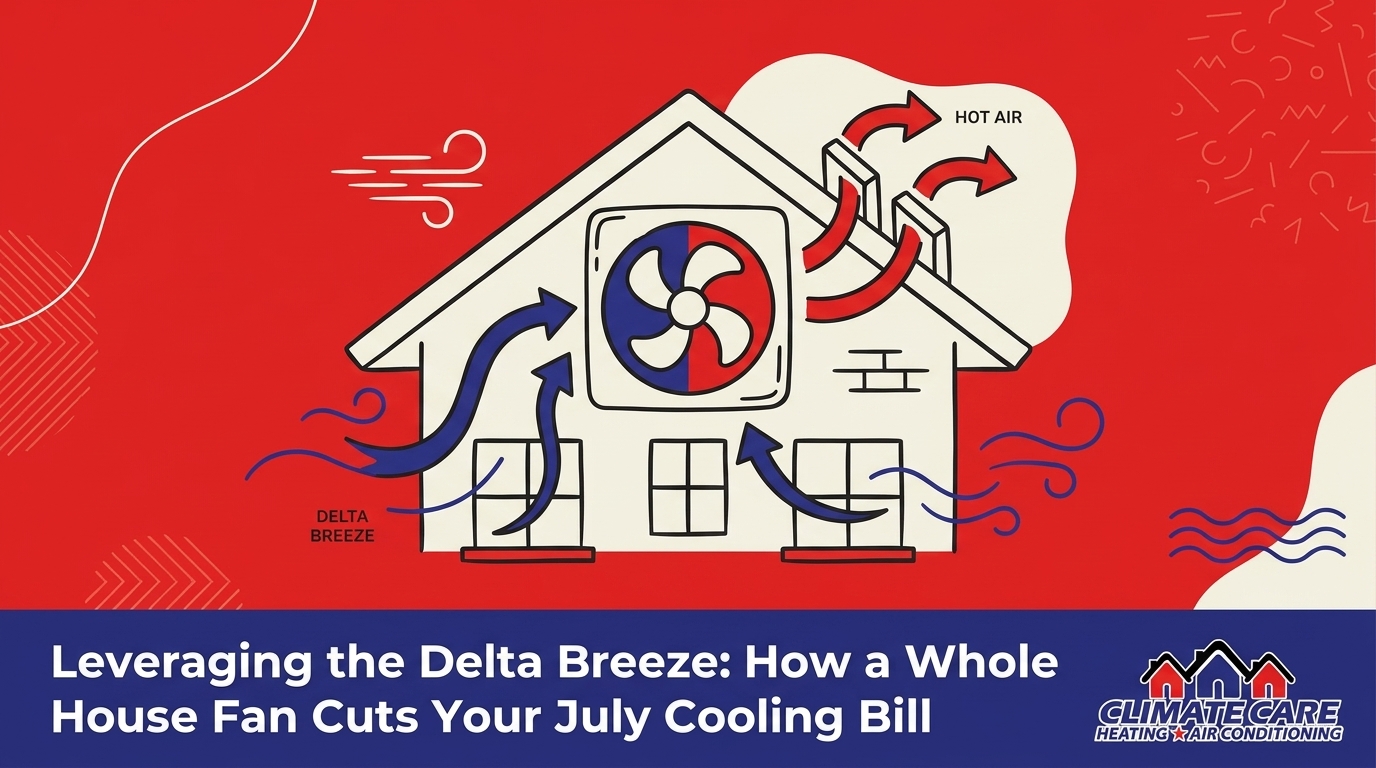
Your air conditioner has been running for hours, but the bedrooms still feel uncomfortably warm. Leveraging the Delta Breeze: How a whole house fan cuts your July cooling bill starts with understanding the real enemy of summer comfort. The issue isn't always a weak air conditioner; it is the massive amount of heat trapped directly above your ceiling. During hot July evenings, your attic acts like a giant radiator, pressing 130-degree heat down into your living space. You are left with a frustrating decision: keep paying to run the AC all night, or find a way to actively flush that heat out.
If you are tired of high energy bills, exploring Whole House Fans might be the smartest upgrade to your Air Conditioning Services this summer.
Most homeowners assume that once the sun goes down, the house should naturally cool off. However, this ignores the physics of thermal mass. Throughout a long summer day, your roof shingles, roof decking, and attic insulation absorb intense solar radiation. By late afternoon, the temperature inside a poorly ventilated attic can easily exceed 140°F. This massive pocket of heat does not just disappear when the sun sets. Instead, it slowly radiates downward through your ceiling and into your living areas.
The radiant heat problem:
• Overworked equipment: Your central air conditioner is forced to cool not just the air in the room, but the continuous wave of heat pressing down from above.
• Uneven temperatures: Second-story bedrooms often feel significantly hotter than the ground floor because they are closest to the attic heat source.
• Extended run times: The thermostat registers the rising indoor temperature and keeps the compressor running long into the night.
Your air conditioning system is designed to remove heat from the air inside your home through a refrigeration cycle. It is not designed to perform rapid attic heat displacement. To solve the root cause of the problem, you need a strategy that physically removes the trapped hot air from the structure of your home.
To truly optimize your home's cooling strategy, you have to look outside. The Central Valley benefits from a highly specific regional weather pattern known as the Delta Breeze. This phenomenon brings cool, dense marine air from the San Francisco Bay, funneling it through the Carquinez Strait and directly into our region.
During the peak of summer, daytime temperatures in Manteca CA routinely exceed 90 or even 100 degrees. However, thanks to the marine layer influence, evening temperatures can experience a rapid and dramatic drop into the low 60s. This reliable evening cooldown is the ultimate secret weapon for home energy efficiency, provided you know how to capture it.
Many people try to take advantage of this cool air by simply opening a few windows. Unfortunately, passive ventilation is rarely enough. Here is why opening windows falls short:
• Lack of pressure: Without a strong prevailing wind blowing directly through your house, the cool outside air has no way to force the hot, stagnant indoor air out.
• Thermal mass retention: Your drywall, flooring, and furniture have absorbed heat all day. Passive airflow is too slow to strip the heat out of these solid materials.
• The attic barrier: Open windows on the ground floor do absolutely nothing to relieve the massive heat load trapped in your attic.
To fully leverage the Delta Breeze, you need an active mechanical system. You need a way to rapidly replace the hot air inside your home with the cool air outside, while simultaneously forcing the trapped heat out of your attic space. This is where specialized ventilation equipment changes the game.
Active heat displacement relies on a simple but powerful principle of physics: negative and positive pressure. Unlike standard air conditioning, which relies on a closed-loop refrigeration cycle to chill existing indoor air, a whole house ventilation system physically moves massive volumes of air through the structure.
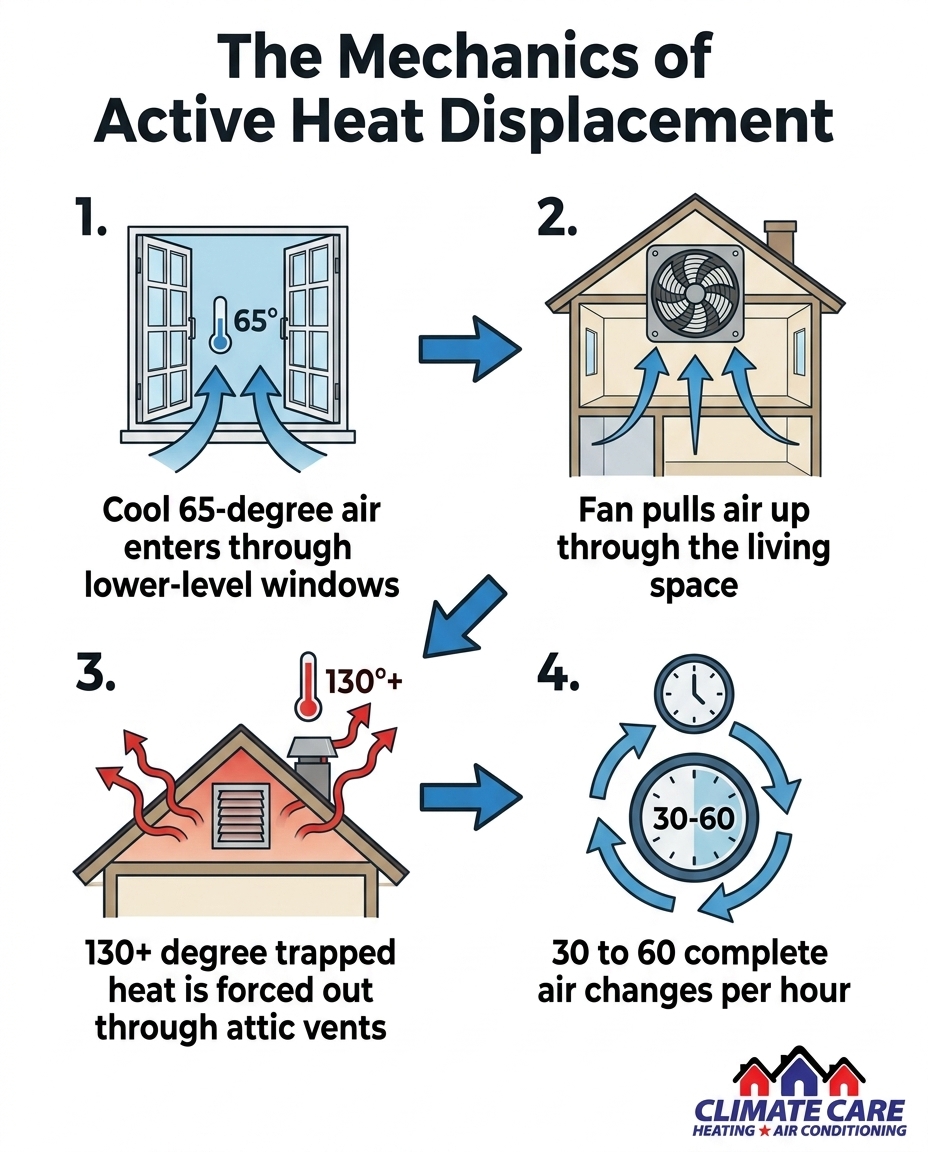
When you activate the system, a powerful fan pulls the cool, heavy evening air in through your open lower-level windows. This creates a negative pressure zone in your living space. The fan then forces this air up through the ceiling and into the attic, creating a positive pressure zone above you. Finally, the system pushes the trapped 130-degree air out through your existing attic vents (such as gable vents, ridge vents, or soffit vents).
According to Department of Energy data, a properly sized system can provide 30 to 60 complete air changes per hour. This means the entire volume of air inside your home is replaced with fresh, cool outdoor air every one to two minutes. This rapid exchange is one of the 10 Sure Fire Ways To Cool Your Home Down Naturally, effectively stripping the stored heat out of your walls and furniture.
It is common to hear the terms "attic fan" and "whole house fan" used interchangeably, but they are two distinctly different pieces of equipment with different functions.
• Standard Attic Fans: These are mounted on the roof or in a gable vent. They only pull air from the outside directly into the attic and exhaust it back out. They help lower the attic temperature during the day, but they do not pull air from your living space.
• Whole House Fans: These are mounted in the ceiling between your living space and your attic. They pull air from your open windows, through the living area, into the attic, and then out the roof vents.
To fully leverage the evening breeze and cool the entire structure of the home, pulling air through the living space is absolutely necessary. A standard attic exhaust fan alone will not cool your bedrooms.
The primary reason homeowners invest in active ventilation is the dramatic reduction in energy consumption. Running a central air conditioner requires a significant amount of electricity, primarily to power the heavy-duty compressor outside. In contrast, a ventilation fan only requires enough electricity to spin a high-efficiency motor.
Data shows that whole house ventilation systems use only 10% to 15% of the energy of a traditional central air conditioner. By turning off your AC and relying on the fan during cool July evenings, you drastically cut your daily kilowatt-hour usage. This strategy is especially valuable because evening hours often align with peak utility rate periods, when electricity is the most expensive.
Furthermore, flushing the heat out of your home's structure at night reduces the workload on your primary cooling system the following afternoon. Because the walls, floors, and attic start the next day significantly cooler, it takes much longer for the house to heat up. Your AC won't have to kick on until much later in the day.
Here is a breakdown of how the two systems compare:
• Cooling Method — Central Air Conditioning: Chemical refrigeration cycle — Whole House Fan: Active air displacement
• Energy Consumption — Central Air Conditioning: High (3,000+ watts typical) — Whole House Fan: Low (300 - 600 watts typical)
• Optimal Run Time — Central Air Conditioning: Mid-day peak heat — Whole House Fan: Evenings and early mornings
• Impact on Structure — Central Air Conditioning: Cools ambient air slowly — Whole House Fan: Rapidly strips heat from thermal mass
Think of this installation as a long-term investment in energy efficiency. It does not replace your need for a Manteca AC Tune-Up to keep your primary system running well during 100-degree afternoons, but it serves as the perfect companion system to handle the evening cooldown for pennies on the dollar.
Having the right equipment is only half the battle; knowing exactly when and how to operate it makes all the difference. To get the maximum benefit from the evening breeze, you need to follow a specific operational strategy. Running the system incorrectly can actually pull hot air into the house or create unwanted drafts.
Follow these steps to synchronize your cooling strategy:
1. Monitor outdoor temperatures: Wait for the outside air temperature to drop below your indoor temperature. If it is 78°F inside, wait until the outside air hits 75°F or lower before initiating the system.
2. Open the right windows: Open lower-level windows on the shaded or windward side of the house first. This creates a wind tunnel effect, pulling the coolest possible air from the shaded areas of your yard directly into the living space.
3. Ensure adequate ventilation area: You must open enough windows to satisfy the fan's airflow requirements. Cracking a single window is not enough; open multiple windows halfway to ensure smooth, quiet operation.
4. Start high, then go low: Run the system on its highest speed setting for the first 30 to 45 minutes. This rapidly flushes the massive heat load out of the attic. Once the house feels comfortable, switch to a lower speed for continuous, quiet nighttime circulation.
A critical safety note: Always ensure your windows are open before turning the unit on. If you run a powerful exhaust fan in a tightly sealed house, it will create strong negative pressure. This can cause dangerous backdrafts from gas appliances, such as pulling carbon monoxide down the flue of a gas water heater or furnace. Always open windows first, then turn on the fan.
While the primary goal of attic heat displacement is temperature control, there is a massive secondary benefit: improving your home's air quality. Modern homes are built with tight envelopes and heavy insulation to maximize energy efficiency. While this keeps conditioned air inside, it also traps indoor pollutants.
During peak summer, houses are typically sealed tight for weeks at a time to keep the AC running efficiently. This causes the indoor air to become stale. Volatile organic compounds (VOCs) from cleaning supplies, off-gassing from new furniture, pet dander, and lingering cooking odors build up continuously.
Because a whole house fan provides 30 to 60 air changes per hour, it acts as a massive reset button for your home's atmosphere. Running the system for just ten minutes completely exhausts the stale, contaminated air and replaces it with fresh, outdoor air.
This rapid air exchange removes lingering odors and airborne irritants instantly. If you accidentally burn dinner, turning on the fan clears the smoke in minutes. If you are focused on improving your overall Indoor Air Quality, using the evening breeze to flush out the house is one of the most effective, natural methods available.
When researching home cooling strategies, you will find a lot of generic national advice. A common tip found on national blogs is to "keep your windows closed and sealed all summer long to save energy." While that is excellent advice for a homeowner living in the humid swamps of Florida or the muggy heat of Texas, it is terrible advice for someone living in the Central Valley.
Generic national cooling advice often completely ignores the rapid evening cooling provided by marine air. An HVAC strategy designed for our region must be custom-tailored to maximize this specific weather pattern. If you ignore the evening breeze, you are leaving free cooling on the table and overworking your air conditioner unnecessarily.
This is why working with a locally owned, brother-operated team makes a tangible difference. We actually experience and understand Central Valley microclimates firsthand. We know exactly how the heat settles in Manteca CA neighborhoods, and we know how fast the temperature drops when the breeze rolls in. When you work with local experts, you get systems designed for the local reality, ensuring you get the most efficient, effective cooling strategy for your specific home.
An attic fan works by pulling hot air out of your attic space and exhausting it outside. It creates negative pressure in the attic, which draws cooler outside air in through the soffit or gable vents. By continuously circulating the air, it prevents the attic temperature from reaching extreme highs, which reduces the amount of radiant heat pressing down into your living space.
Standard attic fans only cool the attic space, but whole house fans cool the entire home by pulling air directly from the living areas. When you open your windows and turn on a whole house fan, it draws cool outdoor air through the house, up into the attic, and out the roof vents. This active airflow strips heat away from the walls, floors, and furniture, cooling the entire structure.
The best time to turn on the system is in the early evening, as soon as the outdoor temperature drops below the indoor temperature. In the Central Valley, this usually happens shortly after the sun goes down and the marine breeze arrives. You can run it on high to quickly flush out the heat, then leave it on low overnight for continuous fresh air.
The main difference is where they draw air from. An attic fan only pulls air from outside directly into the attic to cool the roof space. A whole house fan is installed in the ceiling of your living space; it pulls air through your open windows, through the rooms of your home, and then pushes it into the attic to exhaust outside.
No, you should never run both systems at the same time. The whole house fan requires open windows to pull in outside air, while your air conditioner requires closed windows to efficiently cool the indoor air. Running them together will simply pull the expensive, conditioned air right out of your house and exhaust it into the attic.
Relying solely on your air conditioner to fight against 130-degree attic heat is an expensive and frustrating battle. By understanding how a whole house fan works in tandem with the local evening breeze, you can cool your home faster and cheaper than using central air alone. Taking advantage of this rapid evening cooldown provides the relief of lower cooling bills and a much more comfortable living space.
If you are ready to stop paying to cool trapped heat during hot July evenings, reach out for a professional assessment of your home's ventilation needs. A properly sized system will transform the way your home feels, ensuring you stay comfortable all summer long.
Our customers love our service and support.

Had Climate Care inspect our HVAC before summer. Christopher Hayes was polite, knowledgeable, and efficient. Great service from the office team—highly recommend!
Alex Corona did a thorough furnace check-up today, showing before-and-after photos and answering all my questions. I’m happy with his work and highly recommend him. Great job—happy customer!
Alan C. serviced my furnace today and gave me a courtesy call before arriving. He was very professional, provided great service, and shared lots of pictures. Definitely a five-star experience—I’ll use them again!
On 02/19/2025, Alan inspected my furnace and did a great job explaining everything. He was professional, hardworking, and focused on customer satisfaction. Highly recommend requesting him!