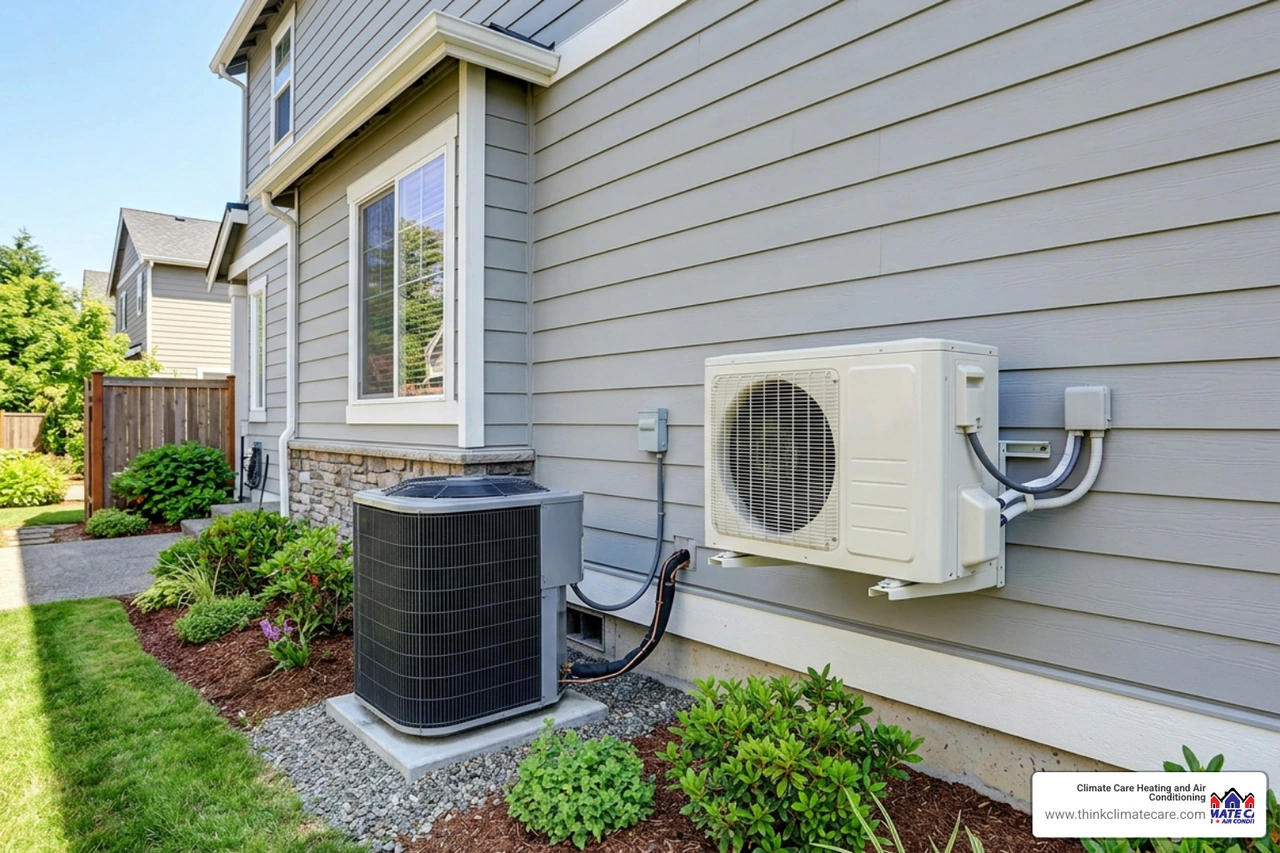
Is a Mini Split or Central AC Right for Your Home? Here's the Quick Answer
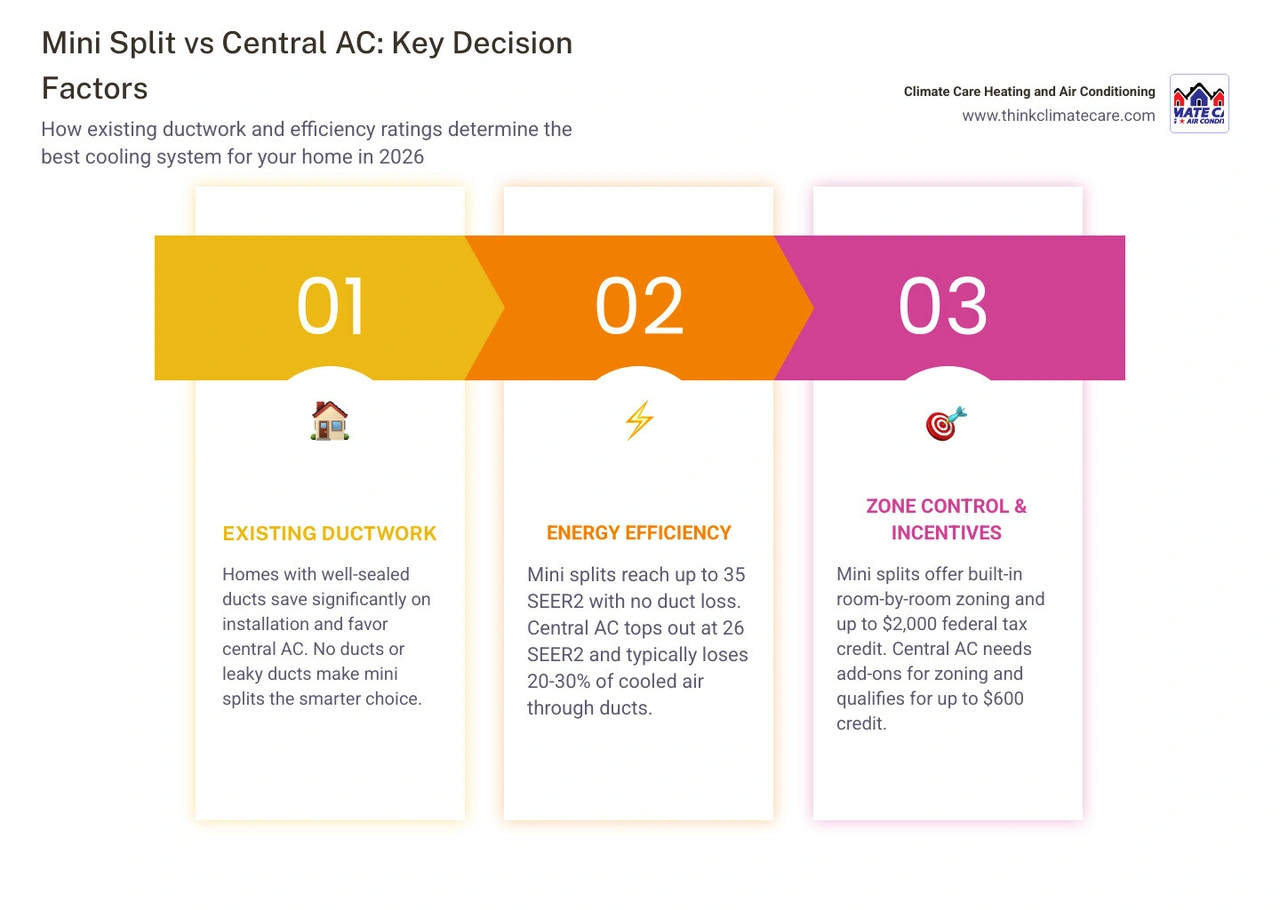
When it comes to the mini split vs central AC cost comparison, the single biggest factor that shapes your decision is whether your home already has ductwork in good condition. Here is a quick breakdown to help you get your bearings before diving deeper:
Quick Comparison: Mini Split vs Central AC
• Best for homes with existing ducts — Mini Split: No — Central AC: Yes
• Best for homes without ducts — Mini Split: Yes — Central AC: No
• Energy efficiency (SEER2) — Mini Split: Up to 35 — Central AC: Up to 26
• Zone control — Mini Split: Built-in, room-by-room — Central AC: Requires add-ons
• Duct energy loss — Mini Split: None — Central AC: 20-30% typical
• Federal tax credit (2026) — Mini Split: Up to $2,000 — Central AC: Up to $600
• Typical lifespan — Mini Split: 15-20+ years — Central AC: 15-20 years
• Works as heater too — Mini Split: Yes (heat pump) — Central AC: No (cooling only)
Summers in the Central Valley are no joke. If you have ever watched your energy bill climb through July in Manteca, Stockton, or Sacramento while your upstairs bedroom still feels like an oven, you already know that your cooling system matters enormously. The question is not just which system feels cooler — it is which system makes financial sense for your specific home, right now, in 2026.
The answer is not the same for every homeowner. A home built in the 1960s with no existing ductwork faces a completely different set of tradeoffs than a newer build in South Stockton with a well-sealed duct system already in place. According to the U.S. Department of Energy and the EPA's Energy Star program, most homes lose 20 to 30 percent of their cooled air through duct leaks and poor insulation before it ever reaches a room — a silent efficiency drain that many homeowners never think about.
This guide breaks down the full picture for Central Valley homeowners: upfront installation realities, long-term operating costs, energy efficiency ratings, zone control, available incentives, and the honest pros and cons of each system. No fluff, no contractor bias — just the information you need to make a confident decision.
Similar topics to mini split vs central ac cost comparison:
• adding cooling without ductwork options compared
• central ac vs ductless mini split comparison
Mini Split vs Central AC Cost Comparison: How Existing Ductwork Changes Everything
When we evaluate the financial layout of upgrading your HVAC system, the presence and condition of air ducts are the absolute hinge point. If your home has existing ductwork that is structurally sound, clean, and properly sized, leveraging it for a traditional central system is often the most straightforward path. However, if your home is historic, was built with wall heaters, or has ducts that have deteriorated over decades of hot Central Valley summers, the math shifts dramatically.
Opting for a central AC in a home without existing ducts is not just a matter of buying the equipment. It requires cutting into plaster or drywall, sacrificing closet space for duct runs, and performing extensive structural retrofitting. This can easily double or triple the total installation complexity and upfront labor investment.
By contrast, ductless mini split systems bypass this invasive construction entirely. Instead of routing bulky metal or flexible ducts through your ceilings and walls, they rely on small refrigerant lines that require only a tiny three-inch hole to connect the outdoor compressor to indoor handlers. When deciding on the right approach, a complete Central AC vs Ductless Mini Split Comparison reveals that skipping the ductwork installation often yields a much faster, less disruptive, and highly cost-effective setup. For older homes or unique layouts, looking at Adding Cooling Without Ductwork Options Compared is the best way to understand how to keep your home comfortable without tearing down your walls.
What is the Main Difference Between a Mini Split and Central AC?
To understand how these systems impact your monthly utility bills, it helps to look at how they move air.
A traditional central AC system relies on forced-air technology. It uses a single, powerful indoor air handler (often paired with a furnace) to push cooled air through a vast network of hidden ducts. This air is distributed through vents located throughout your entire home, governed by one central thermostat.
A mini split system utilizes ductless technology. Instead of one central unit pushing air through the entire house, a mini split pairs a single outdoor compressor with individual, low-profile indoor air handlers mounted directly in the rooms you use most. These handlers sit on the wall or ceiling, cooling the air directly within that specific zone. This means you do not need ducts at all. If you are exploring this technology for a property in the state capital, our guide on Ductless AC Sacramento walks through how these compact systems handle our intense valley heatwaves without wasting energy on empty rooms.
A Deep Dive into the Mini Split vs Central AC Cost Comparison for Installation
The upfront installation process differs significantly between these two systems. For a central AC, the installation labor is concentrated on setting up the central condenser, the evaporator coil, and ensuring the ductwork is sealed and balanced. If your home already has functional ducts, this is a relatively quick process that can be completed in just a day or two.
For a mini split system, the complexity depends on your "zone count"—how many indoor air handlers you need to cover your living spaces. While a single-zone system for a home office or sunroom is incredibly quick to set up, a multi-zone system requires running refrigerant lines, electrical connections, and condensate drain lines to each individual head.
Additionally, we must always evaluate your electrical panel capacity. Because mini splits run on highly efficient inverter technology, their electrical draw is remarkably low, but multi-zone installations may still require dedicated breakers.
Here is a look at how the installation, lifespan, and maintenance factors stack up:
• Installation Complexity — Mini Split System: Low to moderate (no major drywall cutting needed) — Central AC System: High if ductwork must be added or replaced
• Average Installation Time — Mini Split System: 1 to 3 days (depending on zone count) — Central AC System: 1 to 2 days (with existing ducts); 4 to 7 days (with new ducts)
• System Lifespan — Mini Split System: 15 to 20+ years — Central AC System: 15 to 20 years (compressors often wear faster)
• Regular Maintenance — Mini Split System: Monthly filter washing; annual professional coil cleaning — Central AC System: Quarterly filter changes; annual duct inspections & coil cleaning
• Zone Customization — Mini Split System: Built-in standard (independent room control) — Central AC System: Requires expensive motorized dampers and bypass ducts
Whether you choose a multi-zone ductless layout or a traditional system, securing a professional installation is key to ensuring long-term system health. If you are ready to upgrade, you can learn more about our specialized Mini Split Installation Sacramento CA services or explore our traditional AC Installation Sacramento CA options to see which best matches your property's existing layout.
Which System is More Energy Efficient and Offers Better Zone Control?
When comparing monthly operating costs, energy efficiency is where ductless technology shines. Modern mini splits can achieve SEER2 (Seasonal Energy Efficiency Ratio 2) ratings up to 35. High-end central air systems, even with advanced variable-speed compressors, typically top out around 26 SEER2.
The secret to this efficiency gap lies in two factors: variable-speed inverter technology and the elimination of duct energy loss. Traditional central systems often operate on an "on/off" cycle, drawing maximum power every time they start up. Mini split inverters act more like a dimmer switch, continuously adjusting their speed to maintain a steady temperature using only a fraction of the wattage.
Additionally, because there are no ducts, mini splits suffer zero duct energy loss. You do not have to worry about cooled air leaking into a scorching-hot attic. This direct-delivery method, combined with room-by-room temperature customization, allows you to turn off cooling in unoccupied guest rooms while keeping your active living spaces perfectly chilled.
For homeowners in the southern part of the valley, we offer tailored solutions to maximize these savings. Check out our dedicated Mini Split Installation Modesto CA services for room-by-room zoning, or look into our high-efficiency AC Installation Modesto CA options if you want to refresh your existing whole-home central system.
When is a Mini Split the Better Choice for Your Home?
While central air remains a reliable choice for modern homes with existing, well-insulated ductwork, a mini split is often the superior choice in several common scenarios:
• Home Additions & Converted Spaces: If you are building a new mother-in-law unit, converting a garage into a home office, or finishing an attic, extending your existing central ductwork can put a strain on your current system. A single-zone mini split provides independent comfort without overloading your main unit.
• Historic or Older Homes: Homes built without ductwork are perfect candidates for ductless systems, preserving original plaster walls, beautiful ceilings, and architectural charm.
• Nuisance Rooms: If you have a south-facing master bedroom or a sunroom that never seems to stay cool, a mini split can resolve localized hot spots without forcing you to lower the thermostat for the entire house.
If you are dealing with uneven temperatures in San Joaquin County, we can help you find the right fit. Learn more about our Mini Split Installation Stockton CA for targeted, localized comfort, or explore our traditional AC Installation Stockton CA services to restore balanced cooling across your entire property.
Do Mini Splits Qualify for Rebates or Tax Credits in 2026?
Yes! Because mini splits are designed as heat pumps—providing both ultra-efficient cooling in the summer and highly efficient heating in the winter—they qualify for substantial financial incentives that standard central air conditioners do not.
Under the federal Energy Efficient Home Improvement Credit (Section 25C), homeowners can claim a tax credit of up to 30% of the project cost, capped at $2,000 per year, for qualifying high-efficiency heat pumps and ductless systems. Standard cooling-only central AC units are typically capped at a much lower $600 credit.
When you factor in these federal tax credits along with local utility rebates for meeting strict energy efficiency standards, the upfront cost premium of a high-performance mini split often pays for itself in just 3 to 5 years. If you are located in the Tri-Valley area, we can guide you through the process of claiming these incentives with our Mini Split Installation Tracy CA services, or help you install a qualifying central system with our professional AC Installation Tracy CA options.
Weighing the Pros and Cons: A Mini Split vs Central AC Cost Comparison
Every home has its own unique layout, and both systems come with distinct advantages and tradeoffs. Here is a balanced look at the pros and cons of each option:
Ductless Mini Splits
• Pros: Incredible energy savings (up to 35 SEER2); built-in zoning for room-by-room control; whisper-quiet indoor operation; dual heating and cooling capabilities; no duct maintenance or energy leaks.
• Cons: Higher upfront cost for whole-home multi-zone setups; visible wall-mounted indoor units; requires regular, hands-on filter cleaning every few weeks.
Central Air Conditioning
• Pros: Lower initial setup costs if quality ductwork is already in place; virtually invisible aesthetics with air vents flush to the wall or ceiling; superior whole-home air filtration and integration with indoor air quality accessories.
• Cons: Higher monthly utility bills due to typical 20-30% duct energy losses; no independent zone control without expensive motorized upgrades; shorter overall system lifespan.
No matter which way you lean, we are here to ensure your system is perfectly sized and professionally calibrated. Homeowners in our home base can explore our Mini Split Installation Manteca CA for modern, zoned ductless comfort, or check out our premier AC Installation Manteca CA options to refresh their home's central cooling system.
Conclusion: Making the Right Choice for Your Central Valley Home
The ultimate winner of the mini split vs central AC cost comparison depends entirely on your home's unique structure, your family's comfort goals, and how long you plan to stay in your home. If your home has a reliable, clean set of ducts, upgrading to a modern, high-efficiency central system is a fantastic, cost-effective choice. But if you want to eliminate duct energy waste, gain absolute control over the temperature of every room, and maximize your monthly energy savings, going ductless is an investment that pays dividends for years to come.
At Climate Care Heating and Air Conditioning, we believe in holistic HVAC care. We focus on maximizing your system's performance, lowering your operating costs, and meeting the highest environmental standards. Whether you are in Manteca, Modesto, Stockton, or Sacramento, our team of friendly, licensed technicians is here to help you design the perfect cooling solution. Plus, with our comprehensive membership plan, you can enjoy priority service, regular maintenance tune-ups, and significant savings to keep your system running smoothly through every summer heatwave.
Ready to find the perfect fit for your home? Explore our Climate Care Ductless Services today or contact us to schedule a personalized, in-home consultation!