Reading Your SEER Rating Chart: Translating Efficiency Numbers into PG&E Bill Savings
Reading Your SEER Rating Chart: Translating Efficiency Numbers into PG&E Bill Savings
Deciphering SEER Ratings During the Late-Summer Cooling Crunch
Your air conditioner is running nonstop, but the house still feels warm, leaving you staring at equipment quotes and trying to make sense of reading your SEER rating chart: translating efficiency numbers into PG&E bill savings. That strange, metallic noise from your older compressor isn't going away on its own. As the August late-summer cooling load reaches its peak and the back-to-school transition begins, the pressure to make a smart, long-lasting replacement decision mounts. At Climate Care Heating & Air Conditioning, our team fields countless calls every late summer from Manteca homeowners who find comparing multiple HVAC quotes incredibly frustrating when their current system is failing—especially when the efficiency numbers seem like a foreign language.
When you need reliable guidance on an Air Conditioning system, exploring a professional air conditioning upgrade ensures you get localized, accurate efficiency data.
In our years of working in the Central Valley, we've seen firsthand how generic national efficiency charts often misrepresent true energy reductions because they ignore local utility structures entirely. A chart built for a mild climate simply does not apply to the intense heat we experience locally. True efficiency is measured in percentage drops and kilowatt-hour (kWh) reductions, not generic promises that fail to account for high-usage periods. By shifting your focus away from misleading national averages, you can adopt a localized approach to reading efficiency charts that actually applies to Central Valley cooling demands.
The Shift from SEER to SEER2: What Central Valley Homeowners Need to Know
Before you can accurately read an efficiency chart, you need to understand the current testing standards. In 2023, the HVAC industry underwent a massive regulatory shift, moving from the traditional SEER (Seasonal Energy Efficiency Ratio) to the updated SEER2 standard. This change wasn't just a rebranding; it introduced much stricter testing conditions, known as the DOE M1 standard, designed to better reflect real-world static pressure inside your ductwork.
Key regulatory changes affecting your upgrade:
• Stricter testing environments: SEER2 testing increases the external static pressure by up to five times compared to old SEER tests, mimicking the actual resistance of typical residential ductwork.
• California's Title 24 minimums: The state minimum efficiency requirement for split-system air conditioners is now 14.3 SEER2.
• Direct comparisons: A modern 14.3 SEER2 rating is roughly equivalent to the older 15 SEER rating, meaning the baseline for new equipment is already quite high.
Looking at an outdated SEER chart can lead to highly inaccurate expectations for your future energy consumption. If a contractor shows you a chart based on the old testing metrics, the estimated percentage drops will not align with how modern equipment actually performs in a Manteca / Central Valley home. Our installation team at Climate Care Heating & Air Conditioning always reminds customers that modern minimum standards already offer a significant baseline improvement over older 10 or 12 SEER units manufactured a decade ago. Even if you only upgrade to the state minimum, you are stepping into a much higher tier of operational efficiency.
How to Read a SEER2 Rating Chart (The Right Way)
To get real value out of an efficiency chart, we advise our customers to look at percentage efficiency gains instead of generic monetary columns. Utility rates fluctuate, but the mathematical percentage of energy required to move heat out of your home remains constant. Here is exactly how to read a SEER2 chart to understand your potential energy reduction.
1. Identify your current baseline: Determine the SEER rating of your existing system. Systems over a decade old are typically rated at 10 or 12 SEER.
2. Locate your target SEER2 rating: Find the modern ratings on the chart, such as the 14.3 SEER2 minimum, a high-efficiency 16 SEER2, or a premium 18 SEER2.
3. Track the percentage intersection: Follow the row of your baseline unit to the column of your target unit to find the exact percentage of cooling energy saved.
4. Apply the reduction to your usage: Understand that this percentage represents the drop in kilowatt-hours (kWh) your compressor will consume to achieve the same amount of cooling.
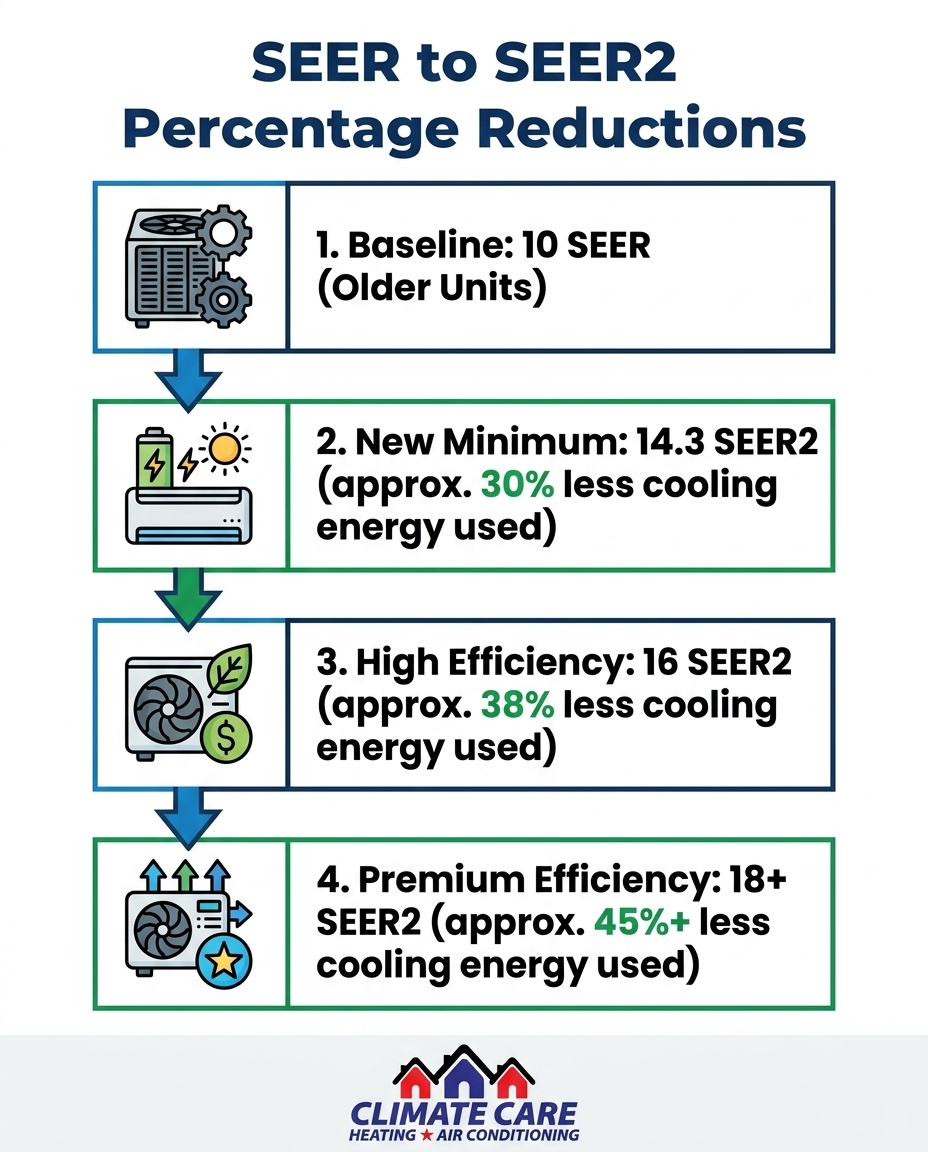
• 10 SEER — Target SEER2 Rating: 14.3 SEER2 (State Minimum) — Estimated Cooling Energy Reduction: ~30% Less Energy Used
• 10 SEER — Target SEER2 Rating: 16.0 SEER2 (High Efficiency) — Estimated Cooling Energy Reduction: ~38% Less Energy Used
• 10 SEER — Target SEER2 Rating: 18.0 SEER2 (Premium Efficiency) — Estimated Cooling Energy Reduction: ~45% Less Energy Used
• 12 SEER — Target SEER2 Rating: 16.0 SEER2 (High Efficiency) — Estimated Cooling Energy Reduction: ~25% Less Energy Used
Focusing on Percentages Over Promises
Percentage drops are mathematically reliable regardless of how utility rates change over the next decade. If you focus on the SEER2 efficiency percentages, you protect yourself from misleading sales pitches that promise specific monthly reductions. Furthermore, a pattern we see often is that a 10% efficiency gain compounds over the 15-year lifespan of the equipment. Every single time the thermostat calls for cooling, that percentage reduction applies to the total energy drawn by the compressor, resulting in massive long-term kilowatt-hour reductions.
SEER to SEER2 Percentage Reductions
Why Generic Efficiency Charts Fail in the Central Valley Climate
The problem with national data: Generic efficiency charts assume a standard 1,000-hour cooling season. This model is built for mild, temperate climates where the air conditioner only runs for a few hours in the late afternoon. Over years of servicing Manteca tract homes and historic properties alike, we know this vastly underestimates the reality of our region, rendering national averages practically useless for local homeowners trying to gauge actual equipment performance.
The cause of the discrepancy: With intense, prolonged late-summer heatwaves regularly hitting Manteca, sustained 90-100+ degree days force older AC units to run continuously from late morning well into the night. Central Valley homes face significantly higher cooling degree days (CDD) than coastal California. This means your air conditioner is logging thousands of operational hours, far exceeding the national baseline. As the August late-summer cooling load peaks during the back-to-school season, the sheer volume of hours your system spends running creates a massive accumulation of energy usage right at the end of the season.
The local solution: Because your total cooling hours are so high, a 10% efficiency gain yields a much larger absolute drop in kWh consumed than it would in a milder climate. When your system runs for 2,500 hours a season instead of 1,000, that 30% or 40% reduction in energy draw applies to a massive pool of usage. This is why investing in higher SEER2 percentages is far more impactful locally than generic charts imply. By focusing on how the equipment handles extreme, continuous runtimes, you can accurately gauge the true impact of an upgrade.
Translating Efficiency Percentages into PG&E Kilowatt-Hour Reductions
Understanding your utility provider's billing structure is the most critical step in evaluating an HVAC upgrade. PG&E residential rate plans typically utilize Time-of-Use (TOU) peak pricing, where electricity costs significantly more between 4 PM and 9 PM. Some plans also use tiered allowance structures, where exceeding a baseline energy threshold pushes your household into a higher, more expensive usage tier.
How older systems trigger higher tiers:
• Peak hour vulnerability: The hottest part of the day aligns perfectly with the 4 PM to 9 PM peak pricing window. An older, inefficient AC must run constantly during this exact timeframe just to keep up.
• Rapid tier escalation: Because older units draw maximum wattage every time they cycle on, they rapidly consume your baseline energy allowance, pushing you into higher tiers where the cost per kWh increases dramatically.
• Continuous cycling: Single-stage compressors blast at 100% capacity, consuming massive amounts of energy during the most expensive hours of the day.
At Climate Care Heating & Air Conditioning, our deep understanding of local PG&E utility rates helps homeowners make financially sound, localized HVAC upgrade decisions without relying on guesswork. When you apply a SEER2 efficiency percentage reduction to your home, you directly lower the total kWh consumed. More importantly, staying below baseline allowances or reducing usage during TOU peaks provides compounding benefits. A modern variable-speed system doesn't just use less energy overall; it runs at lower capacities during peak hours, actively helping you avoid those punishing upper tiers in a Manteca / Central Valley home.
Evaluating Your Current System's Baseline Performance
Reading a SEER chart accurately requires knowing exactly how inefficient your current system is right now. You cannot calculate your potential SEER2 efficiency percentages without a firm grasp of your starting point. A 15-year-old unit that was originally rated at 12 SEER is likely operating at an 8 or 9 SEER equivalent today due to coil degradation, motor wear, and general age.
When a Climate Care Heating & Air Conditioning technician performs a comprehensive professional inspection, we evaluate more than just the nameplate on the side of the condenser. Our technicians check your ductwork for leaks, measure the static pressure, and calculate the actual real-world output versus the unit's original rating. If your ductwork is drastically undersized or leaking conditioned air into the attic, even the highest SEER2 unit will underperform. Professional insights can uncover whether an upgrade or a targeted repair makes the most sense for your current situation.
What a baseline assessment checks:
• Refrigerant charge and coil health: Ensuring the system can effectively absorb and release heat.
• Airflow and static pressure: Verifying that the blower motor isn't fighting against restrictive ductwork.
• Electrical draw: Measuring exactly how many amps the aging compressor pulls during startup and operation.
Once you know your true baseline, you can accurately map your potential efficiency gains. Additionally, exploring available HVAC specials and rebates can make the transition to a higher efficiency unit more accessible. Generic federal tax credits or local utility incentive programs may apply to qualifying heat pump or AC installations, helping you offset the initial investment while securing long-term operational reductions (we always recommend verifying current programs and eligibility with your utility or a tax professional).
Choosing the Right SEER2 Rating for Your Home
The "best" SEER2 rating for your house isn't necessarily the highest number on the chart; it is the rating that perfectly balances your upfront investment with your long-term kWh reduction goals. If your home struggles with severe heat exposure, poor natural shading, or high cooling demands, aiming above the state minimum is usually a wise strategy.
Based on the end-of-season cooling demands we witness every year, our team highly encourages homeowners to look beyond the minimum requirements if their late-summer cooling loads are exceptionally high. For instance, comparing premium variable-speed systems—such as weighing a 19 SEER vs 21 SEER unit—can reveal incredible opportunities for maximum tier avoidance. Variable-speed units operate like a car's gas pedal, ramping up and down to match the exact cooling demand rather than blasting at full capacity. This precision drastically cuts down on the energy consumed during PG&E's peak TOU hours.
When reviewing your SEER2 efficiency percentages, consider how long you plan to stay in the home. The longer you remain, the more those compounding percentage drops work in your favor. Furthermore, utilizing flexible HVAC financing options can help align high-efficiency upgrades with your household goals, allowing you to install a superior system that actively suppresses your daily energy usage.
Make a Confident, Localized Efficiency Upgrade Decision
Understanding efficiency charts is entirely about percentages and kWh reductions, not generic national estimates. Local climate realities and deep utility knowledge are the true keys to evaluating an upgrade that handles the brutal August late-summer cooling load. Reach out to our team at Climate Care Heating & Air Conditioning to learn more about localized, high-efficiency options that fit your specific cooling needs and keep your home comfortable year-round.
Frequently Asked Questions
How do I read a SEER rating chart accurately?
To read a SEER chart accurately, focus on the percentage of energy saved rather than estimated monetary columns. First, identify the baseline SEER rating of your current older unit, then locate the target SEER2 rating of the new system. The intersection of these two numbers on a reliable chart will show you the exact percentage drop in cooling energy required to condition your home.
How does a higher SEER rating lower my PG&E energy usage?
A higher SEER rating means the air conditioner requires less electricity to produce the same amount of cooling. By drawing fewer kilowatt-hours (kWh) during operation, the system helps prevent your household from exceeding baseline energy allowances. This efficiency is especially critical for staying out of expensive upper usage tiers during high-demand summer months.
What is the difference between SEER and SEER2 in California?
SEER2 is the updated 2023 testing standard that utilizes stricter conditions to better reflect real-world ductwork resistance. In California, the Title 24 minimum requirement for split-system air conditioners is now 14.3 SEER2. This modern baseline is roughly equivalent to an older 15 SEER rating, ensuring that even entry-level new systems are highly efficient.
How do PG&E Time-of-Use rates affect my air conditioning costs?
Time-of-Use (TOU) rates charge significantly more for electricity consumed during peak hours, typically between 4 PM and 9 PM. Older, inefficient air conditioners run continuously at maximum capacity during these hot afternoon hours, rapidly accumulating high-cost kilowatt-hours. Upgrading to a high SEER2 variable-speed unit reduces the energy drawn during this critical window, actively suppressing your usage multiplier.
Is upgrading to the highest SEER2 rating always necessary for Central Valley homes?
Upgrading to the absolute highest SEER2 rating isn't strictly necessary for every home, but going above the minimum is highly recommended for our region. Homes with significant sun exposure or high daily cooling demands benefit immensely from the tier-avoidance capabilities of 16 to 18+ SEER2 systems. The right choice balances your initial investment with the total volume of cooling hours your specific home requires.
Had Climate Care inspect our HVAC before summer. Christopher Hayes was polite, knowledgeable, and efficient. Great service from the office team—highly recommend!
Corey W.
Alex Corona did a thorough furnace check-up today, showing before-and-after photos and answering all my questions. I’m happy with his work and highly recommend him. Great job—happy customer!
Ingrid P.
Alan C. serviced my furnace today and gave me a courtesy call before arriving. He was very professional, provided great service, and shared lots of pictures. Definitely a five-star experience—I’ll use them again!
Rolando L.
On 02/19/2025, Alan inspected my furnace and did a great job explaining everything. He was professional, hardworking, and focused on customer satisfaction. Highly recommend requesting him!