Does a High SEER Rating Matter for Heating or Just Air Conditioning?
That high SEER rating on your outdoor unit only measures summer cooling efficiency. Discover which HVAC ratings actually impact your winter heating performance.
Late summer in the Central Valley brings a distinct shift. Here at Climate Care Heating & Air Conditioning, we know that making reprogramming your thermostat for back-to-school schedules without spiking your energy bill becomes a top priority for local homeowners. The relentless heat remains, but your daily routine abruptly changes. For the past few months, your home has likely been constantly occupied, with the cooling system running steadily to keep everyone comfortable. Now, the late August back-to-school transition means the house suddenly sits completely empty during the hottest parts of the day.
To ensure your home remains comfortable without wasting energy, reviewing your air conditioning systems and their daily schedules is a critical first step.
The immediate temptation for many homeowners is to walk past the thermostat on their way out the door and turn the cooling system completely off. The logic seems sound on the surface: if no one is home to enjoy the cool air, why pay to run the air conditioner? However, a pattern we see often is that this common reaction fundamentally misunderstands how residential cooling dynamics actually work.
You face a crucial decision point: finding the optimal daytime setback temperature that successfully balances daily energy efficiency with afternoon comfort. Allowing a house to bake in the afternoon sun creates a massive thermal load that your equipment will have to fight against later. Understanding your home's unique cooling dynamics prevents the system from working twice as hard when you finally return. Instead of relying on a simple "on/off" approach, adapting to this seasonal shift requires a targeted strategy designed specifically for the way a house behaves when it sits empty.
The "recovery penalty" is the massive surge of energy your air conditioning system consumes when it is forced to cool down a blistering hot house from scratch, rather than simply maintaining a moderate baseline temperature throughout the day. In milder climates, turning the system off entirely might yield minor energy savings. However, in our years of servicing Manteca homes, our team has seen firsthand that doing this in our region is a costly mistake.
The Problem: During the late August back-to-school transition, the intense, dry heat of the Central Valley routinely pushes afternoon outdoor temperatures well past 95 degrees. Generic national energy advice often suggests shutting systems down when you leave. However, that advice fails to account for regional climate realities. When a Central Valley home is left completely unconditioned for eight hours, indoor temperatures soar, turning your living space into an oven.
The Cause: When you finally turn the system back on, it must operate continuously at maximum capacity for hours just to make the house livable again. A cooling system consumes significantly more energy trying to overcome a 15-degree temperature deficit than it does cycling on and off periodically to maintain a moderate setback. This extended, uninterrupted run time places immense strain on your compressor, blower motor, and electrical components, accelerating wear and tear.
The Solution: Implementing a strategic setback temperature rather than a full shutdown eliminates the recovery penalty. By keeping the indoor environment within a reasonable range, the system only needs to bridge a small temperature gap when you return. To ensure your equipment is prepared for this daily cycle, our technicians highly recommend scheduling a Manteca AC tune-up before the late summer heatwave ends.
• Complete Shutdown — System Behavior: Off all day; runs continuously for 3+ hours upon return. — Energy Impact: Massive energy spike during the most expensive billing hours.
• Moderate Setback — System Behavior: Cycles occasionally; requires only 30-45 minutes to reach comfort. — Energy Impact: Steady, predictable usage that avoids peak-hour surging.
To fully grasp why the recovery penalty is so severe, you must understand the concept of thermal mass. Thermal mass refers to the ability of the solid materials inside your home to absorb, store, and eventually release heat. Your house is not just a pocket of air; it is a dense collection of physical objects.
When an unconditioned house sits empty in the Manteca / San Joaquin Valley heat, the rising indoor air temperature is only half the battle. Radiant heat aggressively penetrates your windows and roof, soaking directly into your solid furnishings. Your heavy leather couches, thick drywall, hardwood flooring, and kitchen cabinetry all act like massive thermal sponges, absorbing heat for hours on end.
Here is why this matters: simply cooling the air inside a room is relatively fast, but extracting deeply trapped heat from solid objects takes hours. If you allow your home's thermal mass to heat up to 88 degrees while you are at work and the kids are at school, turning the air conditioner on at 3:30 PM will only cool the air temporarily.
As soon as the cold air hits those 88-degree walls and floors, the solid objects immediately begin radiating their stored heat back into the room. Your air conditioning system is forced into an extended run cycle, battling not just the hot air, but the continuous heat radiating from the very structure of your home. Maintaining a moderate setback temperature prevents your home's thermal mass from ever getting that hot in the first place, drastically reducing the total cooling load required later in the afternoon.
The back-to-school season introduces a frustrating timing conflict for homeowners. Just as the kids step off the bus and walk through the front door, the daytime outdoor heat is hitting its absolute peak. You want the house to be comfortable the moment they arrive, but this timing sets up a perfect storm for your utility bills.
This 3:30 PM arrival aligns almost perfectly with the start of Time-of-Use (TOU) peak utility rates. Most local utility providers transition to their most expensive billing tiers between 4:00 PM and 9:00 PM. If your house has been sitting completely unconditioned all day, forcing your cooling system to recover from 90-plus degrees during this exact window guarantees maximum financial impact.
Your system will be running at full capacity, drawing maximum wattage, precisely when electricity is at its absolute highest premium. As a local HVAC company serving the Manteca community, the Climate Care Heating & Air Conditioning team understands the reality of local peak energy rates (like PG&E) and the daily chaos of family back-to-school schedules. We've spoken with countless parents, and we know that telling a family to simply suffer through the heat until 9:00 PM is not a realistic solution.
The answer lies in a gradual cooling approach. By utilizing strategic thermostat pre-cooling, you can force the system to do its hardest work just before the peak rate window opens. The house reaches a comfortable temperature using cheaper, off-peak electricity, allowing the system to simply coast and maintain that comfort once the expensive afternoon rates kick in.
The Department of Energy provides a baseline recommendation for energy-saving setbacks, advising homeowners to adjust their thermostats by 7 to 10 degrees from their normal setting for the eight hours they are away. However, in our specific climate, our team typically sees that setting the thermostat too high invites the thermal mass issues we discussed earlier.
We recommend a targeted 78-82 degree setback range as the sweet spot for the late August back-to-school transition. This specific range is warm enough to significantly reduce how often the compressor cycles on during the empty morning hours, yet cool enough to prevent your drywall and furniture from absorbing excess radiant heat.
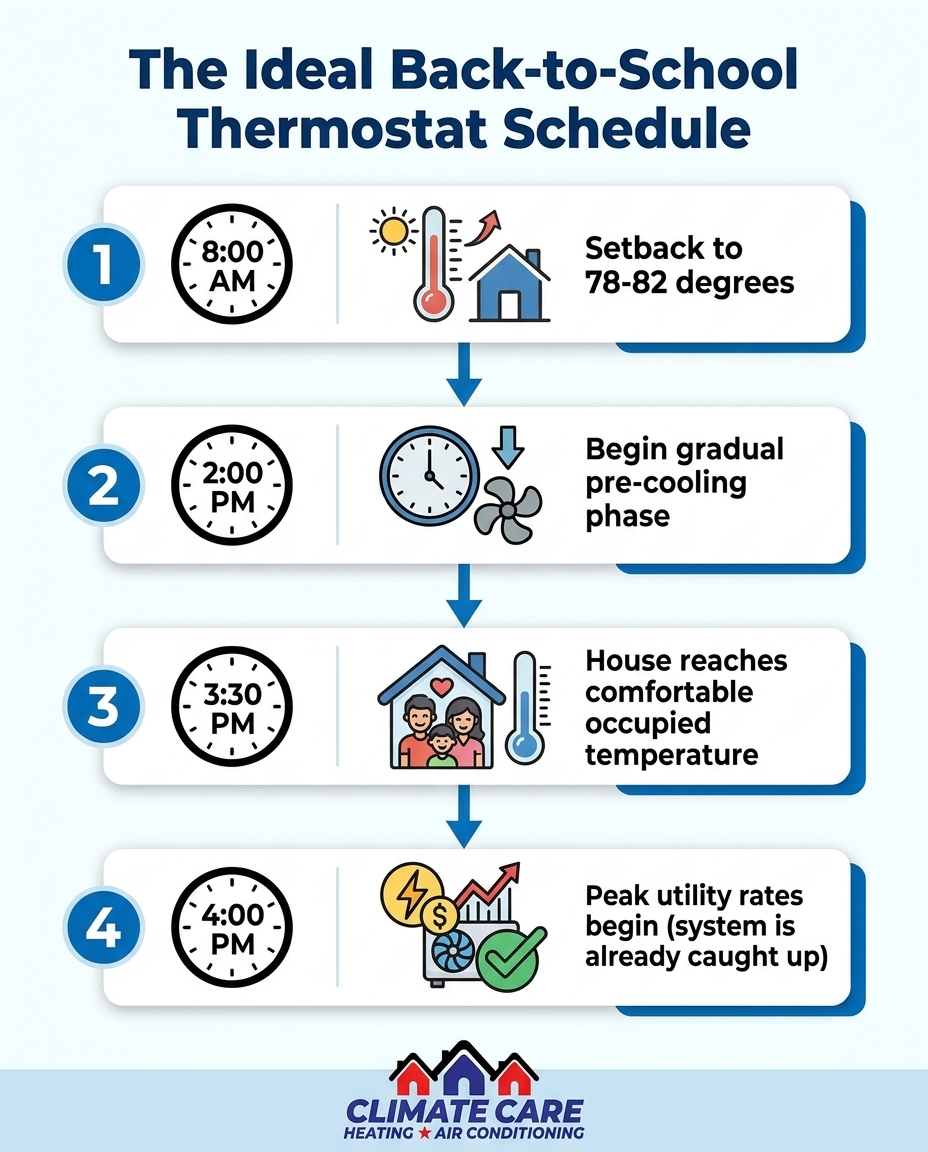
1. 8:00 AM (Departure): Program your thermostat to shift to the upper end of the 78-82 degree setback range just as the last person leaves the house. The system will largely sit idle throughout the morning.
2. 2:00 PM (Pre-cool): Program the thermostat to begin a gradual cooling phase. Dropping the temperature slowly over an hour allows the system to extract heat efficiently before peak utility rates take effect.
3. 3:30 PM (Arrival): The house reaches your preferred occupied temperature (e.g., 74 degrees) right as the family returns home.
4. 4:00 PM (Peak Rates Begin): Because the heavy lifting is already done, the system only needs to run in short, efficient bursts to maintain comfort during the most expensive billing hours of the day.
Modern programmable and smart thermostats make automating this exact sequence effortless, ensuring you never have to remember to adjust the dial manually during the morning rush.
A smart thermostat schedule is highly effective on its own, but we always advise our customers that they can drastically reduce the overall cooling load on their equipment by implementing a few passive cooling strategies. These simple adjustments support your setback temperature and keep the indoor environment more stable during the late August back-to-school transition.
Closing blinds and heavy curtains is one of the most impactful habits you can build. Before rushing out the door for the school drop-off, ensure that all window coverings on the south and west-facing sides of your home are tightly closed. These windows receive the most direct, intense solar radiation during the afternoon. Blocking this radiant heat at the glass prevents it from ever reaching your thermal mass.
Managing ceiling fans is another critical step. Ceiling fans are excellent for circulating air, creating a wind-chill effect that makes a room feel cooler to human skin. However, fans cool people, not rooms. Leaving ceiling fans running in an empty house does absolutely nothing to lower the air temperature; it only wastes electricity. Ensure all fans are switched off when the rooms are unoccupied.
Minimizing indoor heat generation during the afternoon helps tremendously. Avoid running the dishwasher, the clothes dryer, or the oven during the hottest parts of the day. These appliances generate significant internal heat that your air conditioner must then work to remove. Finally, check your home's weatherstripping around doors and windows. Ensuring these seals are intact keeps the expensive, conditioned air inside and blocks the hot, dry outdoor air from infiltrating your living spaces.
A strategic 78-82 degree setback schedule only works if your cooling equipment is operating at peak efficiency. When 2:00 PM rolls around and the thermostat calls for the pre-cooling phase to begin, your system needs to execute a reliable, powerful afternoon sprint. When our Climate Care Heating & Air Conditioning technicians get called out for late-summer breakdowns, it's often because compromised equipment failed to bridge the temperature gap before the peak utility rates hit.
Dirty air filters or neglected evaporator coils severely handicap the system's ability to recover temperature. A clogged filter restricts necessary airflow, choking the blower motor and drastically extending the time it takes to cool the house. Similarly, a layer of dust on the indoor coil acts as an insulator, preventing the refrigerant from effectively absorbing heat out of your indoor air.
This is why professional upkeep is vital before the late summer heatwave ends in the Manteca / San Joaquin Valley area. We strongly suggest enrolling in a routine HVAC maintenance plan to ensure a licensed technician regularly inspects, cleans, and calibrates your equipment to handle these daily temperature swings.
Watch for warning signs that your system is struggling to recover even with a moderate setback. If the thermostat clicks on at 2:00 PM but the house is still uncomfortably warm by 4:00 PM, or if the air coming from the vents feels weak or lukewarm, your equipment is underperforming. Addressing these symptoms early prevents minor inefficiencies from turning into complete system breakdowns during the hottest weeks of the year.
What temperature should I leave my empty house in summer?
The most effective daytime setting for an empty house is a moderate setback between 78 and 82 degrees. This range is warm enough to reduce daily energy consumption but cool enough to prevent your furniture and walls from absorbing excessive radiant heat.
Does turning the AC off during the day save money?
In regions with extreme afternoon heat, turning the system completely off rarely saves money. The massive energy spike required to cool a blistering hot house from scratch during peak afternoon utility rates usually negates any minor savings gained during the morning.
How long does it take an AC to cool a hot house?
A properly sized, well-maintained air conditioner typically lowers the indoor temperature by about one degree every 20 to 30 minutes. If your house has heated up to 85 degrees, it could take over three hours of continuous running to return to a comfortable 74 degrees.
What is the ideal thermostat setting for peak utility hours?
During peak utility hours (usually 4 PM to 9 PM), the ideal strategy is to have your home already pre-cooled so you can set the thermostat to 78 degrees or higher. This allows the system to coast and cycle infrequently while electricity costs are at their highest.
Should I use a temporary hold setting or a permanent schedule for school days?
A permanent, automated schedule is far more reliable than a temporary hold for daily routines. Programming a specific back-to-school schedule into your smart thermostat ensures the home begins pre-cooling automatically every afternoon, even if you are running late.
Navigating the late summer heat doesn't mean you have to choose between a comfortable afternoon return and a massive utility bill. By implementing a strategic daytime setback, you can enjoy clear, actionable temperature guidelines that prevent an uncomfortably hot house at 3:30 PM while avoiding overworking your AC unit. Reach out today to ensure your cooling system is fully optimized for the season ahead.
Our customers love our service and support.

Had Climate Care inspect our HVAC before summer. Christopher Hayes was polite, knowledgeable, and efficient. Great service from the office team—highly recommend!
Alex Corona did a thorough furnace check-up today, showing before-and-after photos and answering all my questions. I’m happy with his work and highly recommend him. Great job—happy customer!
Alan C. serviced my furnace today and gave me a courtesy call before arriving. He was very professional, provided great service, and shared lots of pictures. Definitely a five-star experience—I’ll use them again!
On 02/19/2025, Alan inspected my furnace and did a great job explaining everything. He was professional, hardworking, and focused on customer satisfaction. Highly recommend requesting him!