What Are Federal Tax Credits for Heat Pump Upgrades?
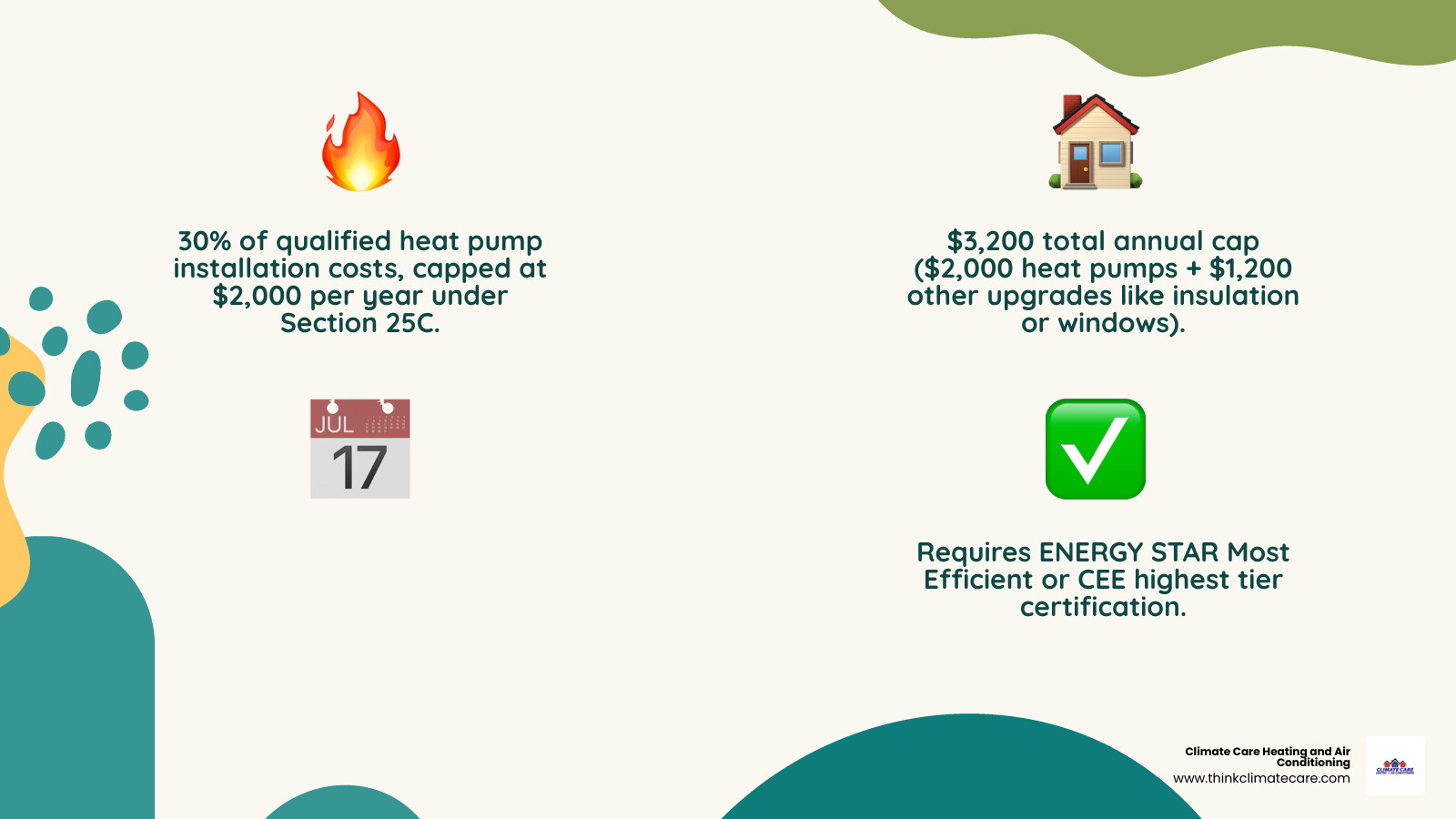
Federal tax credits for heat pump upgrades let qualifying homeowners claim 30% of their installation costs back on their federal taxes — up to $2,000 per year for air-source heat pumps under Section 25C of the tax code.
Here's a quick summary of what you need to know:
• Credit amount: 30% of qualified installation costs, capped at $2,000 for heat pumps
• Maximum annual credit (all improvements): $3,200 total ($2,000 for heat pumps + $1,200 for other upgrades like insulation, windows, and doors)
• Eligibility deadline: Installations completed by December 31, 2025 qualify — the credit is claimed on your 2025 tax return filed in 2026
• Who qualifies: Homeowners with an existing primary residence in the U.S. who owe federal income taxes
• What qualifies: Heat pumps that meet ENERGY STAR Most Efficient certification or the CEE highest efficiency tier
• How to claim: File IRS Form 5695 with your federal tax return
• Is it refundable? No — it can only reduce your tax bill to zero, with no carryforward
If you installed a qualifying heat pump at your Manteca home in 2025, you may still be able to put real money back in your pocket when you file your taxes this year. The key is knowing what qualifies, what paperwork you need, and how to stack these savings with other available incentives.
Navigating federal tax credits for heat pump upgrades in 2026
As we move through April 2026, many of our neighbors in the Central Valley—from Stockton and Modesto down to Turlock—are preparing their 2025 tax filings. If you made the switch to a high-efficiency heat pump last year, you are likely sitting on a significant tax break. While the primary Section 25C credits for air-source heat pumps were centered on installations completed by December 31, 2025, understanding how these interface with your current tax return is vital for maximizing your return on investment.
The federal government provides two main "flavors" of tax credits for those looking to green their homes: Section 25C and Section 25D.
Section 25C (Energy Efficient Home Improvement Credit) covers air-source heat pumps and heat pump water heaters. It offers a 30% credit on the total project cost, including labor, but it is capped at $2,000 per year. This is part of a larger $3,200 aggregate annual cap. For instance, you could claim $2,000 for your heat pump and another $1,200 for weatherization like attic insulation or energy-efficient windows.
Section 25D (Residential Clean Energy Credit) is a different beast entirely. This applies to geothermal heat pumps. Unlike the air-source credit, this one is uncapped—meaning you get a full 30% of the project cost regardless of how high that number goes. Furthermore, while the 25C credit is generally for primary residences, the 25D credit can often be applied to secondary homes as well.
It is important to remember that these are non-refundable tax credits. This means the credit can reduce the amount of tax you owe to zero, but the IRS won't send you a check for any "leftover" credit amount. For the 25C credit, there is no carryforward; if you can't use it all in the tax year the equipment was installed, the remaining balance expires.
• Credit Percentage — Section 25C (Air-Source): 30% — Section 25D (Geothermal): 30%
• Annual Limit — Section 25C (Air-Source): $2,000 — Section 25D (Geothermal): Uncapped
• Expiration — Section 25C (Air-Source): Dec 31, 2025 (for current filing) — Section 25D (Geothermal): Available through 2032
• Home Type — Section 25C (Air-Source): Existing Primary Residence — Section 25D (Geothermal): Primary & Secondary Homes
• Carryforward — Section 25C (Air-Source): No — Section 25D (Geothermal): Yes
Eligibility Requirements for federal tax credits for heat pump upgrades
Not every unit you see at a big-box store qualifies for these incentives. To ensure you can claim federal tax credits for heat pump upgrades, the equipment must meet rigorous efficiency standards. The IRS relies on standards set by the Consortium for Energy Efficiency (CEE) and ENERGY STAR.
For installations completed in 2025, the equipment generally had to meet the "ENERGY STAR Most Efficient" certification or the highest non-advanced tier established by the CEE. In practical terms, this means looking at several specific ratings:
• SEER2 (Seasonal Energy Efficiency Ratio 2): For split ducted systems, a SEER2 of 15.2 or higher is typically required.
• EER2 (Energy Efficiency Ratio 2): This measures efficiency at peak cooling times.
• HSPF2 (Heating Seasonal Performance Factor 2): This is critical for our chilly California winter nights in places like Lodi or Oakdale.
• Regional Standards: The requirements can vary slightly between the Northern and Southern U.S. tiers. In our region (Southern Tier), ductless mini-splits often require a SEER2 > 16, EER2 > 12, and HSPF2 > 9.
Whether you installed a ducted central heat pump, a packaged unit, or a ductless mini-split, the unit must have been new. Used equipment does not qualify for the credit. If you are unsure if your specific model qualifies, How Climate Care Can Help Cut Your Tax Bill provides further insights into aligning your home upgrades with these technical requirements.
How to Claim federal tax credits for heat pump upgrades on Your 2025 Return
Claiming your credit isn't automatic; it requires specific documentation and the correct IRS forms. As you file your taxes this month for the 2025 tax year, you will need to use IRS Form 5695 (Residential Energy Credits).
One of the most significant changes for the 2025 tax year is the requirement for a Qualified Manufacturer Identification Number (QMID) or a Product Identification Number (PIN). Starting in 2025, the IRS requires taxpayers to report this four-digit code provided by the manufacturer to verify that the product actually meets the energy-efficiency standards claimed.
To successfully claim the credit, follow these steps:
1. Gather Receipts: Ensure you have the itemized invoice showing the cost of the heat pump and the labor for installation.
2. Obtain the Manufacturer’s Certification: This is a signed statement from the manufacturer certifying that the product qualifies for the tax credit.
3. Find the QMID: Check your installation paperwork or the manufacturer’s website for the specific identification number required for 2025 filings.
4. Complete Form 5695: Enter your qualified expenses in Part II of the form (specifically looking at lines related to electric heat pumps).
5. Transfer to Form 1040: The final credit amount from Form 5695 will be applied to your standard tax return to reduce your liability.
Keep these records for at least three years. If the IRS ever asks for proof of your upgrade, having that manufacturer’s certification and your itemized Climate Care invoice will make the process stress-free.
Comparing Air-Source and Geothermal Tax Incentives
While air-source heat pumps are the most common choice for homeowners in the Central Valley, geothermal (ground-source) heat pumps offer a different path to savings. Because geothermal systems are incredibly efficient and help reduce peak demand on the electrical grid, the federal government treats them more like solar panels than traditional HVAC equipment.
Under Section 25D, geothermal installations qualify for a 30% tax credit that is uncapped. If a complex geothermal installation costs a significant amount, you still get 30% of that total back as a credit. Unlike the air-source credit (25C), which is currently in a transition/expiration phase for many homeowners, the geothermal credit has been extended through 2032.
Another massive advantage of geothermal is the carryforward provision. If your tax liability is lower than the credit amount, you can carry the remaining credit over to future tax years. This makes geothermal an attractive long-term investment for those who may not have a massive tax bill in a single year but want to eliminate fossil fuel use in their homes.
Combining Federal Credits with California State Rebates
One of the best ways to "hack" your HVAC costs is to stack federal credits with local and state incentives. In California, we have access to some of the most robust programs in the country, though they often come with specific income requirements.
The High-Efficiency Electric Home Rebate Act (HEEHRA) and the broader HEEHRP programs provide point-of-sale rebates for low-to-moderate-income households. These can be as high as $8,000 for a heat pump installation.
Here is how the math works when combining incentives:
• Step 1: Calculate the total cost of installation.
• Step 2: Subtract any state or utility rebates received at the time of purchase. The IRS requires you to calculate your 30% tax credit based on your out-of-pocket expenses after rebates are applied.
• Step 3: Apply the 30% federal tax credit to that remaining balance (up to the $2,000 cap for air-source units).
For our customers in Manteca, Modesto, and Tracy, we often see utility-specific rebates from providers like PG&E or local irrigation districts. These can range from $500 to $1,500. By combining a utility rebate, a state-administered fund, and the federal tax credit, the net cost of a premium, high-efficiency system can often drop to the price of a standard, less efficient unit.
Conclusion: Planning Your Next Energy-Efficient Upgrade
Upgrading your home’s heating and cooling system is about more than just staying comfortable during a Central Valley heatwave; it’s a strategic financial move. By taking advantage of federal tax credits for heat pump upgrades, you are investing in a system that lowers your monthly utility bills while significantly reducing your tax liability.
At Climate Care Heating and Air Conditioning, we pride ourselves on a holistic approach to HVAC. We don't just swap out boxes; we look at your home's performance, cost-efficiency, and environmental impact. Whether you’re in Sacramento, Stockton, or anywhere in between, our team is here to help you navigate the technical requirements of these credits to ensure you get every dollar you deserve.
If you missed the 2025 window or are looking to plan your next set of upgrades—like a heat pump water heater or electrical panel improvements—now is the time to start. Our membership plans offer priority service and additional savings to keep your new high-efficiency system running at peak performance for years to come.
Get Expert Help With Heat Pump Tax Credits