What Homeowners in Manteca Need to Know About Heat Pumps
How does a heat pump work is one of the most common questions homeowners ask when exploring smarter ways to heat and cool their homes — and the answer is surprisingly straightforward.
Quick Answer: How a Heat Pump Works
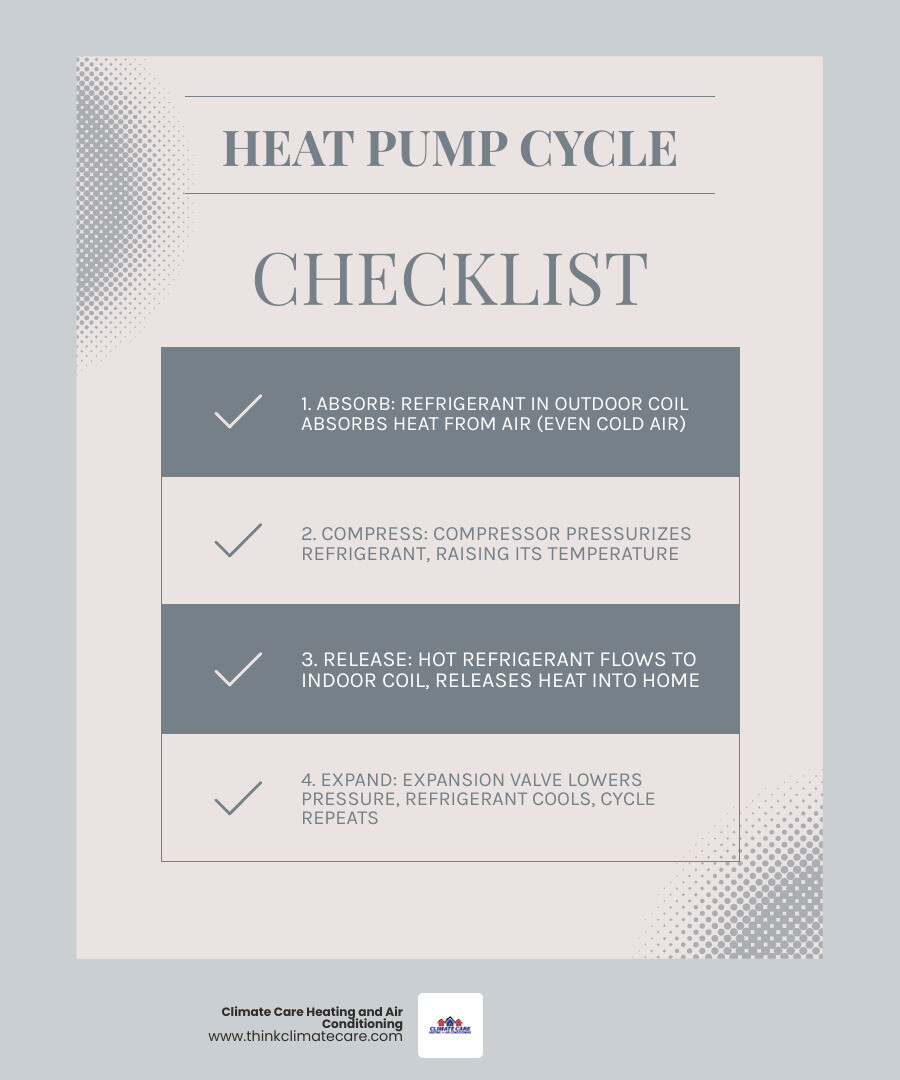
1. Absorb — A refrigerant fluid circulates through an outdoor coil and absorbs heat from the surrounding air (even cold air contains usable heat energy)
2. Compress — The compressor pressurizes the refrigerant, raising its temperature significantly
3. Release — The hot refrigerant moves to an indoor coil and releases that heat into your home
4. Expand — The refrigerant passes through an expansion valve, cools back down, and the cycle repeats
In summer, the process simply runs in reverse — pulling heat out of your home and releasing it outside, just like an air conditioner.
The key difference between a heat pump and a traditional furnace or electric heater? A heat pump never generates heat. It moves it. That distinction matters a lot, because moving heat takes far less energy than creating it from scratch. In fact, a typical heat pump can deliver around 4 units of heating or cooling for every 1 unit of electricity it consumes — making it 3 to 5 times more efficient than a gas boiler or electric resistance heater.
For homeowners in Manteca dealing with triple-digit Central Valley summers and chilly winters, that efficiency can translate directly into lower utility bills and more consistent comfort year-round.
How Does a Heat Pump Work?
To understand the "magic" of a heat pump, we have to look at the refrigeration cycle. This is the same technology that keeps your milk cold in the fridge and your bedroom chilly in July. It relies on the laws of thermodynamics—specifically, the fact that heat naturally flows from a warmer place to a cooler one.
A heat pump uses a special fluid called refrigerant. This isn't just any liquid; it has an incredibly low boiling point. While water boils at 212°F, some refrigerants boil at -50°F. This means they can turn into a gas even when it feels freezing outside to us.
The Four Main Components
The cycle depends on four heavy lifters working in a closed loop:
1. The Evaporator (The Heat Collector): In heating mode, this is located in the outdoor unit. The cold, liquid refrigerant flows through these coils. Because the refrigerant is colder than the outdoor air, it absorbs heat from the air and evaporates into a low-pressure gas.
2. The Compressor (The Heat Multiplier): This is the heart of the system. It takes that low-pressure gas and squeezes it. When you compress a gas, its temperature spikes—think of how a bike pump gets hot when you use it. This turns the refrigerant into a high-pressure, very hot vapor.
3. The Condenser (The Heat Distributor): Now the hot gas travels to the indoor coils. As air from your home blows over these coils, the refrigerant releases its heat into your rooms. As it loses heat, it "condenses" back into a high-pressure liquid.
4. The Expansion Valve (The Reset Button): Before the refrigerant goes back outside, it passes through this valve. It’s like a nozzle that sprays the liquid into a low-pressure environment. This sudden drop in pressure causes the temperature to plummet, readying the refrigerant to start the whole "absorbing" process over again.
This phase change—moving from liquid to gas and back again—allows the system to leverage latent heat. It takes a lot of energy to turn a liquid into a gas, and when that gas turns back into a liquid, it releases all that stored energy. That’s how we can move massive amounts of heat with just a little bit of electricity to run the compressor and fans.
The Science of How a Heat Pump Works in Winter
One of the biggest hurdles for homeowners is believing that a machine can find heat in 35°F weather. It sounds impossible, right?
But here is the scientific reality: unless it is "Absolute Zero" (-459.67°F), there is heat energy in the air. To a refrigerant that boils at -50°F, a 35-degree day in Sacramento feels like a sauna. The evaporator coil is kept even colder than the outside air, so heat naturally migrates into the coil.
The "secret weapon" in this process is the reversing valve. This component allows the system to switch the direction of the refrigerant flow. In the winter, it ensures the indoor coil acts as the condenser (releasing heat) and the outdoor coil acts as the evaporator (absorbing heat).
If you are noticing your system struggling during a particularly frosty Northern California morning, it might be time for a professional look. We provide expert heat pump service Sacramento CA to ensure your reversing valve and refrigerant levels are optimized for the winter months.
How a Heat Pump Works for Summer Cooling
In the summer, a heat pump is essentially a high-performance air conditioner. The reversing valve flips, and the cycle runs the other way.
Instead of looking for heat outside, the indoor coil becomes the "collector." It absorbs the heat from your living room, kitchen, and bedrooms. The refrigerant carries that heat to the outdoor unit, where the compressor and fan dump it into the neighborhood air.
Because heat pumps are designed to move heat so efficiently, they often provide better humidity control than traditional AC units. By keeping the indoor coil at a precise temperature, they pull moisture out of the air, making those muggy Modesto afternoons much more bearable. If your home feels more like a swamp than a sanctuary, you might need a heat pump repair Modesto CA to get your cooling cycle back on track.
Efficiency Metrics: COP and SEER2
When we talk about how well a system works, we use three main "yardsticks." As of April 2026, these ratings are more important than ever for meeting new environmental standards.
• COP (Coefficient of Performance): This is a simple ratio. If a system has a COP of 4, it means for every 1 unit of electricity you pay for, you get 4 units of heat. Compare that to an electric space heater, which has a COP of 1 (1:1 ratio).
• SEER2 (Seasonal Energy Efficiency Ratio): This measures cooling efficiency over a typical summer. Higher numbers mean lower electric bills during those July heatwaves. Most modern units we install range from 14 to 23 SEER2.
• HSPF2 (Heating Seasonal Performance Factor): This measures heating efficiency over the winter. A rating between 8 and 10 is considered excellent for our region.
• Air-Source Heat Pump — Efficiency (COP): 3.0 – 5.0 — Energy Source: Electricity — Heat Method: Transfer
• Ground-Source Heat Pump — Efficiency (COP): 3.0 – 6.0 — Energy Source: Electricity — Heat Method: Transfer
• Gas Boiler/Furnace — Efficiency (COP): 0.85 – 0.98 — Energy Source: Natural Gas — Heat Method: Combustion
• Electric Resistance — Efficiency (COP): 1.0 — Energy Source: Electricity — Heat Method: Generation
As you can see, heat pumps aren't just a "little" better; they are in a completely different league. By moving heat instead of burning fuel, they can satisfy over 80% of global heating and cooling needs with a significantly lower carbon footprint.
Choosing and Maintaining Your System
Not all heat pumps are created equal. Depending on your property in the Central Valley, one type might serve you better than another.
Air-Source vs. Ground-Source Systems
Air-Source Heat Pumps (ASHP) are the most common. They are easy to install, look like a standard AC unit, and work perfectly in our Mediterranean climate. They extract heat from the ambient air.
Ground-Source Heat Pumps (GSHP), also known as geothermal, are the "gold standard" for efficiency. Instead of using the air—which changes temperature constantly—they use the ground. Six feet under the surface, the earth stays a consistent 55–60°F year-round. This stable "heat sink" allows GSHPs to achieve COPs as high as 6.0. However, they require burying loops of pipe in your yard, which makes the initial setup more intensive.
Whether you choose a standard split system or a ductless mini-split for a home without existing vents, getting the right fit is crucial. If you're ready to upgrade, our team specializes in heat pump installation Manteca CA, ensuring your system is sized perfectly for your home’s square footage and insulation levels.
Maintenance for Long-Term Performance
A heat pump is a precision machine. Because it works year-round (unlike a furnace that sleeps all summer), it needs a little more love to reach its 15-to-25-year lifespan.
• Filters: Change them every 1–3 months. A dirty filter chokes the airflow, forcing the compressor to work harder and increasing the risk of a breakdown.
• Coils: Outdoor coils can get clogged with Central Valley dust, cottonwood seeds, or dry grass. Keeping them clean ensures the heat transfer happens efficiently.
• Inspections: We recommend a "check-up" twice a year—once before the cooling season and once before the heating season.
Ignoring these small steps can lead to "short-cycling" or icing up. If your unit is making strange rattling noises or your energy bills are spiking, don't wait. We offer comprehensive heat pump maintenance Stockton CA to catch small issues before they become expensive repairs.
Modern Refrigerants and the Environment
In 2026, we are more focused than ever on sustainability. Older systems used refrigerants with high Global Warming Potential (GWP). Modern heat pumps use low-GWP refrigerants that are much safer for the atmosphere. Combined with the fact that they don't burn fossil fuels on-site, switching to a heat pump is one of the single biggest steps a homeowner can take to reduce their carbon footprint.
Conclusion: Sustainable Comfort with Climate Care
Understanding how does a heat pump work helps you realize that you don't need to burn fuel to stay warm, and you don't need to waste massive amounts of energy to stay cool. By simply moving heat from where it is to where you want it, you can enjoy a more comfortable, cost-effective, and "green" home.
At Climate Care Heating and Air Conditioning, we don't just "fix boxes." We take a holistic approach to your home’s HVAC system. From ensuring your ductwork is sealed to recommending the most efficient ENERGY STAR models, we focus on performance and long-term savings. Our comprehensive membership plans offer Manteca residents priority service and significant savings on regular maintenance, so your heat pump stays as efficient as the day it was installed.
Ready to experience the efficiency of moving heat? Whether you need a heat pump tune up Sacramento CA or a full heat pump replacement Stockton CA, we are here to help.
Learn more about our Heat Pumps services and join the thousands of California homeowners making the switch to sustainable comfort.