Why Scheduling Maintenance in October Beats the November Rush
Waiting for the first freeze to test your heater means facing booked dispatch boards. See the operational reality of HVAC scheduling and how early booking helps.

How much does a whole house fan save on cooling is one of the most common questions we hear from homeowners across Manteca, Modesto, Stockton, and Sacramento — and the answer is significant. In the right conditions, a whole house fan can cut your summer cooling costs by 50% to 90% compared to running central air conditioning alone.
Here's a quick breakdown of what you can expect:
• Energy use per hour — Whole House Fan: 200–700 watts — Central Air Conditioning: 3,000–5,000 watts
• Typical % of AC energy use — Whole House Fan: 6%–30% — Central Air Conditioning: 100%
• Potential cooling bill reduction — Whole House Fan: 50%–90% — Central Air Conditioning: Baseline
• Best conditions for use — Whole House Fan: Cool evenings, dry climate — Central Air Conditioning: Hot, humid days
The Central Valley is one of the best regions in the country for whole house fans. Warm days and cool evenings create ideal conditions for night-flushing your home's heat — and that combination can make a dramatic difference on your monthly utility bill.
That said, savings depend on several factors: your home's size, how well your attic is ventilated, your local electricity rate, and how strategically you run the fan. The sections below walk you through exactly how it all works — and how to get the most out of this cooling approach in the Sacramento region.
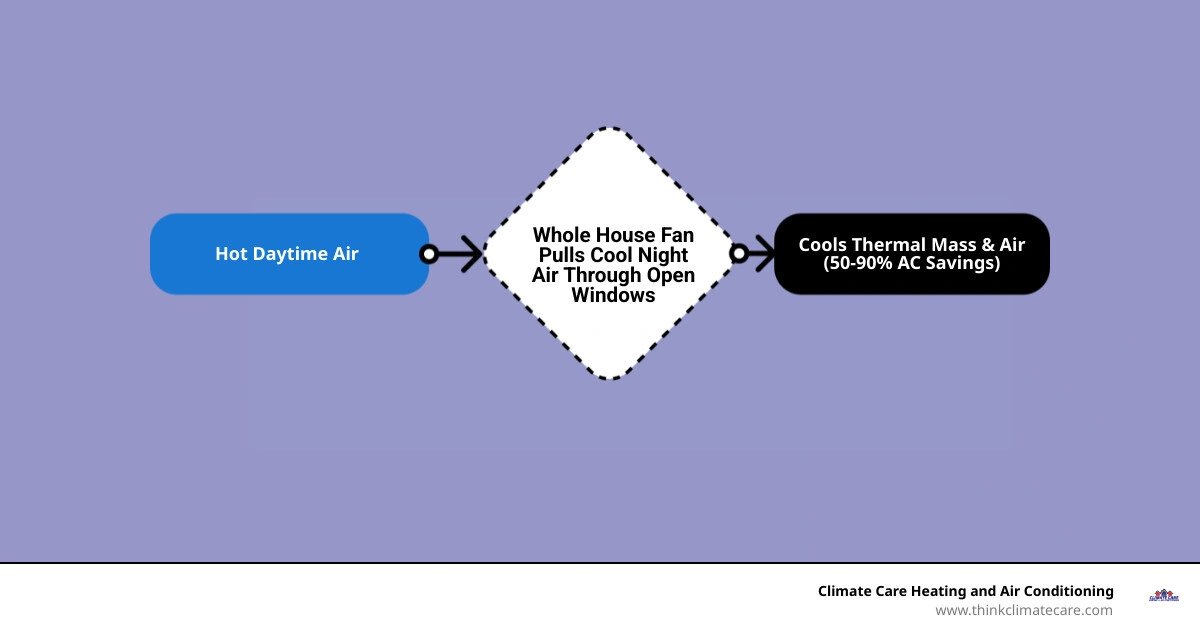
To get the most out of your system in Sacramento or Elk Grove, timing is everything. Because we live in a climate where the delta—the difference between daytime highs and nighttime lows—is often 30 degrees or more, "night flushing" is your secret weapon.
The best practice is to wait until the outdoor temperature drops below your indoor temperature, typically around dusk. By opening a few windows and turning on the fan, you pull that crisp Delta breeze throughout your home. This doesn't just cool the air; it cools the "thermal mass" of your home—the walls, furniture, and flooring that usually hold onto heat long after the sun goes down.
Running your fan from dusk through the early morning hours allows you to "pre-cool" the structure. When you close the windows and blinds in the morning, your home stays cooler for much longer, delaying the moment your AC needs to kick in. For more details on this strategy, check out these nighttime cooling benefits with whole house fans.
In Modesto and surrounding areas like Ripon and Salida, your savings are directly tied to your home's physics. The most critical factor is attic ventilation. A whole house fan works by pulling air in through windows and pushing it out through your attic vents. If your attic doesn't have enough "Net Free Vent Area" (NFVA), the air has nowhere to go. This creates backpressure that makes the fan work harder and reduces its efficiency.
Ideally, you need about one square foot of net free vent area for every 750 CFM (Cubic Feet per Minute) of fan capacity. Without this, you might experience whistling sounds or poor airflow. If you've noticed your home isn't cooling as fast as it should, you may need help fixing airflow problems with whole house fan installations to ensure the hot air can actually escape.
Home size also plays a role. A fan should be sized to provide at least 15 to 20 complete air exchanges per hour. In a larger Modesto home, an undersized fan won't achieve the "wind chill" effect that makes the system feel so refreshing, leading you to reach for the AC remote sooner than necessary.
When we look at the raw numbers, the energy disparity between a fan and a compressor-based AC unit is staggering. A standard central air conditioner is a "power hungry" appliance, often drawing between 3,000 and 5,000 watts per hour to run the compressor and the blower motor. In contrast, a modern high-efficiency whole house fan, like a QuietCool system, typically draws between 200 and 700 watts.
To put that in perspective, running a whole house fan for an entire evening often costs less than running your AC for just 30 minutes. This is why Pacific Gas & Electric (PG&E) and other energy experts note that these systems use up to 90% less energy than traditional cooling.
• Central AC (3-Ton) — Typical Wattage: 3,500W — Est. Operating Cost (per hour): High
• Whole House Fan — Typical Wattage: 500W — Est. Operating Cost (per hour): Low
• Ceiling Fan — Typical Wattage: 75W — Est. Operating Cost (per hour): Minimal
By shifting the heavy lifting of cooling to the fan during the evening and morning, you can see a massive QuietCool energy savings impact on your monthly statement. In many Central Valley homes, this translates to a cooling bill reduction of 50-90% during the peak summer months.
Because the energy savings are so high, the return on investment (ROI) for a whole house fan is among the fastest of any home improvement. While a new high-efficiency AC unit might take a decade to pay for itself in energy savings, a whole house fan often pays for itself in just two to four cooling seasons.
Beyond the monthly bill, there is a "hidden" saving: the extended lifespan of your HVAC system. By using a fan to handle the cooling for 12 out of 24 hours a day, you are significantly reducing the wear and tear on your expensive AC compressor. Fewer start-stop cycles mean fewer repairs and a longer life for your central unit. You can learn more about these long-term benefits of whole house fans to see how they protect your home's infrastructure.
To keep your savings high and your home safe, a little maintenance goes a long way. In Stockton and Lathrop, we always remind homeowners that you must open windows before turning the fan on. If you run a powerful fan in a sealed house, it can create negative pressure that pulls combustion gases (like carbon monoxide) from your water heater or furnace back into the living space—a dangerous phenomenon known as backdrafting.
For peak performance, we recommend an annual "spring cleaning." This involves vacuuming the intake grille and ensuring the attic louvers are moving freely. If you are in the Stockton area and need a professional to verify your system's safety and airflow, our team provides expert whole house fans in Stockton CA services to keep things running efficiently.
The most successful homeowners in the Central Valley don't choose between AC and a fan—they use a hybrid strategy. This approach uses the right tool for the right time. During a 105-degree afternoon in Turlock or Patterson, your AC is the hero that provides dehumidification and precision cooling. But the moment the sun dips and the outside air hits 75 degrees, the fan takes over.
This hybrid method maximizes QuietCool ventilation and IAQ (Indoor Air Quality). While AC recirculates the same air, a whole house fan completely replaces stale indoor air with fresh outdoor air every few minutes. This removes pet dander, cooking odors, and VOCs while cooling the home's structure. By the time you wake up, your home's "thermal mass" is so cold that you might not need to turn the AC on until well into the afternoon.
California’s Title 24 Building Energy Efficiency Standards have recognized the power of these systems for years. In many of our local climate zones, whole house fans are actually a prescriptive requirement for new home construction because they are so effective at reducing the load on the state's power grid.
For homeowners in Modesto, Oakdale, or Riverbank, there are often utility incentives or tax credits available for installing high-efficiency cooling systems. Because these fans help reduce peak demand during hot California afternoons, local providers sometimes offer rebates to offset the initial installation. If you are looking for the most efficient Quiet Cool systems in Modesto CA, we can help you navigate the current standards and find a system that qualifies for any available local perks.
At Climate Care Heating and Air Conditioning, we believe in holistic HVAC care. We aren't just here to fix a broken wire; we want to help you create a home that is comfortable, healthy, and affordable to run. In the Manteca, Stockton, and Sacramento regions, a whole house fan isn't just a luxury—it's one of the smartest financial moves a homeowner can make.
By understanding how much does a whole house fan save on cooling, you can take control of your utility bills and enjoy a fresher, cooler home. Whether you are in Tracy, Lodi, or Roseville, our team is ready to help you size and install the perfect system for your unique space.
Ready to stop overpaying for comfort? Explore our options for Whole House Fans and start your journey toward a 90% lower cooling bill today. From Sacramento to Turlock, we’ve got you covered with expert service and the most efficient cooling technology on the market.
Our customers love our service and support.

Had Climate Care inspect our HVAC before summer. Christopher Hayes was polite, knowledgeable, and efficient. Great service from the office team—highly recommend!
Alex Corona did a thorough furnace check-up today, showing before-and-after photos and answering all my questions. I’m happy with his work and highly recommend him. Great job—happy customer!
Alan C. serviced my furnace today and gave me a courtesy call before arriving. He was very professional, provided great service, and shared lots of pictures. Definitely a five-star experience—I’ll use them again!
On 02/19/2025, Alan inspected my furnace and did a great job explaining everything. He was professional, hardworking, and focused on customer satisfaction. Highly recommend requesting him!