Why Indoor Air Quality at Home Matters More Than You Think
How to improve indoor air quality at home is one of the most important things you can do for your family's health — and most people never think about it.
Here are the top ways to improve your indoor air quality right now:
1. Control pollution sources — remove or reduce VOCs, radon, smoke, and chemical cleaners
2. Improve ventilation — open windows when outdoor air is clean, run exhaust fans in kitchens and bathrooms
3. Use air filtration — install HEPA or MERV-13 filters in your HVAC system or use a portable air purifier
4. Control humidity — keep indoor humidity between 30–50% to prevent mold and dust mites
5. Clean regularly — vacuum with HEPA filtration, dust with microfiber cloths, and wash bedding weekly
The numbers tell a clear story. Americans spend about 90% of their time indoors. Yet the EPA has found that indoor air can contain pollutant levels 2 to 5 times higher than outdoor air. In some cases, that gap is even wider.
For families in Manteca, where hot summers mean windows stay shut for months, the air inside your home can quietly build up allergens, VOCs, and fine particles. Children, older adults, and anyone dealing with asthma or allergies feel these effects most — but poor air quality affects everyone's comfort, sleep, and long-term health.
The good news? Most of the steps that make a real difference are simple, low-cost, and easy to start today.
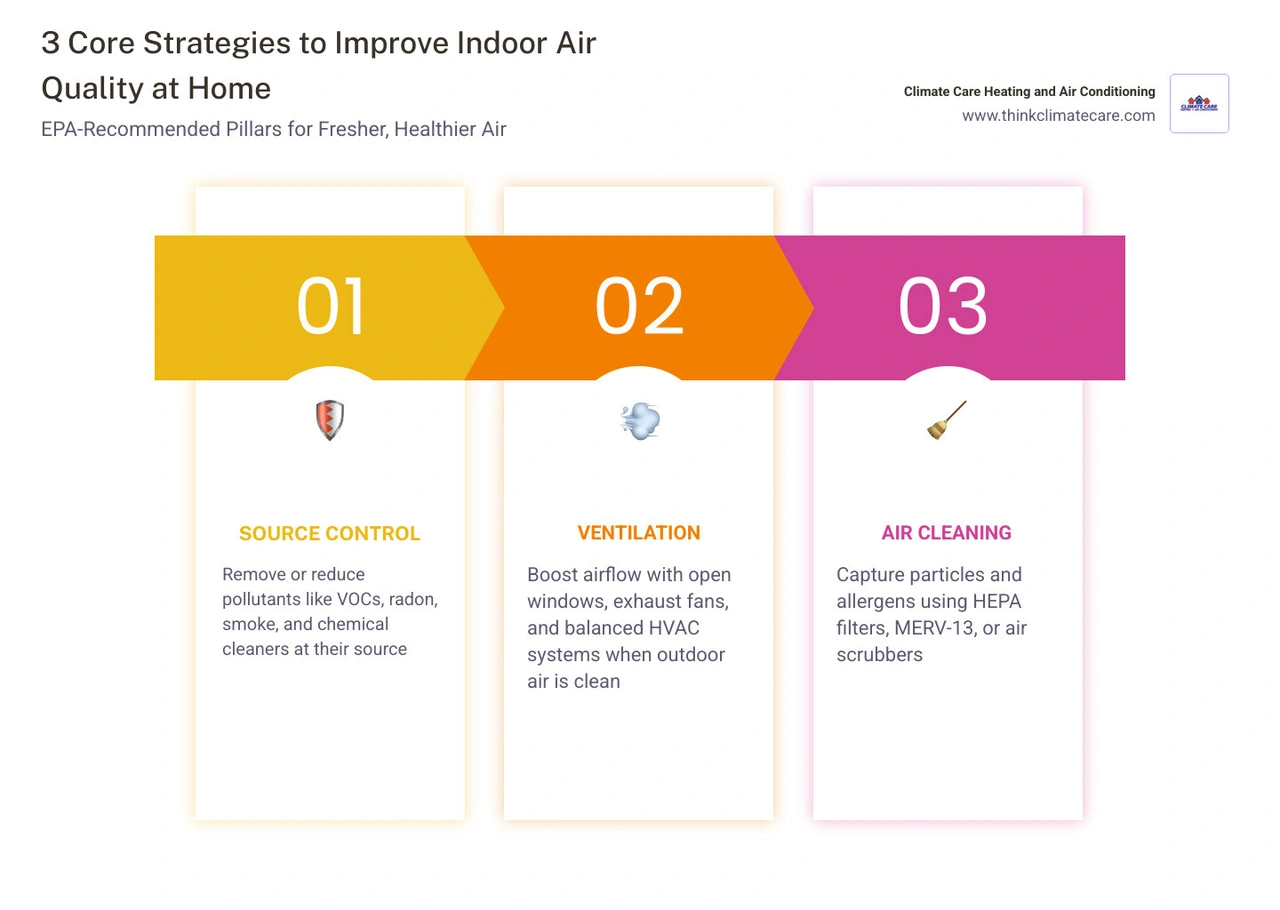
Three Core Strategies for How to Improve Indoor Air Quality at Home

When it comes to the science of breathing easier, the Environmental Protection Agency (EPA) points to three pillars of success: source control, ventilation, and air cleaning. Think of these as your "Air Cleaning Allies." If you only focus on one, you're leaving the job half-done.
As of April 2026, we’ve seen that the most energy-efficient homes are often the most "airtight." While great for your utility bill, this means pollutants get trapped inside. By balancing these three strategies, you can enjoy an energy-efficient home that doesn't sacrifice your respiratory health.
The first step is understanding what you're fighting. Many common household items—from the glue in your furniture to the spray under your sink—are constant emitters. You can learn more about 5 Common Products That Pollute Your Homes Air to identify the "usual suspects" in your living space.
Controlling Pollution Sources and VOCs
Source control is the most effective and cost-efficient way to protect your air. If you don't let the "bad guys" in, you don't have to work so hard to filter them out.
• Volatile Organic Compounds (VOCs): These are gases emitted from paints, cleaners, and even new carpets. VOC levels can be 2 to 5 times higher indoors than out. When shopping, look for "Low-VOC" or "No-VOC" labels.
• Radon Testing: Radon is a naturally occurring radioactive gas that can seep into homes through foundation cracks. It is the second leading cause of lung cancer in the U.S. We recommend using a DIY testing kit or hiring a professional to ensure your home is safe.
• Smoke-Free Policy: There is no safe level of secondhand smoke. Furthermore, "thirdhand smoke"—the residue that sticks to clothes and furniture—can linger for years. Establishing a strict no-smoking policy is a non-negotiable for healthy air.
• Chemical-Free Cleaning: Swap out harsh bleach and ammonia-based sprays for natural alternatives like vinegar, baking soda, or soy-based products.
• Carbon Monoxide (CO): This "silent killer" is produced by fuel-burning appliances. Ensuring your gas stove, water heater, and furnace are properly vented is vital. For a deeper dive, check out How to Protect Your Family from Carbon Monoxide.
Enhancing Ventilation to Improve Indoor Air Quality at Home
If source control is your first line of defense, ventilation is your cleanup crew. Most standard HVAC systems in areas like Stockton or Modesto do not actually bring "fresh" air in from the outside; they simply recirculate the air already in your home.
• Natural Ventilation: On days when the outdoor air quality index is good, crack open windows and doors for at least 10 to 15 minutes. This dilutes indoor pollutants with fresher air.
• Mechanical Ventilation: Use your kitchen and bathroom exhaust fans every time you cook or shower. Ensure these fans actually vent to the outside, rather than just recirculating air back into the attic or room.
• Airflow Balance: Sometimes, certain rooms feel "stuffy" while others feel drafty. This is often an airflow issue. Professional Air Balancing Service ensures that fresh, filtered air reaches every corner of your home equally.
Advanced Air Cleaning and Filtration Systems
When source control and ventilation aren't enough—especially during allergy season or wildfire events—advanced filtration becomes your best friend.
A standard 1-inch furnace filter is designed to protect the equipment, not your lungs. To truly clean the air, you need higher-grade options.
• Standard Fiberglass — Efficiency: Low — Best For: Protecting HVAC equipment from large dust
• MERV-13 — Efficiency: High — Best For: Capturing bacteria, tobacco smoke, and fine particles
• HEPA — Efficiency: 99.97% — Best For: Microscopic allergens, viruses, and ultra-fine dust
• Air Scrubber — Efficiency: Active — Best For: Neutralizing VOCs and surface contaminants
If you or a family member suffer from chronic respiratory issues, you might ask, "Does Your Home Need an Air Scrubber?" These devices use UV light and specialized technology to actively "scrub" the air and surfaces, rather than just waiting for particles to pass through a filter. For many, Fighting Allergies with Whole House Air Filtration is the only way to find true relief during the Central Valley's intense pollen seasons.
Maintaining Your Home for Long-Term Air Purity
Improving your air isn't a "one and done" project; it's a lifestyle. Regular maintenance prevents the buildup of the "dust reservoir"—the collection of skin cells, pet dander, and dirt that settles into your carpets and upholstery.
Start with a regular cleaning routine. Use vacuums equipped with HEPA filters to ensure you aren't just sucking up dust and blowing the smaller, more irritating particles back out the exhaust. When dusting, ditch the feather duster (which just moves dust around) and use damp microfiber cloths that trap particles.
Don't forget your bedding! Dust mites love mattresses and pillows. Washing your sheets weekly in hot water (at least 130°F) kills these microscopic pests and keeps your sleeping environment fresh. Consistent Addressing Air Quality with HVAC Service ensures that your home’s "lungs"—the HVAC system—stay clean and efficient.
Managing Humidity and Allergens
In the Sacramento and San Joaquin Valleys, humidity can be a tricky beast. The EPA recommends keeping indoor relative humidity between 30% and 50%.
• If it's too high (over 60%): You're inviting mold growth and dust mite infestations. Mold can leach VOCs and release spores that trigger severe asthma attacks.
• If it's too low (under 30%): Your nasal passages dry out, making you more susceptible to viruses and respiratory irritation.
Using a dehumidifier in damp basements or laundry rooms can prevent mold before it starts. For those with severe allergies, UV-C Air Purification for Allergies and Asthma can be a game-changer, as it neutralizes biological growth within the HVAC system itself.
The Role of HVAC Maintenance to Improve Indoor Air Quality at Home
Your HVAC system is the heart of your home's climate, but it can also be a hidden source of pollution if neglected.
Filter Replacement: This is the simplest yet most overlooked task. A clogged filter restricts airflow, forcing your system to work harder and allowing dust to bypass the filter entirely. If you're in the capital region, our Air Filter Replacement Sacramento Guide provides a roadmap for choosing the right schedule.
Ductwork Integrity: Over time, ducts can develop leaks or accumulate thick layers of dust and debris. Leaky ducts in a crawlspace or attic can actually suck "bad" air into your living space. This is Why Duct Cleaning is Important for Indoor Air Quality; it removes the physical buildup of allergens that filters can't reach.
Safety Measures and Professional IAQ Services
Beyond comfort, air quality is about safety. Every home must have functioning smoke detectors and Carbon Monoxide (CO) alarms on every level, especially near sleeping areas. Test these monthly and change the batteries at least once a year.
While DIY steps are fantastic, sometimes you need a professional eye. At Climate Care Heating and Air Conditioning, we provide comprehensive IAQ assessments. Whether you are in Lathrop, Turlock, or Roseville, our team can test for specific pollutants and recommend tailored solutions like air scrubbers or whole-home purifiers.
Investing in your air is an investment in your health. By Breathing Better How Professional Indoor Air Quality Services Enhance Your Health, you reduce the risk of long-term illness and ensure your home remains the sanctuary it was meant to be.
If you're ready to take the next step toward a fresher home, we're here to help. From Manteca to Sacramento, our team is dedicated to your comfort and health.
Contact Climate Care Today for an Indoor Air Quality Consultation