Central Air vs Mini Split for the Central Valley Homes: Which System Is Right for You?
When weighing central air vs mini split for the Central Valley homes, the short answer is: it depends on whether your home already has ductwork, how many rooms you need to cool, and how much control you want over your energy bills.
Here's a quick breakdown to help you decide:
• Best for — Central Air: Homes with existing ducts — Mini Split: Homes without ducts, additions, ADUs
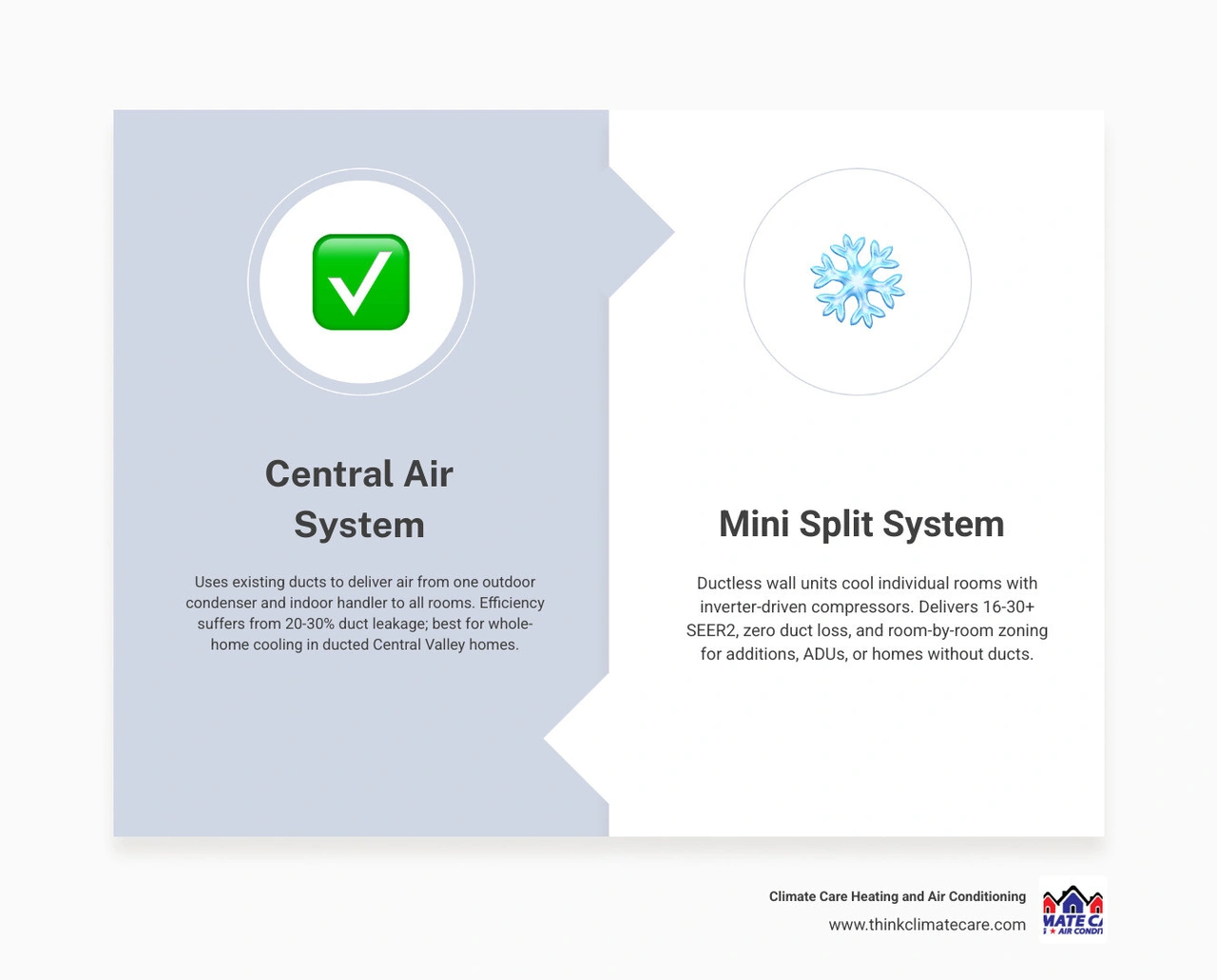
• Efficiency — Central Air: 13–21 SEER2 (loses 20–30% through ducts) — Mini Split: 16–30+ SEER2 (no duct losses)
• Zoning — Central Air: Single thermostat (whole home) — Mini Split: Room-by-room control
• Wildfire smoke filtration — Central Air: Stronger (high-MERV whole-home filters) — Mini Split: Basic washable filters (upgradeable)
• Installation — Central Air: 1–2 days with existing ducts — Mini Split: 4–8 hours per zone
• Lifespan — Central Air: 12–15 years average — Mini Split: 15–20 years average
• Heating capability — Central Air: Requires separate furnace or heat pump — Mini Split: Built-in heat pump (heating + cooling)
Living in Manteca, Stockton, Modesto, or anywhere else in the Central Valley means your cooling system faces some of the toughest conditions in California — triple-digit summer days that stretch for weeks, scorching attic temperatures, and wildfire smoke seasons that test your air quality year after year. Your HVAC system isn't just a comfort upgrade here. It's a necessity.
Central air has been the go-to choice for decades, especially in homes that already have ductwork in place. But ductless mini-split systems have become a serious competitor, offering higher efficiency ratings, flexible room-by-room control, and simpler installation in homes where running new ducts would be costly or disruptive.
Neither system wins in every situation. The right choice comes down to your home's layout, your existing infrastructure, and what you value most — whether that's whole-home filtration during smoke season, lower monthly energy bills, or the ability to cool just the rooms you actually use.
This guide walks through everything Central Valley homeowners need to know to make a confident, informed decision.
Central Air vs Mini Split for the Central Valley Homes: Core Technology and Performance in Extreme Heat
To make the right choice, it helps to understand how these systems differ under the hood. A traditional central air system is a ducted split system. It features a large outdoor condenser unit and an indoor air handler (usually paired with a furnace in your closet or attic). It relies on a network of sheet metal or flexible ducts to push conditioned air to every room in your house simultaneously, controlled by a single thermostat.
A ductless mini-split system, on the other hand, bypasses the "ductwork monster" entirely. It pairs an outdoor compressor with one or more compact indoor air handlers (often called "heads") mounted directly on your walls or ceilings. These heads are connected to the outdoor unit by small refrigerant lines running through a tiny three-inch wall opening.
To understand how our unique regional weather impacts these systems, it is vital to look at How Central Valley Climate Affects Your HVAC System. Our long, dry summers put immense physical stress on HVAC machinery, and how each system handles this stress determines your daily comfort.
How Central Air vs Mini Split for the Central Valley Homes Handle Triple-Digit Summer Heat
When the thermometer hits 105°F in Sacramento, Tracy, or Lodi, your cooling system faces its peak load. Traditional central air units typically operate on a single-stage or two-stage compressor. This means they turn on at full blast, cool the house down quickly, and then shut off. During extreme heat waves, this constant cycling on and off can lead to temperature swings and high energy consumption.
In contrast, most modern mini-split systems utilize advanced inverter-driven compressors. An inverter compressor acts like a dimmer switch rather than an on/off light switch. It continuously adjusts its speed to match the cooling demand of the home. Once the desired temperature is reached, the mini-split runs at a low, steady speed to maintain it.
This continuous operation is incredibly effective at keeping up with intense valley heat waves. It prevents the system from working too hard to cool down a hot house from scratch, which is crucial for overall reliability. However, to achieve this efficiency, having an accurately sized system is essential. You can learn more about this by reading our guide on Getting the Right Size HVAC for Central Valley Homes.
Energy Efficiency, SEER2 Ratings, and Duct Loss in Manteca Homes
As of June 2026, energy standards in California require highly efficient HVAC equipment. When comparing energy efficiency, mini-splits are the clear leaders. While high-end central air systems can achieve up to 21 SEER2, top-tier ductless mini-splits routinely reach 25 to 30+ SEER2.
The secret to this efficiency gap lies in the ductwork itself. In a typical Central Valley home, ducts run through unconditioned attics where temperatures can soar to 150°F. Ducted central air systems can lose 20-30% of conditioned air through leaks and poor insulation, significantly increasing energy costs in hot climates like the Sacramento Valley.
By delivering air directly to the living space, mini-splits completely eliminate this thermal loss. When you pair this with inverter technology, mini-split systems can reduce household cooling costs by 30-50% versus traditional central air when zoning is used to cool only occupied rooms. If you are looking for year-round efficiency, explore the Heat Pump Benefits for Central Valley Homeowners to see how these systems save you money during our chilly winters as well.
Managing Indoor Air Quality and Wildfire Smoke in the Sacramento Valley
Indoor air quality (IAQ) is a major concern for families living in Elk Grove, Roseville, and Folsom. Between agricultural dust and summer wildfire smoke, our air filtration needs are demanding.
Central air systems have a distinct advantage when it comes to heavy-duty air filtration. Because they utilize a centralized air handler with powerful blowers, they can easily support thick, high-efficiency media filters (such as MERV 13 or HEPA-type filters) and whole-home air purification systems. This allows them to scrub the air throughout your entire home during severe smoke events.
Mini-splits do filter the air, but their indoor heads use smaller, washable mesh filters designed primarily to catch dust and pet dander. While some modern mini-splits offer advanced multi-stage filtration options, they require frequent hands-on maintenance. You will need to rinse the filters every 2-4 weeks during peak summer to maintain optimal airflow and air quality. However, mini-splits avoid the issue of dust, mold, and pollen accumulating inside hidden ductwork over time.
Zoning and Temperature Control: Solving the Hot Upstairs Bedroom Problem
We have all experienced the "thermostat wars" in multi-story homes in Ceres, Turlock, or Ripon. The downstairs area feels like an icebox while the upstairs bedrooms remain uncomfortably warm.
Central air systems struggle with this because they typically rely on a single thermostat to control the entire house. Even with automated dampers, achieving perfect balance is difficult.
Mini-splits solve this problem naturally through zoning. Each indoor head operates independently with its own thermostat. If you have a multi-zone setup, you can keep your upstairs master bedroom at a cool 72°F for sleeping while leaving the unoccupied downstairs living room at 78°F.
Additionally, mini-splits are incredibly quiet. The indoor heads operate at decibel levels as low as 19 to 26 dB — which is softer than a whisper. Traditional central air systems are much louder due to the sound of air rushing through metal ducts and the physical clunk of the system kicking on.
Making the Right Choice for Your Central Valley Home
Choosing between these two systems often comes down to your home’s architecture, layout, and how you use your living space day to day. If your home does not have existing ductwork, running new ducts can be highly invasive and expensive. For a deeper dive into your options, check out our comparison on Adding Cooling Without Ductwork: Options Compared.
Comparing Central Air vs Mini Split for the Central Valley Homes with Existing Ductwork vs No Ducts
If your Central Valley home already has a well-designed duct system in good condition, upgrading to a high-efficiency central air system is often the most straightforward and practical path. However, if your ducts are deteriorating, undersized, or non-existent, a ductless system becomes highly attractive.
• Newer home with good ducts — Recommended System: Central Air — Why It Works Best: Reuses existing infrastructure; lower initial setup complexity.
• Historic home (no ducts) — Recommended System: Mini Split — Why It Works Best: Preserves plaster walls and architectural character; no invasive construction.
• Home addition or ADU — Recommended System: Mini Split — Why It Works Best: Avoids overloading your main system; provides independent control.
• Multi-story home with hot spots — Recommended System: Hybrid Setup — Why It Works Best: Keeps central air for downstairs; adds a mini-split for hot upstairs rooms.
For homeowners in older neighborhoods in Sacramento or Stockton, preserving the architectural integrity of historic properties is a priority. Running bulky ductwork through plaster walls or beautiful tongue-and-groove ceilings is often out of the question. In these cases, a ductless system is the ideal solution. To see how this applies locally, read about installing Ductless AC in Sacramento.
Maintenance, Lifespan, and Year-Round Heating Performance
Both central air and mini-split systems require regular care to perform reliably during our intense climate shifts.
• Central Air Maintenance: Requires changing the return air filter every 1-3 months, keeping the outdoor unit clear of agricultural dust, and scheduling annual professional duct inspections.
• Mini-Split Maintenance: Requires rinsing the indoor filters every few weeks and scheduling a professional deep cleaning of the indoor blower wheels every 1-2 years to prevent dust buildup.
In terms of longevity, traditional central air systems in the Central Valley typically last 12-15 years, largely due to the heavy workload of pushing air through hot attics. Mini-split systems typically last 15-20 years. This longer lifespan is partly due to their gentler, inverter-driven operation, which avoids the constant mechanical stress of hard starting and stopping.
Furthermore, because most modern mini-splits are heat pumps, they provide incredibly efficient heating during our chilly valley winters. They move heat rather than generating it, allowing you to stay warm without relying on expensive gas furnaces or inefficient baseboard heaters.
If you are ready to explore your options and find the perfect comfort fit for your home, check out our specialized Ductless Mini-Split Systems services. Whether you need a complete system replacement, a zoned upgrade, or a hybrid comfort solution, our team at Climate Care Heating and Air Conditioning is here to provide holistic, energy-efficient comfort designed for the Central Valley.