How a Whole House Fan Reduces Cooling Costs: The Quick Answer
How a whole house fan reduces cooling costs comes down to one simple idea: instead of burning thousands of watts to mechanically chill your air, it uses a fraction of that energy to pull cool outdoor air through your home and push hot air out through the attic.
Here's the short version:
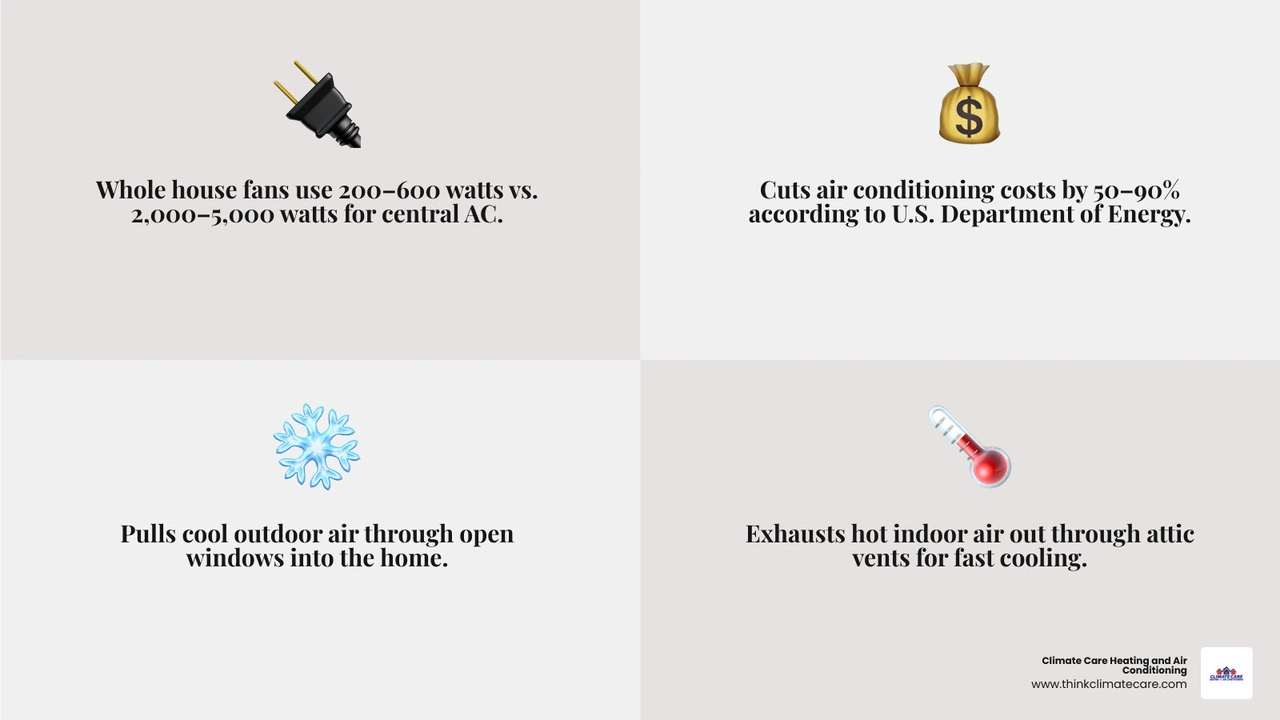
• Energy use: Whole house fans use roughly 200–600 watts, compared to 2,000–5,000 watts for central AC
• Savings potential: The U.S. Department of Energy says whole house fans can cut air conditioning costs by 50–90%
• How it works: The fan draws cooler outside air in through open windows and exhausts hot indoor air out through attic vents
• Best time to run it: Early morning or after sunset, when outdoor temps drop — which happens regularly across the Central Valley
• Result: Your home cools down fast, your AC runs less, and your utility bill drops significantly
For Manteca homeowners dealing with triple-digit summers and rising energy bills, that kind of savings isn't just nice to have — it's a real difference in monthly comfort and budget.
A whole house fan won't replace your AC on the hottest days, but it can do the heavy lifting on most days, letting your central air conditioning system rest when it doesn't need to work so hard.
How a Whole House Fan Reduces Cooling Costs
To understand the financial impact of this technology, we have to look at the numbers. In April 2026, as energy rates continue to be a primary concern for families in Sacramento and Stockton, the efficiency of Whole House Fans stands out more than ever.
The primary reason how a whole house fan reduces cooling costs is its incredibly low wattage draw. A standard central air conditioner is one of the most power-hungry appliances in your home, often consuming between 2,000 and 5,000 watts per hour. In contrast, a modern whole house fan typically operates on just 200 to 600 watts. Some high-efficiency models, like those from QuietCool, can run on as little as 66.7 watts at their lowest setting.
Energy Consumption Comparison
• Central AC (3-Ton) — Typical Wattage: 3,500 Watts — Est. Hourly Cost (at $0.15/kWh): $0.53
• Whole House Fan — Typical Wattage: 200 - 600 Watts — Est. Hourly Cost (at $0.15/kWh): $0.03 - $0.09
• Savings Percentage — Typical Wattage: 80% - 90% Lower
When we calculate these savings over a peak cooling season in the Central Valley, the results are staggering. If your monthly cooling bill is typically around $200, switching to a whole house fan for the majority of your cooling needs could save you between $100 and $180 per month. This is because you are replacing a high-consumption compressor with a high-efficiency motor.
How a Whole House Fan Reduces Cooling Costs via Thermal Mass
One of the most overlooked secrets of how a whole house fan reduces cooling costs is a concept called "thermal mass cooling." Your home isn't just made of air; it's made of wood, drywall, carpet, and furniture. During a hot Modesto afternoon, these materials soak up heat. Even if you turn on the AC and cool the air, these solid objects continue to radiate heat back into the rooms, forcing the AC to kick back on minutes later.
This is often why the second story of a home stays uncomfortably hot long after the sun goes down. A whole house fan solves this by performing 15 to 30 air exchanges per hour. This rapid movement of air doesn't just "refresh" the room; it actually pulls the heat out of the building materials themselves. By cooling the "mass" of the home, you create a reservoir of coolness that helps the house stay at a lower temperature well into the next day. This process, known as "night flushing," significantly delays the time of day when you finally have to turn on your air conditioner. To learn more about this structural advantage, check out The Benefits of Whole House Fans.
How a Whole House Fan Reduces Cooling Costs with Nighttime Air
In areas like Sacramento, Elk Grove, and Roseville, we are blessed with a "diurnal swing"—a fancy term meaning the temperature drops significantly at night. While it might be 95°F at 4:00 PM, it often drops into the low 60s or high 50s by midnight.
Traditional air conditioning ignores this free resource. It keeps the windows shut and recirculates the same stale air. A whole house fan, however, capitalizes on this natural gift. By opening a few windows when the outdoor temperature falls below the indoor temperature, you can "flush" your entire home with crisp, fresh air in about 10 to 20 minutes. This is one of the most effective Nighttime Cooling Benefits with Whole House Fans, as it allows you to sleep in a naturally cooled environment for pennies.
Optimizing Attic Ventilation for Maximum Savings

A whole house fan is only as good as the attic it’s exhausting into. Think of it like a vacuum: if the "exhaust" end is blocked, the "suction" end won't work. For the fan to push hot air out of your living space, that air needs a place to go. This is where attic ventilation becomes critical.
To achieve maximum savings and performance, your attic needs "Net Free Area" (NFA). The general rule of thumb is to have one square foot of net free vent area for every 750 CFM (Cubic Feet per Minute) of fan capacity. Without enough vents, the fan creates back-pressure, which makes the motor work harder and reduces the cooling effect.
Proper ventilation also flushes out the "attic heat soak." Attics in the Central Valley can reach 140°F or higher. That heat sits right on top of your ceiling, radiating downward. By using the fan to push that 140-degree air out and replace it with 65-degree night air, you’re protecting your insulation and roof structure from heat damage. If you've noticed your fan isn't pulling air like it used to, you might be Fixing Airflow Problems with Whole House Fan by simply adding more intake or exhaust vents.
Professional Solutions for Central Valley Homeowners
At Climate Care Heating and Air Conditioning, we’ve seen how the right ventilation strategy changes a home’s comfort level. Whether we are providing Manteca service or Modesto expertise, our goal is always holistic HVAC care. We don't just want to sell you a box; we want to ensure your entire home works as an efficient system.
For homeowners in Stockton and Sacramento, professional installation is key. We ensure that the fan is sized correctly for your square footage—typically 2.5 to 3 CFM per square foot of living space. An undersized fan won't cool the thermal mass, and an oversized fan without enough attic venting can actually cause issues. Our technicians are experts in Quiet Cool Systems Sacramento CA, ensuring a whisper-quiet operation that won't disturb your sleep.
Supplementing Your Central AC in Modesto and Stockton
One of the biggest misconceptions is that you have to choose between a whole house fan and central AC. In reality, they are the ultimate "dynamic duo." In cities like Stockton and Lathrop, we recommend a hybrid cooling strategy.
By using the whole house fan in the evenings and early mornings, you significantly reduce the "runtime" of your air conditioner's compressor. The compressor is the most expensive part of your HVAC system to repair or replace. By letting the fan handle 70% of the cooling load, you are directly extending the lifespan of your AC unit. This QuietCool Cooling strategy ensures that when the triple-digit heat hits at 3:00 PM, your AC is rested and ready to handle the peak load efficiently.
Enhancing Indoor Air Quality and Freshness
Beyond the financial savings, there is a massive health benefit. According to the EPA, indoor air can be significantly more polluted than outdoor air. Cooking smells, pet dander, VOCs from furniture, and carbon dioxide all get trapped inside a sealed home.
Air conditioners don't bring in fresh air; they just filter and recirculate the air you already have. A whole house fan, however, provides a complete air exchange. It "purges" the stale indoor air and replaces it with fresh, oxygen-rich outdoor air. This is a game-changer for QuietCool Ventilation and IAQ (Indoor Air Quality). Within minutes of turning the system on, you'll notice the "stale" smell of the house disappears, replaced by a fresh breeze.
Maintaining Your System for Long-Term Performance
To keep your QuietCool Energy Savings at their peak, a little bit of maintenance goes a long way. Fortunately, whole house fans are much simpler than AC units.
• Check the shutters: Ensure the louvers or dampers open and close freely. If they stick, you won't get optimal airflow.
• Inspect the seals: In the winter, you want to make sure your fan has an air-tight cover or high-quality R-value shutters to prevent your heater's warmth from escaping into the attic.
• Clean the intake: Dust can accumulate on the ceiling grille. A quick vacuuming once a season keeps the air moving freely.
• Window Screen Check: Since you'll be opening windows more often, ensure your screens are clean and intact to keep the Central Valley bugs outside where they belong!
Regular seasonal checks ensure you are getting the most out of your Whole House Fans. At Climate Care, our membership plans include comprehensive checks that cover these vital systems, ensuring you're never caught in a heatwave without a plan.
Is a Whole House Fan Right for Your Home?
If you live in any of our service areas—from the quiet streets of Ripon and Escalon to the bustling neighborhoods of Natomas and Rancho Cordova—a whole house fan is likely one of the smartest investments you can make.
The "payback period"—the time it takes for the energy savings to cover the cost of the installation—is remarkably short, often just 2 to 4 seasons. Compare that to solar panels or new windows, which can take decades to pay for themselves, and it’s easy to see why this is a favorite upgrade for savvy homeowners.
Operating Tips for Maximum Savings
To get the best results and see exactly how a whole house fan reduces cooling costs on your next bill, follow this daily routine:
1. Evening Turn-On: Wait until the outdoor temperature is at least 2-3 degrees cooler than the indoor temperature. Open windows in the rooms you want to cool (like bedrooms) and turn the fan on high for 20 minutes to "flush" the house.
2. Overnight Low: Switch the fan to its lowest, quietest setting and leave it running overnight. This is what cools the "thermal mass" of your home.
3. Morning Purge: If it’s still cool at 6:00 AM, give it one last high-speed blast to get the house as cold as possible before the sun hits.
4. The Lockdown: Once the sun starts to warm things up, shut the windows and turn the fan off. Your home will start the day much cooler, and your AC won't need to turn on until much later in the afternoon.
Conclusion
The evidence is clear: how a whole house fan reduces cooling costs is through a combination of low-wattage operation, structural cooling, and smart use of our Central Valley climate. By reducing your reliance on expensive air conditioning and utilizing the free cooling power of the night air, you can enjoy a more comfortable, fresher home while keeping your hard-earned money in your wallet.
Whether you are in Sacramento, Tracy, or right here in Manteca, Climate Care Heating and Air Conditioning is ready to help you find the perfect ventilation solution. We believe in providing our community with high-performance, cost-efficient, and environmentally friendly cooling options. Ready to feel the breeze? Give us a call and let's get your home "fan-tastic" for the summer ahead.
Whole House FansThe Benefits of Whole House FansEnergy Savings with Whole House FansQuietCool Energy SavingsQuietCool CoolingWhole House Fan Sacramento CAWhole House Fan Stockton CAWhole House Fan Modesto CAWhole House Fan Manteca CAQuiet Cool Whole House Fans Elk Grove CAQuiet Cool Whole House Fans Sacramento CAQuiet Cool Whole House Fans Modesto CAQuiet Cool Whole House Fans Stockton CAQuiet Cool Whole House Fans Tracy CAQuiet Cool Whole House Fans Ripon CAQuiet Cool Whole House Fans Manteca CAQuiet Cool Products and System OptionsQuietCool Ventilation and IAQQuiet Cool Systems Stockton CAQuiet Cool Systems Modesto CAQuiet Cool Systems Manteca CAQuiet Cool Systems Elk Grove CAQuiet Cool Systems Tracy CAQuiet Cool Systems Sacramento CAQuiet Cool Systems Ripon CAFixing Airflow Problems with Whole House Fan