Why Getting the Right Size HVAC for Central Valley Homes Is the Most Important Decision You'll Make This Year
Getting the right size HVAC for Central Valley homes is the single biggest factor in whether your system keeps you comfortable, runs efficiently, and lasts 15 to 20 years — or drives up your energy bills and breaks down early. If you're a homeowner in Manteca or anywhere in California's Central Valley, this decision matters more than brand, more than features, and more than almost anything else.
Here's a quick answer to help you get oriented:
Quick Sizing Guide for Central Valley Homes
• Up to 700 — Estimated Tonnage: 1.5 tons — Estimated BTUs: 18,000 BTUs
• 700 - 1,400 — Estimated Tonnage: 2 tons — Estimated BTUs: 24,000 BTUs
• 1,400 - 1,800 — Estimated Tonnage: 2.5 tons — Estimated BTUs: 30,000 BTUs
• 1,800 - 2,100 — Estimated Tonnage: 3 tons — Estimated BTUs: 36,000 BTUs
• 2,100 - 2,400 — Estimated Tonnage: 3.5 tons — Estimated BTUs: 42,000 BTUs
• 2,400 - 3,000 — Estimated Tonnage: 4 tons — Estimated BTUs: 48,000 BTUs
• 3,000 - 3,500 — Estimated Tonnage: 5 tons — Estimated BTUs: 60,000 BTUs
Note: These are starting estimates only. The Central Valley's extreme summer heat, your home's insulation, window placement, ceiling height, and sun exposure all affect the final number. A professional Manual J load calculation is the only way to get it exactly right.
The stakes are real. Industry estimates suggest that up to 90% of HVAC systems are improperly sized or installed — and an improperly installed system can lose up to 30% of its efficiency before it even runs its first full season. In a region where summer temperatures regularly push past 100°F, that's not just uncomfortable — it's expensive.
Too big, and your system short-cycles, leaving your home humid and your bills high. Too small, and it runs nonstop trying to keep up, wearing itself out years ahead of schedule. The right size means steady comfort, lower utility costs, and a system that goes the distance.
Getting the Right Size HVAC for Central Valley Homes

When we talk about "sizing" an HVAC system, we aren't talking about how much space the physical metal box takes up on your side yard. We are talking about its capacity—its ability to move heat. In the HVAC world, this is measured in BTUs (British Thermal Units) and Tonnage.
One "ton" of cooling capacity is equal to 12,000 BTUs per hour. To put that in perspective, one BTU is roughly the amount of heat produced by burning a single wooden match. A 3-ton system, which is common for many 1,800-square-foot homes in Stockton or Lodi, can move 36,000 BTUs of heat out of your home every hour.
In April 2026, as we look at the current climate trends in the Central Valley, getting this number right is more complex than it used to be. Old "rules of thumb" like "one ton for every 500 square feet" are often outdated because modern homes are tighter and better insulated. However, our local climate is also getting more extreme. Ensuring your New HVAC System Properly Sized for Your Home requires a balance between the physical dimensions of your house and the brutal reality of a July afternoon in Sacramento. Mastering the Art of HVAC Sizing and Selection is the difference between a home that feels like an oasis and one that feels like a swampy waiting room.
Why Proper Sizing Matters for Your Comfort
Many homeowners assume that "bigger is better." They think that if a 3-ton unit is good, a 5-ton unit will cool the house down in seconds. This is a common and costly mistake.
When a system is oversized, it suffers from short cycling. It turns on, blasts the house with ice-cold air, satisfies the thermostat in five minutes, and shuts off. This sounds efficient, but it’s actually a disaster for two reasons:
1. Humidity Control: An air conditioner's job isn't just to lower the temperature; it's to remove moisture. Dehumidification only happens when the system runs for a long enough cycle to allow moisture to condense on the cooling coils and drain away. Short cycles leave that humidity in the air, resulting in a "cold and clammy" feeling.
2. Wear and Tear: The most stressful part of an HVAC system’s life is the startup. Frequent starting and stopping burns through components and shortens the 15-to-20-year lifespan you should expect from a quality installation.
On the flip side, an undersized system will run 24/7 during a Central Valley heatwave and still never reach your target temperature. This leads to Addressing Uneven Cooling with HVAC Installation issues where the back bedrooms stay at 80°F while the unit works itself to death. Understanding Why HVAC System Has Uneven Temperature Distribution often starts with checking if the unit has the raw "muscle" to handle the square footage it's assigned to.
The Manual J Load Calculation: Getting the Right Size HVAC for Central Valley Homes
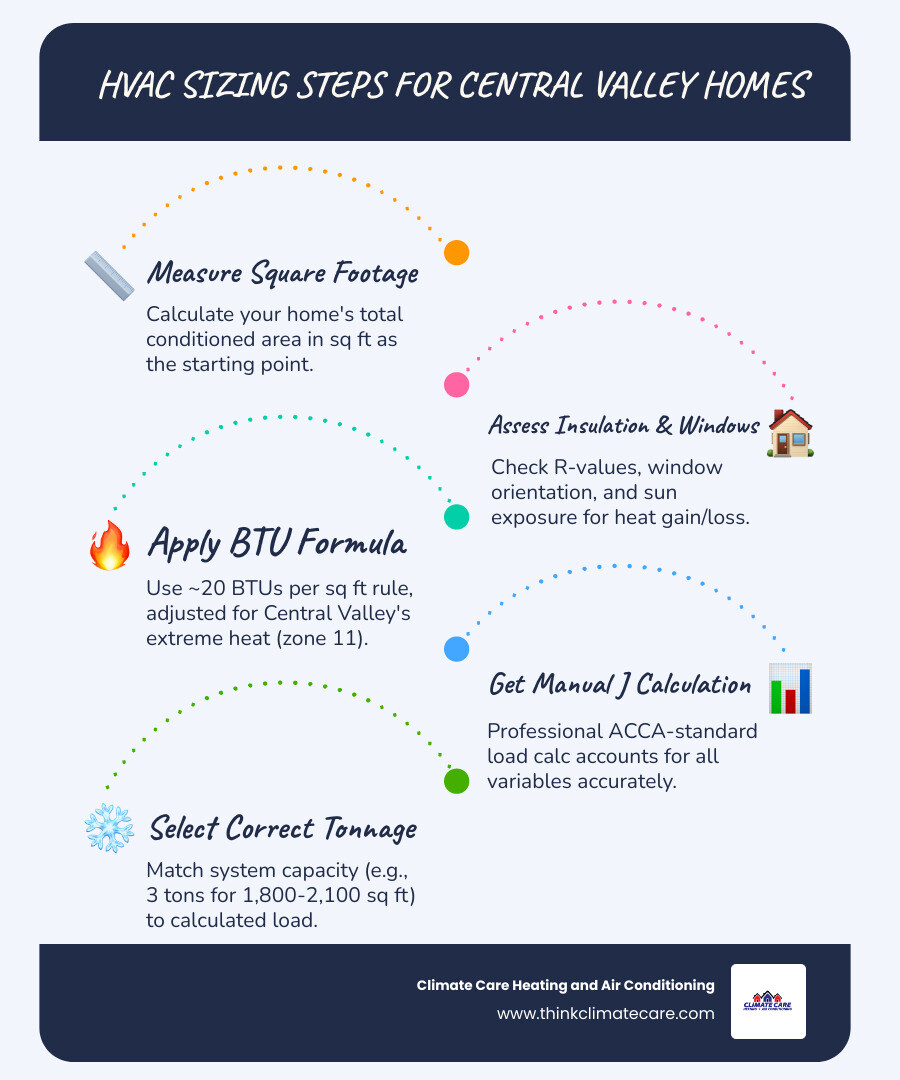
If you want to move beyond guesswork, you need a Manual J Load Calculation. This is the industry-standard method developed by the Air Conditioning Contractors of America (ACCA). It is essentially a mathematical model of your home’s "heat appetite."
A Manual J doesn't just look at the floor; it looks at everything that lets heat in or out. We use professional software to input data points like your home's orientation (does the big picture window face the blazing afternoon sun?), the type of building materials used, and even how many people live there. This is a critical part of a comprehensive HVAC System Design Guide that ensures your system is a "Goldilocks" fit—not too big, not too small, but just right.
By calculating the exact heat gain (how much heat enters in summer) and heat loss (how much escapes in winter), we can specify a system that provides Energy-Efficient HVAC performance. In cities like Turlock and Patterson, where the temperature swing between day and night can be significant, this precision is what keeps your utility bills manageable.
Key Factors Influencing Your Home’s Heating and Cooling Load
When we perform a professional assessment for getting the right size hvac for the central valley homes, we look at several "invisible" factors:
• Insulation R-Values: A home in an older neighborhood in Ripon with original fiberglass batts will need a larger system than a brand-new, spray-foam-insulated home in Mountain House, even if the square footage is identical.
• Window Orientation and Type: Windows are essentially holes in your insulation. South- and west-facing windows in the Central Valley act like heaters. We look at U-ratings and Solar Heat Gain Coefficients (SHGC) to see how much heat those windows are inviting in.
• Ceiling Height: A 1,500-square-foot home with 12-foot vaulted ceilings has significantly more air to cool than one with standard 8-foot ceilings.
• Sun Exposure: Does your home sit in the shade of a massive valley oak, or is it on a corner lot with zero shade? This can change your cooling needs by up to 10-20%.
Addressing these factors is the only way to succeed in Solving Hot and Cold Spots with HVAC Installation. Furthermore, these factors influence what SEER2 rating you should choose. While capacity (tonnage) is about power, SEER2 is about efficiency. You can learn more about What No One Tells You About Your HVAC Units SEER to see how these ratings interact with the size of your unit.
Estimating Capacity: Getting the Right Size HVAC for Central Valley Homes by Square Footage
While a Manual J is the gold standard, you can use square footage to get a "ballpark" estimate. In the Central Valley (Climate Zone 11), a common baseline is 20 BTUs per square foot.
Example: The 1,500 Sq Ft RanchIf you have a standard 1,500-square-foot ranch-style home in Elk Grove:
• 1,500 sq ft x 20 BTUs = 30,000 BTUs.
• 30,000 / 12,000 (BTUs per ton) = 2.5 Tons.
HVAC Sizing Baseline for Central Valley (Zone 11)
• 1,000 — Required BTUs (Approx): 20,000 — Required Tonnage: 1.5 - 2.0
• 1,500 — Required BTUs (Approx): 30,000 — Required Tonnage: 2.5
• 2,000 — Required BTUs (Approx): 40,000 — Required Tonnage: 3.0 - 3.5
• 2,500 — Required BTUs (Approx): 50,000 — Required Tonnage: 4.0
• 3,000 — Required BTUs (Approx): 60,000 — Required Tonnage: 5.0
Note: If your calculation falls between sizes (e.g., you need 2.2 tons), it is generally safer to "size up" to the next available unit (2.5 tons) rather than sizing down, provided the jump isn't more than 15% of the cooling load.
Before you commit to a size, you must decide whether to Repair or Replace: The Cost-Effective Choice for Your HVAC Needs. If your current system is 15 years old and was always "struggling," it was likely undersized from the start.
Choosing Between Central Air and Ductless Mini-Splits
When getting the right size hvac for the central valley homes, you aren't limited to a traditional "split system" (the big box outside and the furnace in the attic).
• Central Air: Best for homes with existing, high-quality ductwork. It provides uniform cooling throughout the entire house. However, if your ducts are leaky or undersized, even a perfectly sized AC will underperform.
• Ductless Mini-Splits: These are incredible for older homes in places like Woodbridge or downtown Sacramento where installing ducts is impossible. They allow for "zoning," meaning you can cool the kitchen to 72°F while leaving the guest room at 78°F. This is often much more efficient because you aren't cooling empty rooms.
For many of our neighbors, a hybrid approach works best—using central air for the main house and a mini-split for a converted garage or a sunny sunroom. Our Complete AC Installation Guide goes into further detail on how to choose the right architecture for your cooling needs.
Professional Assessment and Installation Best Practices
Even a perfectly sized unit will fail if the installation is sloppy. Proper installation includes:
• Ductwork Inspection: We often find that a home needs a 4-ton unit, but the existing ducts were only built to handle 3 tons of airflow. Putting a bigger unit on small ducts is like trying to breathe through a cocktail straw while running a marathon—the system will overheat and fail.
• Refrigerant Charge: Too much or too little refrigerant can drop your efficiency by 20% or more.
• Airflow Balancing: Ensuring that the "static pressure" is correct so that air reaches the furthest bedroom in your house.
In April 2026, we also have to adhere to the latest SEER2 requirements and California Title 24 building codes. Whether you need HVAC Installation Sacramento, CA or HVAC Installation Modesto, CA, working with NATE-certified technicians ensures that your system meets these rigorous environmental and performance standards.
Conclusion
At Climate Care Heating and Air Conditioning, we’ve spent years serving our neighbors from Manteca to Roseville and everywhere in between. We know that getting the right size hvac for the central valley homes isn't just about a chart on a website—it's about understanding the unique way your home interacts with our local climate.
We take a holistic approach to HVAC care. We don't just swap out boxes; we look at your home's performance, your cost-efficiency goals, and the latest environmental standards to ensure you get a system that actually works. Plus, our comprehensive membership plan offers significant savings and priority service, so your perfectly sized system stays in peak condition for its entire 20-year lifespan.
Don't guess on your comfort. Whether you are in Tracy, Elk Grove, or Lathrop, let us help you find the perfect fit for your home. More info about HVAC services is just a click away. Give us a call today, and let’s get your home ready for the next Central Valley summer.