Why the Central Valley Climate Is One of the Hardest Tests for Any HVAC System
How central valley climate affects your hvac system comes down to one core reality: your equipment faces extremes that most systems simply aren't built to handle — scorching summers that push past 100°F, thick Tule fog in winter, wildfire smoke that clogs filters overnight, and humidity swings driven by the Delta Breeze, all packed into a single year.
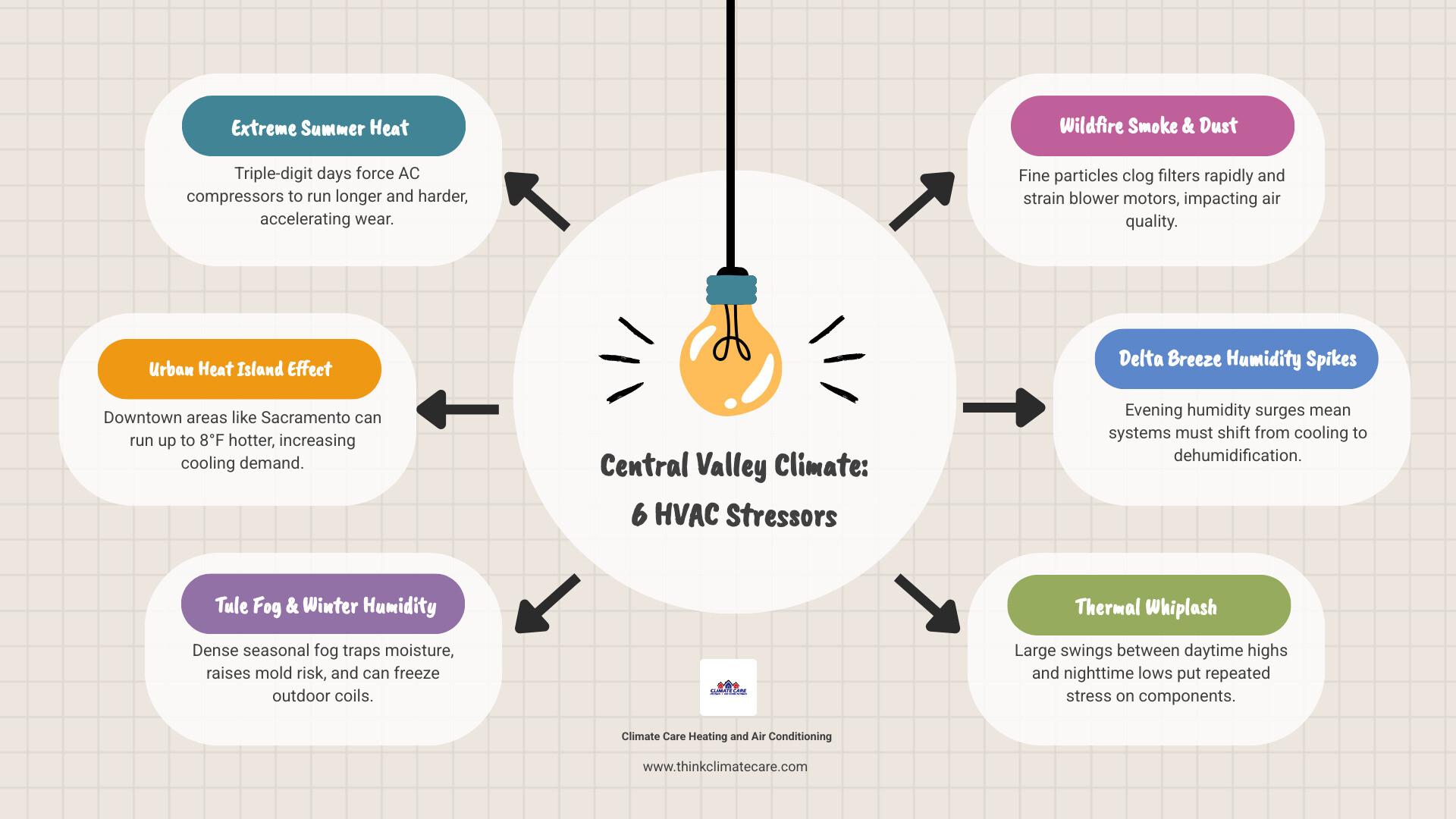
Here is a quick breakdown of the main ways Central Valley climate stresses your HVAC system:
• Extreme summer heat — Triple-digit days force your AC compressor to run longer and harder, accelerating wear
• Urban heat island effect — Downtown areas like Sacramento can run up to 8°F hotter than surrounding neighborhoods, increasing cooling demand even further
• Tule fog and winter humidity — Dense seasonal fog traps moisture, raises mold risk, and can freeze outdoor coils
• Wildfire smoke and agricultural dust — Fine particles clog filters rapidly and strain blower motors
• Delta Breeze humidity spikes — Evening humidity surges mean your system must shift from cooling to dehumidification without warning
• Thermal whiplash — Large swings between daytime highs and nighttime lows put repeated stress on mechanical components
For homeowners in Manteca, this isn't an abstract concern. At least 460 Californians died during seven major heat events over the past decade, and more than 10,000 people visited emergency rooms for heat-related illness. A well-maintained, properly sized HVAC system isn't just about comfort — it's a safety issue.
Understanding how central valley climate affects your hvac system
To truly understand how central valley climate affects your hvac system, we have to look at the unique geography of our region. We live in a giant basin. While that makes for some of the best farmland in the world, it also creates a "bowl" that traps heat, moisture, and pollutants.
In cities like Modesto, Stockton, and Sacramento, our systems aren't just fighting the temperature; they are fighting the very air around them. Urban centers experience significantly higher temperatures than the surrounding rural farmland due to asphalt and concrete soaking up the sun all day. This means while your cousin in the foothills might be enjoying a cool breeze, your AC unit in downtown Sacramento is still screaming for mercy at 10:00 PM.
Common Central Valley climate stressors include:
• Persistent Triple Digits: Long stretches of 100°F+ days that never allow the home to fully "reset."
• Agricultural Particulates: Dust from harvesting and soil preparation that acts like sandpaper on moving parts.
• Inversion Layers: Weather patterns that trap smog and smoke at ground level, forcing your filters to do double duty.
• Microclimate Variability: The difference between a home in the Delta-influenced Lodi area versus the sun-baked streets of Fresno.
Extreme Heat and the Urban Heat Island Effect
When we talk about Sacramento heat or Fresno temperatures, we aren't just talking about a "warm summer." We are talking about a relentless assault on your AC compressor. On a 105°F day, the air entering your outdoor condenser unit is already boiling. To keep your living room at a comfortable 72°F, the system has to work exponentially harder than it would in a coastal climate.
This is exacerbated by the urban heat island effect. In downtown Sacramento, temperatures can be up to 8°F higher than in nearby rural areas. This isn't just a fun fact for meteorologists; it directly impacts your Hvac System Efficiency. When the ambient air is 113°F instead of 105°F, your system may struggle to reach the set point at all.
Furthermore, we often experience "thermal whiplash." This occurs when the afternoon hits 100°F, but the dry valley air allows temperatures to plummet into the 50s or 60s at night. While the relief feels great to us, the rapid expansion and contraction of metal components in your HVAC system can lead to refrigerant leaks and electrical failures over time.
Tule Fog and Winter Humidity Challenges
Many people think HVAC stress ends when the summer heat breaks, but in the Central Valley, winter brings its own monster: the Tule fog. Occurring typically between October and February, this dense, "ground-hugging" fog is more than just a driving hazard.
Tule fog creates a temperature inversion where cold, moist air is trapped near the ground. This moisture is a nightmare for outdoor units. If you have a heat pump, the moisture from the fog can freeze on the outdoor coils. Your system then has to enter a "defrost cycle" to melt the ice, which uses more energy and temporarily stops heating your home.
High humidity during these foggy months also increases mold risks inside your ductwork. If your system isn't properly maintained, that moisture can lead to musty odors and a decline in indoor air quality. For those looking for a solution, there are many Heat Pump Benefits For Central Valley Homeowners specifically designed to handle these transitions, provided they are equipped with high-quality defrost controls.
Wildfire Smoke and Agricultural Dust Impact
As we move into April 2026, we’ve seen that wildfire season has become a permanent fixture of California life. The Central Valley, acting as that giant bowl we mentioned earlier, collects smoke from fires in the Sierras and the Coastal Ranges.
This smoke is filled with PM2.5—microscopic particles that are small enough to enter your bloodstream but large enough to destroy your HVAC blower motor. When these particles combine with the heavy agricultural dust common in places like Turlock and Patterson, your air filter can clog in as little as two weeks.
A clogged filter doesn't just mean "dirty air." It creates a vacuum effect that strains the blower motor, eventually leading to a total system burnout. To combat this, we recommend moving toward Energy Efficient Hvac systems that utilize MERV 13 or higher filtration. These filters are thick enough to catch smoke particles without suffocating your system—if the system is sized correctly to handle the increased resistance.
How central valley climate affects your hvac system efficiency
The "Delta Breeze" is our region's saving grace, but it’s also an HVAC variable. One minute the air is bone-dry, and the next, a surge of humid air from the Bay Area arrives. This fluctuation forces your system to constantly adjust its cooling profile.
Efficiency in 2026 is measured by SEER2 (Seasonal Energy Efficiency Ratio 2) ratings. In California, the minimum requirement is now 14.3 SEER2. However, in the Central Valley, a "minimum" system is often a recipe for high utility bills. Because our systems run so much longer than those in Oakland or San Jose, investing in a higher SEER2 rating (like 18 or 20) pays for itself much faster here.
If you aren't sure where your system stands, look for 5 Signs Your Hvac System Is Energy Efficient. If your unit is constantly cycling on and off or your bills are spiking despite mild weather, the Central Valley climate may have already won the battle against your aging equipment.
How to Protect Your System from Central Valley Weather
Knowing how central valley climate affects your hvac system is half the battle. The other half is taking proactive steps to ensure your home remains a sanctuary. Because our environment is so demanding, "standard" maintenance isn't enough. You need a strategy tailored to the San Joaquin and Sacramento Valleys.
If your system is showing any of the following signs, it's struggling with the local climate and needs immediate attention:
• Uneven Cooling: One room is a freezer while the other is a sauna (common in older homes with outdated ductwork).
• Frequent Cycling: The unit turns on and off every few minutes (a sign of overheating or sensor failure).
• Strange Noises: Grinding or squealing often indicates dust has infiltrated the motor bearings.
• Musty Smells: A sign that Tule fog moisture has led to biological growth in the coils.
Maintenance Strategies for Year-Round Performance
To survive a Central Valley year, we recommend a bi-annual tune-up schedule.
1. Spring (Pre-Heat Wave): We check refrigerant levels, clean the condenser coils (which are likely covered in winter mud and dust), and test the capacitor. Capacitors are the most common failure point during a July heatwave.
2. Fall (Pre-Fog): We inspect the heat exchanger for cracks and ensure the defrost cycle on your heat pump is functioning perfectly before the Tule fog sets in.
One of the most effective things you can do yourself is manage your filters. While some manuals say "change every 90 days," Central Valley residents should check theirs every 30 days. If you live near a construction site or active farmland in Lathrop or Ripon, you might even need to change it more frequently. Keeping a clean filter is the easiest way to Slash Your Energy Bills 5 Easy Hvac Cost Saving Tips For Homeowners.
Upgrading for the future: how central valley climate affects your hvac system choice
If your system was built before 2010, it was designed for a climate that arguably no longer exists. Today’s technology is much better suited for our "New Normal."
Heat Pumps are now the gold standard for our region. Since our winters are relatively mild (rarely dropping below freezing for long), a heat pump is incredibly efficient. It provides both heating and cooling from a single unit, and modern variable-speed models can adjust their output to perfectly match the Delta Breeze fluctuations.
For older homes in areas like midtown Sacramento or downtown Modesto that lack central ductwork, Ductless Mini-Splits are a game-changer. They allow you to cool specific rooms, meaning you aren't wasting money cooling an empty upstairs during a 110°F afternoon.
• Traditional Central AC — Best For: Homes with existing, high-quality ducts — Central Valley Performance: Reliable, but can be expensive to run in peak summer.
• Heat Pumps — Best For: All-season efficiency — Central Valley Performance: Excellent; handles mild winters and hot summers perfectly.
• Ductless Mini-Splits — Best For: Older homes / Additions — Central Valley Performance: Superior; allows for "zonal" cooling to save energy.
• Dual Fuel Systems — Best For: Large homes in colder valley pockets — Central Valley Performance: Best of both worlds; uses gas for extreme cold and electric for everything else.
At Climate Care Heating and Air Conditioning, we specialize in helping Manteca and surrounding residents choose Eco Friendly Hvac Solutions For A Sustainable Home. By The Future Of Hvac Embracing Smart Technology For Energy Savings, such as smart thermostats that can "pre-cool" your home before peak electricity rates hit, you can stay comfortable without breaking the bank.
Whether you are in Elk Grove, Tracy, or Turlock, our team is here to ensure your system is ready for whatever the Valley throws at it next. From urgent repairs to high-efficiency installations, we focus on holistic care that considers the unique environmental stressors of our home.
Ready to bulletproof your home against the next heatwave? Explore our Climate Care HVAC Services and join our membership plan for year-round peace of mind.