Why Temperature Swings in the Central Valley Are Hard on Your HVAC System
How temperature swings affect your heating and cooling comes down to one core problem: your system was designed to maintain steady conditions, not chase a moving target. In the Central Valley — from Manteca to Modesto and Sacramento — that target moves constantly. Tule fog rolls in overnight, mornings dip into the low 40s, and by mid-afternoon the sun has pushed temperatures into the 70s. Then it happens again the next day. And the next.
That kind of daily back-and-forth isn't just uncomfortable. It quietly wears down your heating and cooling equipment in ways that show up as higher energy bills, strange noises, uneven temperatures, and eventually — unexpected breakdowns at the worst possible time.
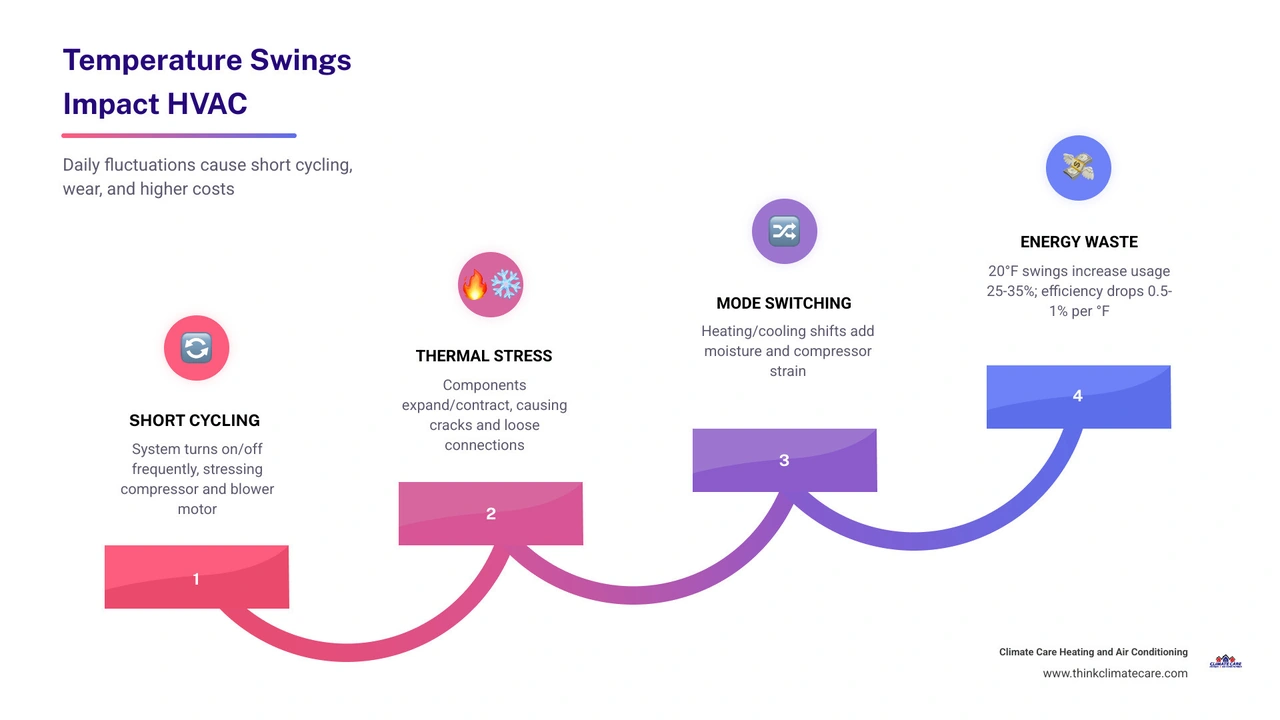
Here's a quick look at what's actually happening when outdoor temperatures fluctuate:
• Frequent short cycling — Your system turns on and off more often than it should, increasing wear on the compressor, blower motor, and ignition system
• Thermal expansion and contraction — Metal components repeatedly expand and shrink, leading to cracks, loose connections, and early component failure
• Mode switching strain — Switching between heating and cooling during spring and fall adds moisture to ductwork and stresses the compressor
• Energy waste — According to ASHRAE data, every 1°F of temperature swing can reduce HVAC efficiency by 0.5–1%, and a 20°F daily variation can push energy use up by 25–35%
• Humidity imbalance — Rapid shifts make it harder for your system to control indoor moisture, leading to muggy or overly dry air
The good news is that most of this damage is preventable with the right habits, equipment, and maintenance schedule.
How Temperature Swings Affect Your Heating and Cooling

Living in the Central Valley, we are no strangers to drastic daily shifts. Whether you are in Modesto or Stockton, your HVAC system is the unsung hero that tries to keep your indoor environment stable while the outdoor world is in chaos. When we talk about how temperature swings affect your heating and cooling, we are looking at the physical toll of rapid atmospheric changes.
The primary issue is "short cycling." This occurs when your system starts and stops frequently because the outdoor temperature is hovering right at the edge of your thermostat's set point. Instead of running a full, efficient cycle that dehumidifies and circulates air properly, the system kicks on for a few minutes, shuts off, and then kicks back on shortly after. This is like driving your car in stop-and-go traffic in downtown Sacramento; it burns more fuel and wears out the brakes and engine much faster than a steady highway cruise.
Beyond the mechanical rhythm, there is the issue of thermal expansion. HVAC systems are made of metal, plastic, and rubber. When the Tule fog clears and the afternoon sun hits your outdoor unit in Lathrop, those materials expand. When the temperature drops 30 degrees overnight, they contract. This constant "breathing" of the metal can lead to microscopic cracks and loose electrical fittings.
The Impact of Short Cycling on Energy Efficiency
Efficiency isn't just a buzzword; it’s the difference between a manageable utility bill and a shocking one. Research from ASHRAE shows that for every 1°F of temperature swing, your HVAC efficiency drops by roughly 0.5% to 1%. If you live in a region with a 20°F daily variation—which is common in the Central Valley—your energy use can skyrocket by 25–35%.
Systems in variable climates like ours work about 15–30% harder than those in stable environments. When your system short cycles, it never reaches its "steady-state" efficiency. It spends all its energy just getting the motor up to speed and the refrigerant pressurized, only to shut down before it can actually provide efficient cooling or heating. This is often exacerbated if your unit isn't the right size for your home. You can learn more by checking if a new HVAC system is properly sized for your home.
How Temperature Swings Affect Your Heating and Cooling Components
The most dangerous impact of temperature fluctuations is on the furnace’s heat exchanger. This metal component handles the combustion process. Frequent expansion and contraction from rapid cycling can cause "metal fatigue," eventually leading to cracks. A cracked heat exchanger is a serious safety hazard, as it can allow carbon monoxide to leak into your home’s air supply.
Electrical components also suffer. Capacitors and blower motors are under immense stress during the startup phase of a cycle. If a system is starting 15 times an hour instead of 3 or 4, those parts will reach their failure point years earlier than expected. Furthermore, these swings can highlight existing pressure imbalances in your HVAC installation, making certain rooms feel like a refrigerator while others feel like a sauna.
Managing Mode Switching and Moisture
In the "shoulder seasons" of spring and fall, many Central Valley homeowners find themselves running the heater in the morning and the AC in the afternoon. This constant mode switching is particularly hard on the system. When the AC runs, moisture condenses on the evaporator coils. If you suddenly switch to heat, that moisture can evaporate back into the ductwork, creating a "musty" smell often referred to as "Dirty Sock Syndrome."
This moisture doesn't just smell bad; it can lead to rust on internal components and mold growth within your vents. If you notice that your home has uneven temperature distribution, it may be a sign that these fluctuations are overwhelming your ductwork's ability to move air effectively.
• Stable (Coastal) — System Stress Level: Low — Energy Increase: 0% (Baseline) — Estimated Lifespan Impact: Full Life (15+ years)
• Moderate Swings (10°F) — System Stress Level: Moderate — Energy Increase: 12-18% — Estimated Lifespan Impact: Reduced by 1-2 years
• Extreme Swings (20°F+) — System Stress Level: High — Energy Increase: 25-35% — Estimated Lifespan Impact: Reduced by 3-5 years
Strategies to Mitigate Weather Stress in the Central Valley
While we can't control the weather in Stockton or Citrus Heights, we can control how our homes respond to it. Mitigating the effects of how temperature swings affect your heating and cooling requires a combination of smart technology and proactive maintenance.
Smart Thermostats and Variable-Speed Technology
One of the best defenses against temperature swings is a smart thermostat with "adaptive recovery." These devices learn how long it takes to heat or cool your home and adjust their schedules based on the outdoor weather forecast. Instead of a sudden, high-stress blast of air when you get home, the system gradually adjusts.
Another lifesaver is "auto-changeover" mode. This allows the thermostat to switch between heating and cooling automatically with a built-in "deadband" (a few degrees of separation) to prevent the system from fighting itself. For the ultimate in comfort, variable-speed equipment acts like cruise control for your home. Rather than being "all on" or "all off," it ramps up or down in tiny increments to match the outdoor temperature perfectly. This is a primary solution for solving hot and cold spots with HVAC installation.
Why Temperature Swings Affect Your Heating and Cooling Performance in Older Units
As systems age, they become less flexible. A unit that is 12–15 years old likely uses single-stage technology, meaning it only has one speed: 100%. In a Central Valley spring, 100% power is often overkill, leading to the short cycling we discussed earlier.
Older furnaces in Sacramento or Elk Grove may also have thinned heat exchangers that are more susceptible to cracking under thermal stress. If you find your system struggling to keep up with the morning chill or the afternoon heat, it might be time to consider modern alternatives like heat pumps or ductless mini-splits. These systems are incredibly efficient at handling fluctuations and can help in addressing uneven cooling in your home.
Professional Maintenance for Long-Term Reliability
At Climate Care Heating and Air Conditioning, we’ve seen how the Central Valley’s unique climate can punish an unmaintained system. Dust from local agriculture and pollen from our beautiful trees can clog filters and coat outdoor coils. When a filter is dirty, the system has to work even harder to pull air through, which doubles the stress caused by temperature swings.
Immediate steps you can take:
• Check your filters monthly: During high-pollen seasons in Manteca or Ripon, filters can clog faster than you think.
• Clear the outdoor unit: Ensure there are at least two feet of clearance around your AC unit. Remove any leaves, weeds, or debris that might restrict airflow.
• Keep a consistent temperature: Avoid "yo-yoing" the thermostat. Rapidly dropping the temperature by 10 degrees puts more strain on the compressor than maintaining a steady, moderate setting.
The most effective way to protect your investment is through professional tune-ups. A Climate Care technician can calibrate your system, tighten electrical connections loosened by thermal expansion, and catch microscopic cracks in your heat exchanger before they become a safety crisis. Our holistic approach ensures your system isn't just running, but running at peak cost-efficiency.
Don't wait for a 100-degree day in Roseville or a freezing night in Turlock to find out your system is failing. Schedule your professional HVAC service today and let us help you stabilize your home's comfort, no matter what the Central Valley weather throws your way. Whether you need a quick repair in Rocklin or a full system replacement in Galt, our team is ready to ensure your budget doesn't freeze along with the fog.