Is It Time to Repair or Replace Your HVAC System? Here's How to Decide
Knowing when to repair vs replace your HVAC system can save you from throwing money at a unit that's already on its way out — or from paying for a brand-new system when a simple fix would do. For homeowners in Manteca and across the Central Valley, where summer temperatures regularly push into triple digits, this decision carries real weight. Your HVAC system isn't just a convenience — your family's safety and comfort.
Quick Answer: Should You Repair or Replace?
• System is under 10 years old, minor repair needed — Recommendation: Repair
• Repair cost exceeds 50% of a new system's price — Recommendation: Replace
• System age × repair cost exceeds $5,000 — Recommendation: Replace
• AC is 10+ years old or furnace is 15+ years old — Recommendation: Start evaluating replacement
• System uses R-22 refrigerant and needs a major repair — Recommendation: Replace
• Three or more repairs in the past three years — Recommendation: Replace
• Cracked heat exchanger or carbon monoxide risk — Recommendation: Replace immediately
• First repair, system otherwise performing well — Recommendation: Repair
Most homeowners face this decision at the worst possible moment — when the AC quits during a July heatwave or the furnace stops working on a cold January night. The good news is there are clear, proven rules to guide you through it without the guesswork.
This guide walks you through every factor that matters: system age, repair costs, energy efficiency, refrigerant type, safety risks, and how the Central Valley's demanding climate affects your timeline. By the end, you'll know exactly what to do.
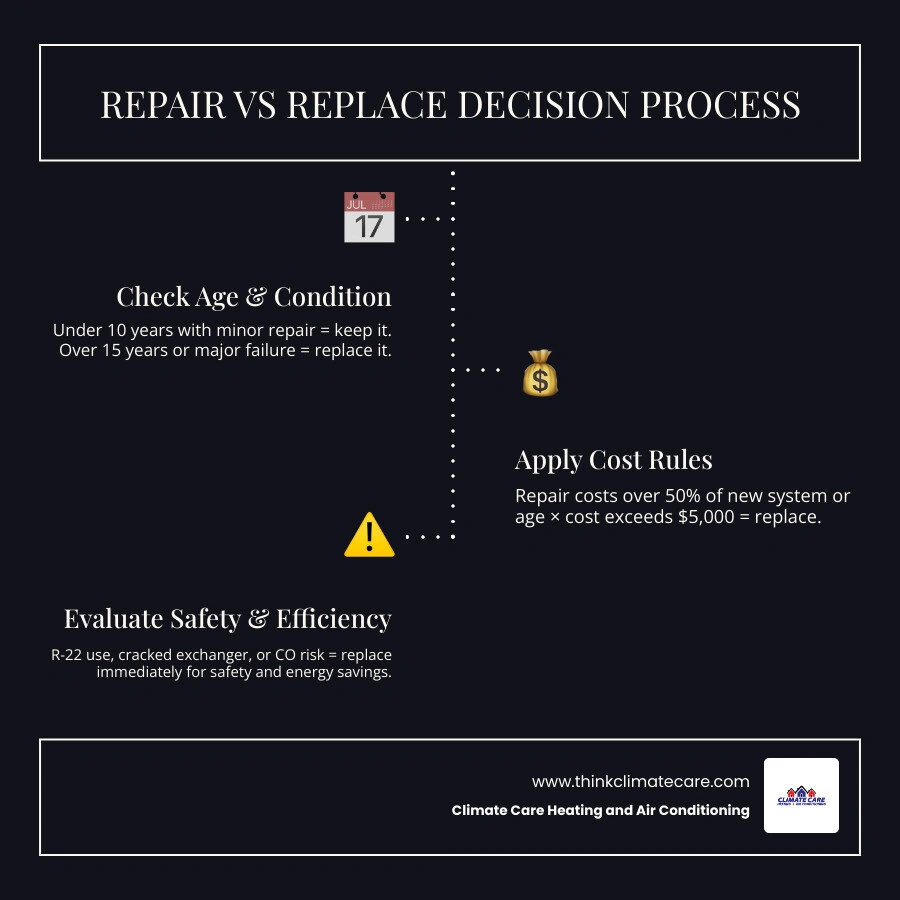
Deciding When to Repair vs Replace Your HVAC System

When your heating and cooling system starts acting up, it can feel like your home's comfort is hanging by a thread. You might ask yourself: is it smarter to keep patching up the old unit, or is it time to invest in a complete upgrade? Making an informed choice requires looking at both immediate costs and long-term value.
To help you navigate this crossroads, we have compiled comprehensive resources on Should I Repair or Replace My HVAC System and Repair or Replace: The Cost-Effective Choice for Your HVAC Needs. By analyzing your system’s performance, age, and efficiency, we can help you turn what feels like a stressful gamble into a logical, budget-friendly decision.
Applying the $5,000 Rule and the 50% Rule
To remove the emotion from the decision, the HVAC industry relies on two simple mathematical formulas: the $5,000 Rule and the 50% Rule.
1.
The $5,000 Rule: Multiply the age of your system (in years) by the written repair estimate (in dollars). If the result is over $5,000, you should replace the unit. If it is under $5,000, a repair is usually the more cost-effective choice.
- Example A: A 12-year-old AC needs a $500 repair. $12 times 500 = 6,000$. Because this exceeds $5,000, replacing the system is the smarter financial move.
- Example B: A 6-year-old system needs the same $500 repair. $6 times 500 = 3,000$. Since this is under the threshold, repairing the system is highly recommended.
2.
The 50% Rule: If a single repair costs more than 50% of the price of a brand-new system, the money is better spent on an upgrade. Investing heavily in an aging system often leads to a "repair spiral," where you find yourself paying for multiple consecutive fixes as other components fail. If you have already paid for three or more repairs over the last three years, your system is likely ready for retirement.
• The $5,000 Rule — How It Works: Age of system $times$ Repair cost — When to Repair: Total is under $5,000 — When to Replace: Total is over $5,000
• The 50% Rule — How It Works: Repair cost vs. New system cost — When to Repair: Repair is < 50% of replacement cost — When to Replace: Repair is > 50% of replacement cost
• The Frequency Rule — How It Works: Number of breakdowns in 3 years — When to Repair: 1 or 2 isolated, minor issues — When to Replace: 3 or more repairs in 3 years
How Age and Lifespan Dictate When to Repair vs Replace Your HVAC System
Even the most well-maintained systems have a natural expiration date. Understanding How Old Is Too Old for an HVAC System is crucial to timing your replacement before a catastrophic breakdown occurs.
• Central Air Conditioners: Typically last 12 to 15 years. In the scorching summers of the Central Valley, units often work double-time, meaning they may begin to decline closer to the 10-to-12-year mark. If your AC is past its tenth birthday, it is time to start researching options like HVAC Replacement Sacramento CA.
• Gas Furnaces: Generally last 15 to 20 years (and up to 25 years with meticulous annual maintenance). If your old heating unit is struggling to keep your home warm, look into our Furnace Replacement Manteca CA Guide to plan a seamless upgrade.
• Heat Pumps: Because heat pumps handle both heating and cooling duties year-round, they experience more wear and tear, typically giving them a lifespan of 10 to 15 years.
Efficiency, R-22 Phase-Out, and Environmental Factors
Modern advancements have dramatically changed the landscape of home comfort. When weighing your options, look beyond the immediate mechanical failure and consider HVAC System Efficiency.
Older systems typically operate at a fraction of the efficiency of new units. In a Standard Efficiency vs High Efficiency HVAC Comparison, a modern high-efficiency system can reduce your cooling energy consumption by 20% to 40%. Additionally, understanding What No One Tells You About Your HVAC Unit's SEER reveals that older systems (often rated at 10 SEER or lower) lose efficiency as they age. Upgrading to a modern 16 SEER2 or higher system can save you hundreds of dollars annually on utility bills.
Another critical factor is the R-22 refrigerant phase-out. R-22 (commonly known as Freon) is an ozone-depleting substance that is no longer manufactured or imported. If your aging AC uses R-22 and suffers a refrigerant leak, recharging it is incredibly expensive and serves only as a temporary band-aid.
Fortunately, upgrading to an eco-friendly system is more affordable than ever. Homeowners can take advantage of California Energy Rebates for HVAC Upgrades as well as Federal Tax Credits for Heat Pump Upgrades, which significantly reduce the upfront cost of high-efficiency systems.
Safety Red Flags and Performance Warning Signs
While efficiency and age are important financial considerations, safety is non-negotiable. Knowing the Warning Signs of HVAC System Failure can protect your family from severe hazards.
If your furnace has a cracked heat exchanger, it poses an immediate risk of carbon monoxide poisoning. This is a critical safety failure that requires an immediate system shutdown and replacement. Other warning signs include persistent electrical burning smells, yellow burner flames instead of blue, or tripped circuit breakers.
On the cooling side, pay attention to performance issues. Is Your AC Short Cycling? If your air conditioner constantly turns on and off in rapid succession, it is placing massive strain on the compressor. Be sure to familiarize yourself with the Signs Your AC Needs Repair and review these 10 Indicators You Need Professional AC Repair to catch minor electrical or airflow issues before they destroy major system components. If you are dealing with winter heating issues, consult our guide on Furnace Failure: A Guide to Spotting 5 Common Seasonal HVAC Problems to identify whether you need a quick sensor cleaning or a complete system replacement.
Local Climate Demands and When to Repair vs Replace Your HVAC System
Living in the Central Valley means our heating and cooling systems face some of the most demanding operating conditions in California. Extreme summer heatwaves in cities like Sacramento, Stockton, and Modesto require air conditioners to run almost non-stop for months. This heavy usage accelerates wear, meaning a system that might last 18 years in a milder coastal climate may only last 12 to 15 years here.
If your system is struggling to keep up with triple-digit temperatures, it might be time to stop patching it up. For tailored local guidance, check out our HVAC Replacement Elk Grove CA Guide or explore options for HVAC Replacement Stockton CA.
Many local homeowners are also transitioning to versatile, dual-fuel heat pumps. If you are interested in this highly efficient alternative, consider a Heat Pump Replacement Stockton CA or find specialized solutions for AC Replacement Sacramento CA. Beyond restoring reliable comfort, learning How a New HVAC System Increases Home Value demonstrates that upgrading your system is a powerful selling point that appeals directly to energy-conscious California buyers.
Conclusion: Making the Right Choice for Your Central Valley Home
Deciding when to repair vs replace your HVAC system doesn't have to be a stressful guessing game. By applying clear guidelines like the $5,000 rule, checking your system's age, and keeping an eye out for safety red flags, you can make a choice that protects both your family's comfort and your household budget.
At Climate Care Heating and Air Conditioning, we specialize in providing holistic, honest HVAC care to our neighbors throughout Manteca, Stockton, Modesto, and the surrounding Central Valley communities. Whether you need a quick, reliable repair to get your system back on track or are ready to transition to a high-efficiency system backed by local rebates, our licensed technicians are here to help.
Ready to make the right choice for your home's long-term comfort? Explore our comprehensive Climate Care HVAC Services or schedule a professional system evaluation with our friendly team today!