Is Your HVAC System Too Old? Here's What Every Central Valley Homeowner Should Know
How old is too old for an HVAC system is one of the most common questions homeowners ask — and for good reason. Most systems are designed to last between 15 and 20 years, but age alone doesn't tell the whole story. Performance, maintenance history, and your local climate all play a role.
Here's a quick answer by system type:
• Central Air Conditioner — Typical Lifespan: 15-20 years — Consider Replacement After: 12-15 years with declining performance
• Gas Furnace — Typical Lifespan: 15-30 years — Consider Replacement After: 15-20 years or frequent repairs
• Heat Pump — Typical Lifespan: 10-15 years — Consider Replacement After: 10 years in high-use climates
• Ductless Mini-Split — Typical Lifespan: 15-20 years — Consider Replacement After: 15 years with performance issues
• Boiler — Typical Lifespan: 20-35 years — Consider Replacement After: 20+ years depending on type
• Packaged Unit — Typical Lifespan: 12-15 years — Consider Replacement After: 12 years due to outdoor exposure
In the Central Valley — where summers in Manteca, Modesto, and Stockton regularly push temperatures well past 100°F — HVAC systems work harder and wear out faster than the national average. Nearly one in three homeowners faces a major breakdown before their system reaches its expected end of life. And older systems don't just break down more often; they silently drain your wallet by losing 20 to 40% of their original efficiency over time.
Whether you're hearing strange noises, watching your energy bills climb, or just wondering how much life your system has left, this guide will help you make a confident, informed decision.
How Old Is Too Old for an HVAC System in the Central Valley?
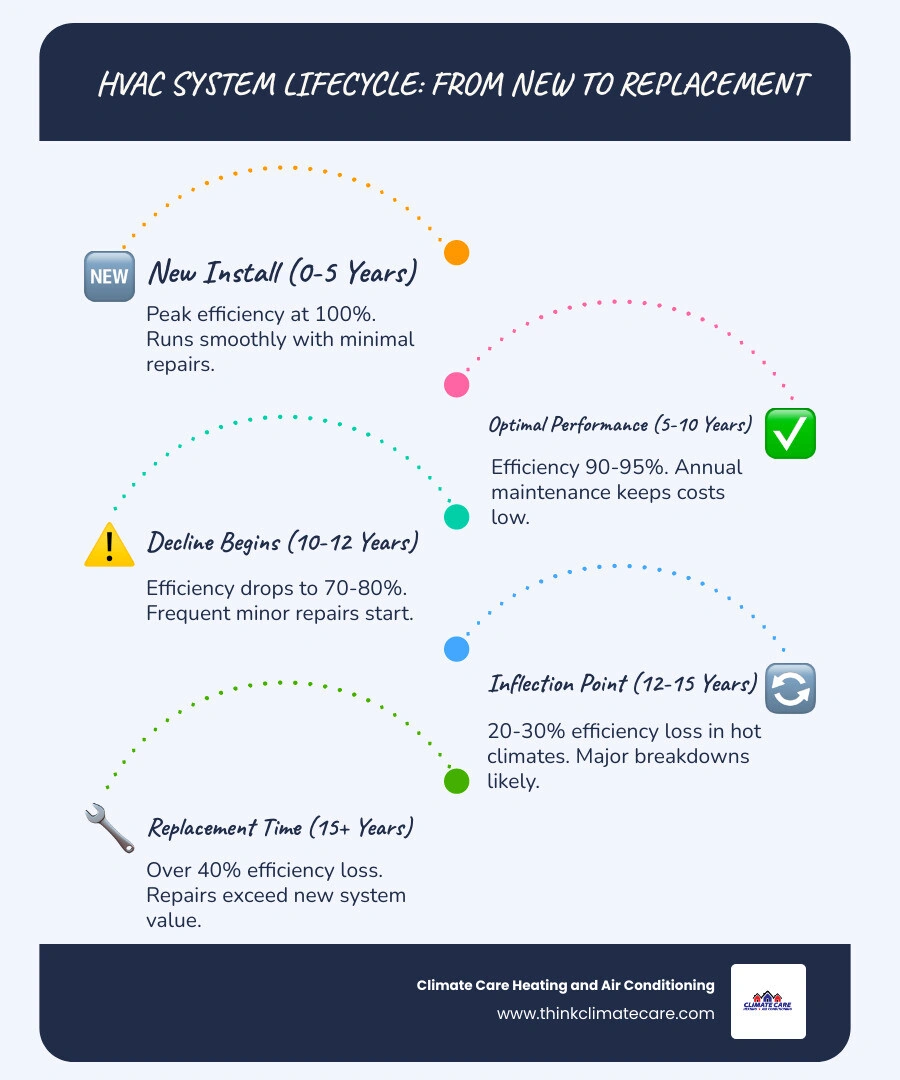
When we talk about whether a system is "too old," we aren't just looking at a number on a calendar. In our region, including cities like Lathrop and Salida, the 12-year mark is a major inflection point. By the time a central AC reaches 12 years, it has likely endured over 4,000 cooling cycles. Research shows that at this age, many units lose 20–30% of their efficiency and become significantly more prone to failure.
While a well-maintained furnace might push toward 20 or even 25 years, heat pumps often have shorter lifespans (10–15 years) because they work year-round to provide both heating and cooling. If your system is approaching these milestones, it is wise to keep a close eye on it. You can find more details on what to watch for in our guide on the warning signs of HVAC system failure.
Determining the Age of Your Current Unit
If you didn't install the system yourself, you might not know exactly when it was put in. Fortunately, your equipment carries its own "birth certificate." You can usually find the manufacturer date on the nameplate located on the backside of the outdoor compressor cabinet.
If the date isn't clearly printed, look for the serial number. Most manufacturers embed the year and week of production within the first few digits. For example, a serial number starting with "14" might indicate a 2014 build date. If you're struggling to find it, checking the signs of a failing AC system can help you assess if the unit's performance matches its suspected age.
Identifying How Old Is Too Old for an HVAC System in Your Home
Age is just one factor; performance is the real clincher. A system is definitely "too old" if it starts exhibiting these symptoms:
• Rising Utility Bills: If your usage hasn't changed but your bills in Sacramento or Elk Grove are skyrocketing, your system is likely working overtime to compensate for worn-out components.
• Uneven Cooling: Are some rooms in your house icy cold while others feel like a sauna? Older blowers and ductwork often struggle with air distribution.
• Strange Noises: Rattling, buzzing, or banging are the sounds of a system in distress.
• Frequent Repairs: If you're calling a technician once a year for a "quick fix," those costs are likely better spent on a new unit.
Safety is also a massive concern. Older furnaces can develop stress cracks in the heat exchanger, which poses a risk of carbon monoxide leaks. This is why we always emphasize the importance of annual furnace inspections to keep your family safe.
Deciding How Old Is Too Old for an HVAC System in Stockton
In Stockton, our local climate plays a massive role in equipment longevity. The high-demand environment of the Central Valley means your AC isn't just a luxury; it’s a necessity. Systems here often fail faster than those in milder coastal regions because they are maxed out for months at a time.
If your Stockton home has a unit over 15 years old, the risk of a total breakdown during a July heatwave is high. Proactive replacement allows you to choose a new system at your own pace rather than making a panicked decision when the house is 90 degrees. For those living in the area, we offer a comprehensive guide to HVAC replacement in Stockton CA to help you navigate the process.
The Impact of Refrigerant Phase-Outs on Older Units
One of the strongest arguments for replacing an aging unit involves the chemicals inside it. Older systems (typically those installed before 2010) use R-22 refrigerant, which was phased out in 2020 due to environmental standards. Because R-22 is no longer produced, repairing a leak in an old unit has become financially catastrophic, with refrigerant prices reaching several hundred dollars per pound.
Modern systems use R-410A or newer, more eco-friendly refrigerants that are much more efficient. Upgrading doesn't just help the planet; it protects you from "throwing good money after bad" on an obsolete system. Read more about making cost-effective HVAC choices to see how the refrigerant transition affects your bottom line.
When to Repair vs. Replace: The $5,000 and 50% Rules
How do you know when to stop repairing? We recommend using two simple industry "rules of thumb":
1. The $5,000 Rule: Multiply the age of your system by the cost of the repair. If the total is more than $5,000, it’s time to replace it. (Example: A 12-year-old system needing a $500 repair = $6,000. Replace it!)
2. The 50% Rule: If a single repair cost exceeds 50% of the price of a brand-new system, replacement is almost always the smarter financial move.
These rules help you avoid the "slow bleed" of maintenance expenses that provide no long-term warranty or efficiency gains. This logic is especially helpful for residents looking into HVAC replacement in French Camp CA.
Why Maintenance Matters for Aging Systems in Manteca and Modesto
Regular maintenance is like an oil change for your car; it is the only way to ensure your system reaches the upper end of its lifespan. In Manteca and Modesto, where dust and heat are constant, unmaintained systems can fail as early as year 10.
A well-maintained unit can potentially last 20 years or more, but only if the internal components are kept clean and lubricated. If you are already facing issues, check out our complete guide to furnace replacement in Modesto CA or learn how to spot furnace failure and seasonal problems before they leave you in the cold.
Conclusion: Planning Your Next Steps with Climate Care
Deciding how old is too old for an HVAC system doesn't have to be a guessing game. At Climate Care, we provide holistic HVAC care that looks at the big picture: your comfort, your safety, and your monthly energy costs. Whether you are in Manteca, Stockton, or Modesto, our local expertise ensures you get a system sized perfectly for our unique Central Valley climate.
Don't wait for a total system failure to start thinking about your home's comfort. A new, high-efficiency system can save you hundreds of dollars a year in electricity while providing peace of mind that your family will stay cool all summer long.
If you're ready to see if your system is nearing its finish line, we are here to help. From furnace replacement in Manteca CA to expert AC installations across the region, we've got you covered.
Schedule your professional HVAC assessment today and let us help you find the most cost-effective solution for your home!