Why HVAC Replacement Is a Smart Investment for Central Valley Homeowners
Understanding why HVAC replacement is a smart investment can save you thousands of dollars over the life of your home — especially here in the Central Valley, where summers regularly push past 100°F and your heating and cooling system works harder than almost anywhere else in the country. If your system is aging, breaking down more often, or driving up your energy bills, you're not alone. Most homeowners in Manteca, Modesto, Stockton, and Sacramento face the same question: is it smarter to keep patching the old system, or replace it?
Here's the short answer:
HVAC replacement is a smart investment because it delivers:
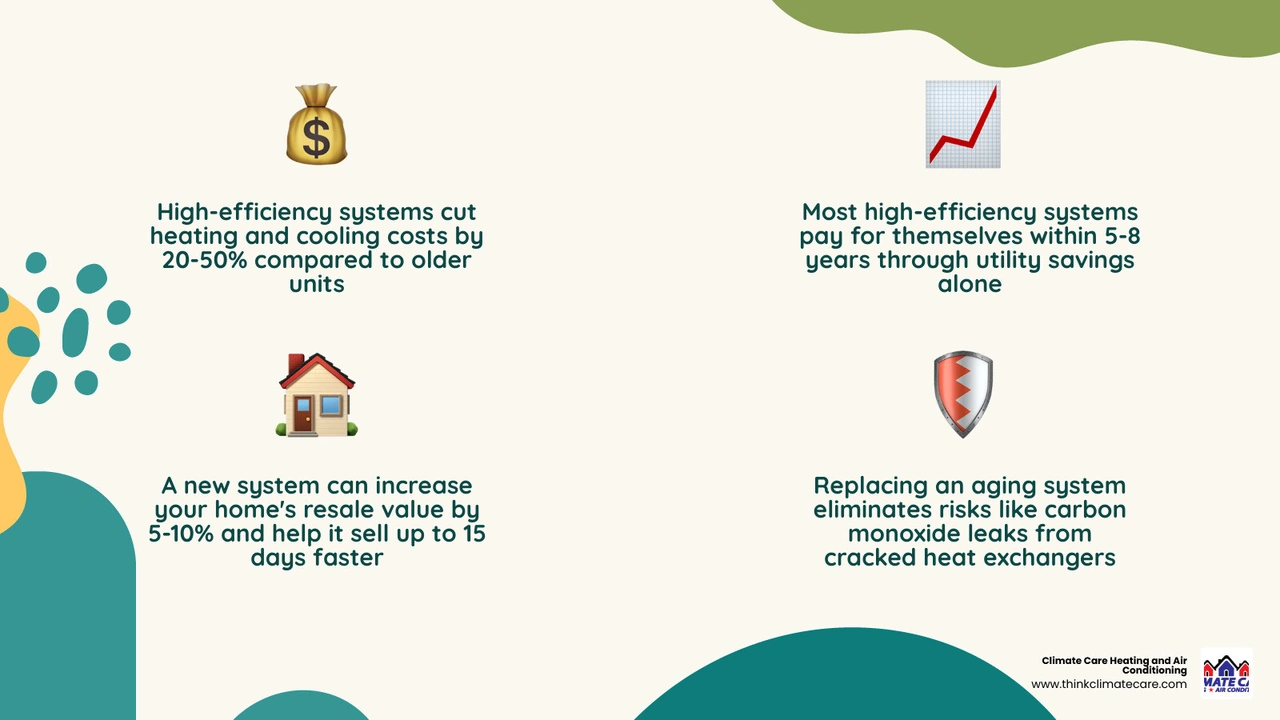
• Lower energy bills - High-efficiency systems cut heating and cooling costs by 20-50% compared to older units
• Faster payback than you think - Most high-efficiency systems pay for themselves within 5-8 years through utility savings alone
• Higher home value - A new system can increase your home's resale value by 5-10% and help it sell up to 15 days faster
• Available incentives - Federal tax credits and utility rebates can offset a significant portion of the upfront cost
• Improved safety - Replacing an aging system eliminates risks like carbon monoxide leaks from cracked heat exchangers
• Better daily comfort - Modern variable-speed systems maintain steadier temperatures and better humidity control
• Fewer surprise repair bills - Replacing before failure puts you in control of timing and cost
Heating and cooling account for up to 50% of a typical home's energy bill. That makes your HVAC system the single largest energy expense under your roof — and one of the most impactful upgrades you can make. This guide walks you through every angle of that decision, from the financial math to the safety risks, so you can make the call with confidence.
Why HVAC Replacement Is a Smart Investment
Viewing a new heating and cooling system as a proactive upgrade rather than an emergency expense changes your entire financial horizon. When you wait for a total system failure during a July heatwave in Modesto or a chilly winter night in Sacramento, you lose leverage. You face emergency scheduling, limited inventory, and rushed decisions.
Investing in a modern system proactively allows you to choose equipment engineered for long-term stability and maximum ROI. Modern units are designed to meet strict Energy Efficient HVAC standards, which dramatically lower your carbon footprint and monthly operating costs. By understanding how modern HVAC System Efficiency metrics work, you can select a system that turns your utility bills from a financial drain into a source of predictable monthly savings.

Financial Returns: Why HVAC Replacement Is a Smart Investment for Energy Savings
The single most immediate benefit of upgrading your HVAC system is the drop in your monthly energy bills. If you are replacing a unit that is 10 to 15 years old, you are likely jumping from an outdated SEER rating to a modern, high-efficiency SEER2 standard.
This upgrade can easily cut your heating and cooling costs by 20% to 50%. Over the typical 15-year lifespan of a new system, those monthly savings compound into thousands of dollars. You can find more practical ways to optimize your current setup by reading our guide on how to Slash Your Energy Bills 5 Easy HVAC Cost Saving Tips for Homeowners and checking the 5 Signs Your HVAC System Is Energy Efficient.
To make this transition even more financially attractive in 2026, homeowners can leverage a variety of financial incentives:
• Federal Incentives: Learn how to maximize your savings with Federal Tax Credits for Heat Pump Upgrades.
• State Programs: Access local funding through California Energy Rebates for HVAC Upgrades.
• Utility Programs: Central Valley residents can find specific utility-backed discounts in our PGE Rebates Central Valley Homeowners Guide.
• Tax Strategies: See how these upgrades lower your tax liability by checking out How Climate Care Can Help Cut Your Tax Bill.
Additionally, convenient Financing programs are available to help break the initial investment into manageable monthly payments, allowing the system to practically pay for itself through energy savings.
Home Value and Resale: Why HVAC Replacement Is a Smart Investment Before Selling
If you plan to put your home on the market in the near future, a new HVAC system is a powerful selling point. Modern homebuyers are highly focused on energy efficiency and avoiding immediate, out-of-pocket repair costs.
Installing a new system can boost your home’s resale value by 5% to 10%. Furthermore, real estate data shows that homes with updated HVAC systems sell up to 10 to 15 days faster than comparable properties with older units. A certified, energy-efficient system provides buyers with peace of mind, simplifies home inspections, and eliminates buyer demands for heavy concessions. For a deeper look at how this mechanical upgrade translates to market value, read our full article on How a New HVAC System Increases Home Value.
The Math of Comfort: Applying the $5,000 and 50% Rules
When faced with a broken air conditioner or furnace, you do not have to rely on guesswork. Professional technicians use two mathematical frameworks to help you decide whether to repair or replace:
1. The $5,000 Rule: Multiply the age of your system (in years) by the repair quote. If the result is over $5,000, replacement is generally the smarter financial choice. If it is under $5,000, a repair may still be a viable option.
2. The 50% Rule: If the cost of a single repair exceeds 50% of the price of a brand-new system, you should invest that money directly into a replacement.
To help you visualize these rules, look at our comparison guide: Should I Repair or Replace My HVAC System.
Repair vs. Replacement Decision Factors
• System Age — Lean Toward Repair: Under 10 Years — Lean Toward Replacement: Over 12–15 Years
• Refrigerant Type — Lean Toward Repair: Modern R-410A / R-454B — Lean Toward Replacement: Phased-out R-22 (Freon)
• Repair Cost Math — Lean Toward Repair: Age × Repair Cost < $5,000 — Lean Toward Replacement: Age × Repair Cost > $5,000
• Energy Utility Bills — Lean Toward Repair: Stable and predictable — Lean Toward Replacement: Steadily climbing
• Safety Concerns — Lean Toward Repair: None (Minor electrical/wear) — Lean Toward Replacement: Cracked heat exchanger / CO risk
Recognizing the Warning Signs of an Aging System
How do you know when your system is nearing the end of its reliable lifespan? In our local climate, typical air conditioning units and heat pumps last between 10 and 15 years, while well-maintained gas furnaces can last up to 20 years. However, our local weather plays a massive role in how fast equipment degrades.
To determine if your unit is past its prime, check out How Old Is Too Old for an HVAC System. In the Central Valley, extreme summer temperatures place incredible stress on your compressor. Learn more about this in our guides on How Hot Dry Weather Shortens HVAC Lifespan and How Central Valley Climate Affects Your HVAC System.
Additionally, agricultural dust, pollen, and persistent heat can clog coils and accelerate wear on moving parts, which is detailed in How Central Valley Dust and Heat Affect Your HVAC.
If your system relies on R-22 refrigerant (Freon), which has been phased out by the EPA, any major refrigerant leak will be incredibly expensive to patch. If you are dealing with frequent breakdowns, uneven indoor temperatures, or rising utility bills, your system is sending clear signals that it is time to upgrade.
Modern Technology: Variable-Speed Motors and Smart Thermostats
Older HVAC systems operate like a car that only has two speeds: completely off, or running at 100 mph. This constant cycling on and off wastes energy and causes significant temperature swings.
Modern systems utilize variable-speed motors. These systems run continuously at lower, quieter speeds, automatically adjusting to the exact heating or cooling needs of your home. When paired with smart thermostats and zoned cooling systems, you can control the temperature of individual rooms. This technology ensures you are not paying to cool empty spaces, while maintaining pristine indoor air quality and precise humidity control throughout your home.
Safety First: Eliminating Carbon Monoxide and Refrigerant Risks
Beyond comfort and finances, replacing an aging HVAC system is a critical safety decision. Older gas furnaces are susceptible to cracked heat exchangers. When a heat exchanger cracks, it can leak deadly, odorless carbon monoxide gas directly into your home's air supply.
Additionally, older systems with electrical wear can pose fire hazards, and those running on phased-out R-22 refrigerant are highly vulnerable to expensive, hazardous leaks. Proactively replacing your system ensures your family is protected from these silent household risks.
Making the Right Choice for Your Central Valley Home
At Climate Care Heating and Air Conditioning, we believe in a holistic approach to your home's comfort. Serving Manteca, Sacramento, Stockton, and the surrounding Central Valley communities, we focus on maximizing your system's performance, cost-efficiency, and environmental standards. We back our professional installations with a comprehensive membership plan designed to give you priority service, regular maintenance, and ongoing savings.
If you are ready to explore your options, check out our localized guides to help you make the right choice for your specific neighborhood:
• HVAC Replacement Manteca CA
• HVAC Replacement Sacramento CA
• HVAC Replacement Stockton CA
• HVAC Replacement Elk Grove CA Guide
• HVAC Replacement Lodi CA Guide
Don't wait for your system to fail during the next major California heatwave. Contact us today to Schedule Expert Service and let our licensed team design the perfect, high-efficiency system for your home.