Why Central Valley Dust and Heat Are Hard on Your HVAC System
How central valley dust and heat affect your hvac comes down to three core problems: filters clog faster, key components like coils and compressors work harder, and extreme temperatures push systems past their design limits.
Here is a quick breakdown:
• Filters: Agricultural dust, wildfire smoke, and fine particulate matter (PM2.5) clog filters in as little as 30 days instead of the typical 90
• Coils: Dust coats condenser and evaporator coils, trapping heat and forcing your system to run longer to reach the same temperature
• Compressor: Sustained triple-digit heat means your compressor rarely gets a break, accelerating wear and increasing the risk of failure
• Energy use: A dust-clogged, overworked system can use significantly more electricity — modern high-efficiency units achieve 20–40% energy savings over older, poorly maintained ones
• Cooling capacity: Most AC units are built to cool a home about 20 degrees below outdoor temperatures — when it is 105°F outside and your home sits at 88°F, your system is likely already struggling
If you live anywhere from Manteca to Fresno to Bakersfield, your HVAC system faces conditions that most general maintenance guides simply do not account for. The Central Valley's unique mix of agricultural dust, stagnant summer heat, seasonal wildfires, and the occasional failure of the Delta Breeze — the cool marine air that normally offers relief — creates one of the harshest environments for home HVAC systems in the country.
When the Delta Breeze disappears and a heat dome settles in, systems that seemed to be running fine suddenly struggle. Service calls spike. Units that ran 10 to 12 hours straight without a break start breaking down. And homeowners are left wondering why their AC cannot keep up — even though it seemed perfectly fine just weeks before.
Understanding what is actually happening inside your system is the first step to protecting it.
How Central Valley Dust and Heat Affect Your HVAC
In the Central Valley, our climate is a "cocktail" of environmental stressors. While a homeowner in a coastal city might change their filter twice a year and call it a day, we don't have that luxury. The sheer volume of particulate matter in our air—from almond harvesting in Modesto to construction dust in Lathrop—acts like a physical barrier to your comfort.
When we talk about [how central valley dust and heat affect your hvac]**, we are looking at a system under siege. During a Rocklin summer, your AC "breathes" more air in a single week than it does in an entire month during the spring. This means it is inhaling massive amounts of dust, pollen, and wildfire smoke.
Common signs that the valley environment is damaging your unit include:
• Rising Energy Bills: If your bill is spiking but your comfort isn't, your system is likely losing HVAC system efficiency.
• Longer Run Times: The unit stays on for 10–12 hours straight without reaching the thermostat setting.
• Strange Noises: Grinding or squealing often points to dust-choked motors or bearings.
• Frequent Cycling: The system turns on and off rapidly (short cycling) because it's overheating.
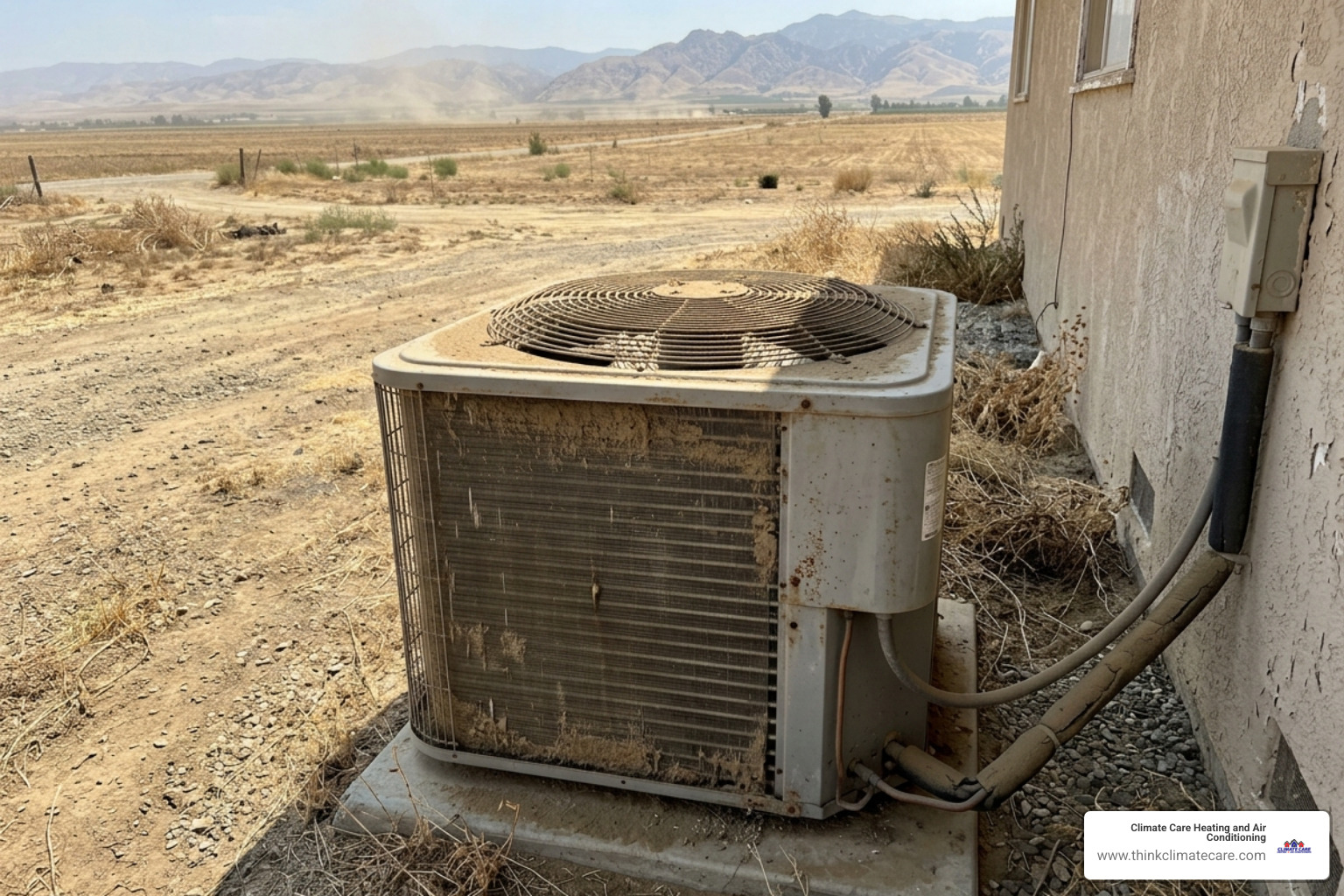
Agricultural activity is a major player here. During harvest season, the air is thick with "ag dust," which is heavier and more abrasive than standard household dust. This debris doesn't just sit on the surface; it works its way into the mechanical "joints" of your system. Combined with "heat domes"—stagnant high-pressure systems that trap hot air in the valley—your HVAC has nowhere to vent the heat it pulls from your home. For more comprehensive support, exploring our HVAC services can help identify these regional stressors before they lead to a total system collapse.
How Central Valley Dust and Heat Affect Your HVAC Filters
The air filter is your system's first line of defense, but in our region, that line is breached quickly. We recommend a strict 30-day check rule. While some filter packaging says they last 90 days, those estimates aren't based on a Sacramento Valley harvest season or a July heatwave.
Our local air contains PM2.5—ultrafine particles that are small enough to bypass cheap fiberglass filters and settle deep within your lungs and your HVAC machinery. When these particles accumulate, they create a "mat" that restricts airflow. This is why following an air filter replacement Sacramento guide is vital for local homeowners.
What happens when you don't change your HVAC air filters in this climate? The restricted airflow causes the blower motor to work overtime, leading to premature burnout. Furthermore, the impact of dirty filters on AC performance is immediate: your cooling capacity drops, and the air inside your home begins to feel "heavy" and dusty. If you have pets or do a lot of indoor cooking, you might even need to swap that filter every three weeks during the peak of summer.
How Central Valley Dust and Heat Affect Your HVAC Components
If the filter is the shield, the internal components are the heart of the system. Dust and heat work together to degrade these parts in specific, measurable ways.
• Evaporator Coils — Impact of Dust & Heat: Dust creates an insulating layer, preventing the refrigerant from absorbing heat. — Resulting Symptom: AC coils keep freezing even in 100°F weather.
• Condenser Fins — Impact of Dust & Heat: Dirt blocks the release of heat to the outdoors, creating a "heat bubble" around the unit. — Resulting Symptom: System blows lukewarm air or shuts down entirely.
• Compressor — Impact of Dust & Heat: High ambient heat increases refrigerant pressure, forcing the compressor to work at its physical limit. — Resulting Symptom: Total system failure or "hard starting" (shaking/loud noise on startup).
• Blower Motor — Impact of Dust & Heat: Dust accumulation on blades creates weight imbalance and friction. — Resulting Symptom: Weak airflow from vents and increased electrical draw.
Regular AC maintenance is the only way to ensure these components stay clean. When dust coats the indoor evaporator coil, it can actually cause the moisture in the air to freeze on contact with the dirt, leading to a block of ice inside your furnace or air handler. This is a primary reason why your AC unit freezes up during the hottest weeks of the year.
The Impact of Stagnant Heat and the Delta Breeze Delusion
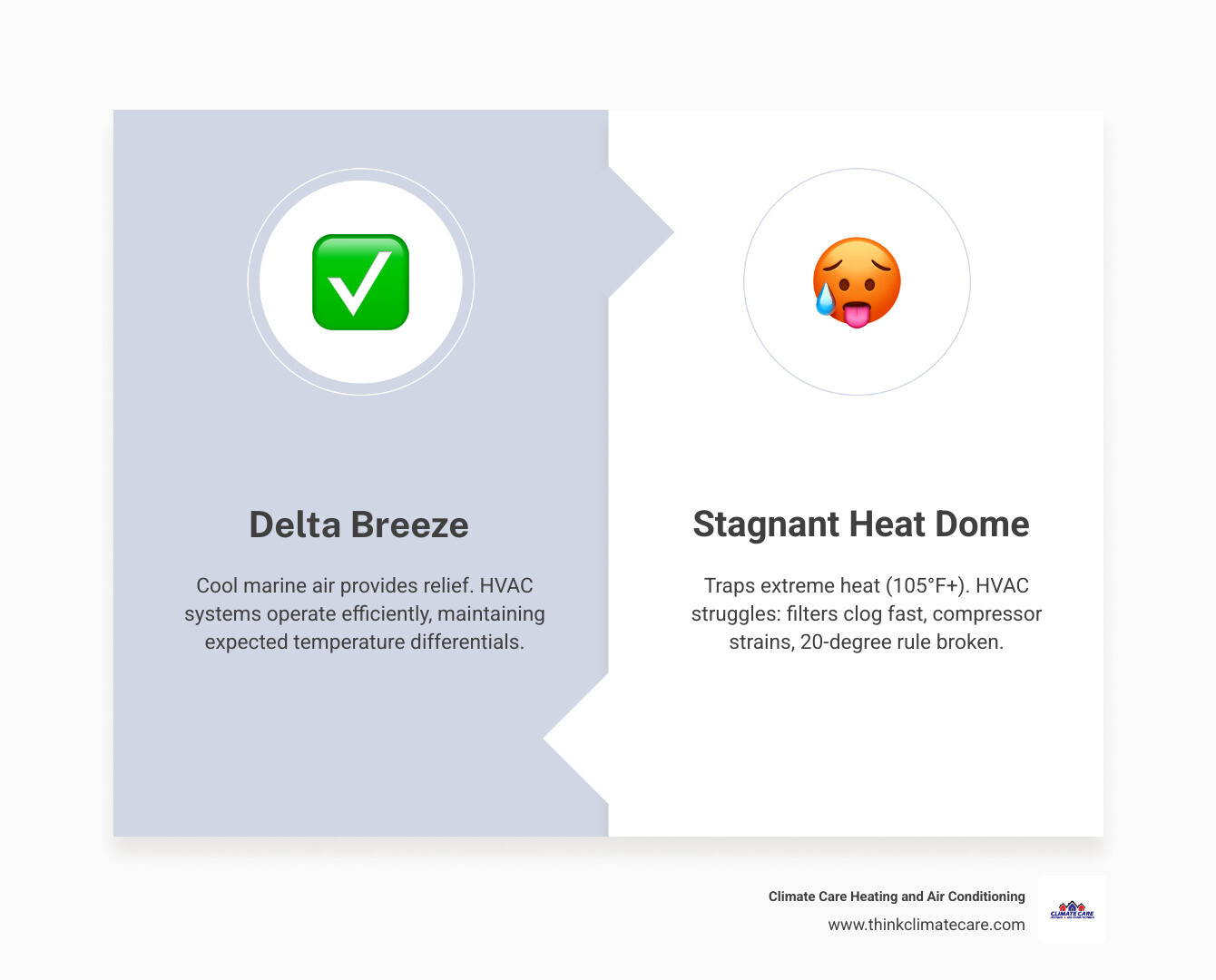
Living in places like Roseville or Rocklin, we often rely on the "Delta Breeze"—that cool, marine air that flows in from the San Francisco Bay—to give our ACs a break at night. However, relying on this can create what we call the "Delta Breeze Delusion."
When a high-pressure heat dome settles over the valley, it blocks the Delta Breeze. Without that nightly cooling, your home retains "radiant heat" in the walls, attic, and furniture. By 6:00 PM the next day, your AC is fighting a losing battle. This leads to HVAC system not cooling effectively because the unit never had a chance to "reset" overnight.
If you notice your AC blowing hot air during a stagnant heatwave, it’s often because the outdoor unit is surrounded by a bubble of trapped, hot air and cannot dissipate the heat it’s removing from your house. This constant strain is one of the most common signs of a failing AC system. When the breeze dies, your HVAC's hidden vulnerabilities—like low refrigerant or dirty coils—suddenly become emergency repairs.
Proactive Maintenance Strategies for Central Valley Homeowners
You don't have to be a victim of the valley weather. While we face unique challenges, a proactive approach can extend your system's life by years. Investing in preventive AC maintenance is a smart way to avoid the stress of a mid-July breakdown.
Here are some DIY steps every Central Valley homeowner should take:
1. Clear the Perimeter: Keep at least two feet of clear space around your outdoor unit. Trim back bushes and remove weeds that trap heat and dust.
2. Gently Rinse the Coils: With the power off, use a garden hose (not a pressure washer!) to gently rinse dust from the outdoor condenser fins.
3. Check Your Ducts: Look for visible gaps or disconnected sections in your attic. In our dry heat, duct tape can fail, and wood can contract, creating leaks.
4. Monitor the 20-Degree Rule: If it’s 105°F outside, your AC is designed to keep your home at roughly 85°F. If you're hitting that mark, your system is working correctly. If it's 90°F inside, you need a HVAC system diagnostic.
For those in the Sacramento area, our HVAC preventative maintenance Sacramento guide provides a deeper dive into seasonal timing and local requirements.
Choosing the Right Filtration for Dust and Pollen
In the Central Valley, the "standard" blue fiberglass filters are almost useless against the fine silt and pollen we deal with. However, you can't just throw the thickest filter possible into your system without consequences.
When looking at HEPA vs. MERV filters, we generally recommend a MERV 8 to 11 for most homes. This provides a perfect balance: it's strong enough to catch ag dust and mold spores but doesn't create so much "static pressure" that it chokes your blower motor.
If you live in high-dust areas like Ceres or Salida, you might consider whole-house air filtration in Modesto, CA or an air scrubber. These systems work alongside your HVAC to neutralize pollutants. If you already have one and aren't seeing results, check out our air scrubber troubleshooting tips to ensure your indoor air quality remains high even during wildfire season.
When to Call a Professional for Heat-Related Issues
Some problems go beyond a simple filter change. In the Central Valley, small issues turn into big ones very quickly because the system runs so frequently. You should call for AC repair services if you notice:
• Ice on the Refrigerant Lines: This is never normal and usually indicates a leak or a severely restricted airflow issue.
• Weak Airflow: If the air coming out of the vents feels like a faint whisper, your blower motor or coils are likely packed with dust.
• Energy Spikes: A sudden 20-30% jump in your utility bill without a change in usage is a red flag.
• Strange Smells: A "burning" smell often means a motor is overheating due to friction from dust.
Understanding how often you should service your HVAC unit is key—in our region, twice a year (once before the heat and once before the Tule fog) is the gold standard. We focus on addressing air quality with HVAC service because we know that a clean system isn't just about temperature; it's about the health of your family.
Long-Term Solutions for Extreme Climate Resilience
At Climate Care Heating and Air Conditioning, we believe your home should be a sanctuary from the valley's harsh elements. If your system was installed before 2010, you are likely missing out on significant energy efficient HVAC technology. Modern variable-speed compressors can adjust their output to handle 110-degree days much more gracefully than older "on/off" models.
Another critical long-term fix is air duct sealing. In the Central Valley, up to 30% of your cooled air can be lost to leaky ducts in a hot attic. Sealing those leaks ensures that the air you're paying to cool actually makes it into your living room instead of cooling your insulation.
Whether you are in Manteca, Stockton, or Elk Grove, our team is here to provide holistic HVAC care. We don't just fix parts; we optimize your system to thrive in the specific dust and heat of the Central Valley. Our comprehensive membership plans offer priority service and significant savings, ensuring that when the Delta Breeze dies down, your home stays cool.
Ready to protect your home from the valley heat? Contact us for professional HVAC Maintenance in Manteca, CA and ensure your system is ready for whatever the summer throws at it.