Why So Many Central Valley Homeowners Are Ditching AC for Natural Cooling
Understanding how whole house fans cool your home naturally starts with one simple idea: move hot air out, pull cool air in — no refrigerant, no compressor, no massive energy bill.
Here's the quick answer:
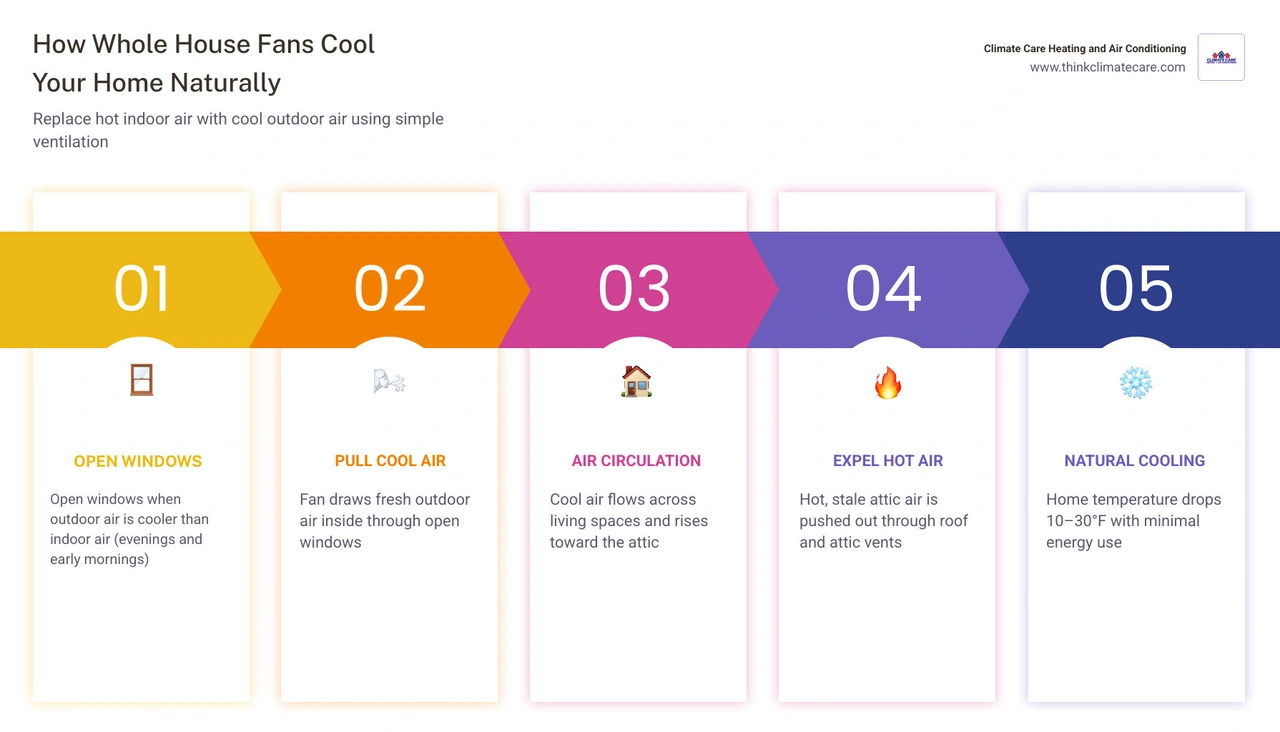
1. Open a few windows when outdoor air is cooler than indoor air (typically evenings and early mornings).
2. The fan pulls cool outdoor air in through those open windows.
3. Air flows across your living space and up into the attic.
4. Hot, stale attic air is pushed out through roof and attic vents.
5. Your home cools down — often by 10–30°F — using a fraction of the energy that central AC requires.
That's it. No refrigeration cycle. No ductwork full of recycled air. Just clean, fresh air moving through your home the way nature intended.
For homeowners in Manteca, Modesto, and the greater Sacramento area, this matters a lot. Central Valley summers are brutal — triple-digit days are common — but so are the dramatic overnight temperature drops that make whole house fans incredibly effective here. While your AC fights to keep up during the day, a whole house fan can do the heavy lifting at night, cutting your cooling costs by as much as 50–90% according to the U.S. Department of Energy.
The difference between struggling through a hot summer and staying comfortable without a sky-high utility bill often comes down to having the right ventilation strategy in place.
How Whole House Fans Cool Your Home Naturally
Unlike a standard air conditioner, which relies on a closed-loop system to recirculate and chemically chill the same indoor air over and over, a whole house fan utilizes an open-loop ventilation system. This process leverages basic thermodynamic principles to replace hot, stagnant indoor air with crisp, cool outdoor air.
During a typical summer day in Tracy, Stockton, or Sacramento, your home acts like a greenhouse, trapping solar radiation. This heat builds up in your drywall, framing, furniture, and especially your attic. In fact, on a 100°F day, attic temperatures can easily soar to between 130°F and 160°F. This creates an "attic heat blanket" that radiates heat downward into your living spaces long after the sun has set.
When you turn on a whole house fan, it acts as the "lungs" of your home. It pulls large volumes of cool evening air through strategically opened windows, drawing it across your living spaces and blowing it up into your attic. This high-volume airflow does three things simultaneously:
• Creates an Instant Breeze Chill Factor: The active movement of air across your skin makes you feel up to 10°F cooler instantly, even before the actual temperature of the room drops.
• Flushes the Attic Heat Blanket: By forcing the superheated air out of your attic vents, it eliminates the thermal pressure pushing down on your ceilings.
• Improves Indoor Air Quality (IAQ): Instead of trapping allergens, cooking odors, pet dander, and airborne pathogens, the fan completely purges your home's air volume. This matches EPA guidance recommending increased outdoor air ventilation to protect indoor spaces from airborne viruses.
By regularly flushing out the stale air, you enjoy a healthier, fresher living environment. You can read more about these structural and health advantages in our guide on The Benefits of Whole House Fans.
The Science of How Whole House Fans Cool Your Home Naturally through Thermal Mass
To understand why a whole house fan is so effective, we have to look at "thermal mass cooling." Every home is made of heavy materials: wood framing, drywall, plaster, concrete foundations, and tile floors. Throughout a hot Central Valley afternoon, these materials absorb and store heat like a giant thermal battery.
If you only cool your home's air with a traditional AC, the moment you turn the system off, the stored heat in your walls and furniture radiates back into the air, quickly warming the house back up. This is why your AC might cycle on and off all night long.
A whole house fan solves this by performing what is known as "night flushing." By moving a massive volume of air—typically fully exchanging the home's entire air volume 15 to 20 times per hour (or about once every 3 to 4 minutes with a properly sized system)—the cool air actively draws the heat out of your home’s physical structure.
Over the course of the night, the fan cools the actual building materials. By morning, your walls, floors, and furniture are deeply pre-cooled, acting as a "coolness reservoir" that keeps your home comfortable well into the following afternoon. To explore how to maximize this process during the peak of summer, check out our breakdown of Nighttime Cooling Benefits with Whole House Fans.
Comparing Energy Savings: Whole House Fans vs. Traditional AC
When it comes to your monthly utility bills, the difference between running a whole house fan and a central air conditioner is staggering. A standard 3-ton central AC unit consumes roughly 2,000 to 5,000 watts of electricity to run its compressor and blower motor. In contrast, a high-efficiency whole house fan uses only 200 to 600 watts—with some advanced models operating on as little as 67 watts on low speed.
Because a whole house fan uses just 1/10th the energy of an AC unit, running it costs mere pennies per hour. Over the course of a hot cooling season in Modesto, Elk Grove, or Ripon, this translates to cutting your air conditioning electricity usage by up to 80% to 90%.
Furthermore, by utilizing natural ventilation during the cooler evening and morning hours, you significantly reduce the workload on your central air conditioner. Instead of running your AC hard for 12 hours a day, you might only need it for 2 or 3 hours during the hottest part of the afternoon. This reduced wear and tear can extend the lifespan of your AC unit from the typical 15 years up to 30 years, saving you thousands in premature replacement costs.
• Central Air Conditioner (3-Ton) — Average Wattage: 2,000 – 5,000 Watts — Energy Consumption: 100% (Baseline) — Estimated Hourly Cost: High — Impact on AC Lifespan: High wear and tear
• Whole House Fan — Average Wattage: 200 – 600 Watts — Energy Consumption: 10% – 20% of AC — Estimated Hourly Cost: Pennies per hour — Impact on AC Lifespan: Extends AC life up to 2x
To see how these numbers translate directly to your wallet, read our detailed analysis on How a Whole House Fan Reduces Cooling Costs and discover more about long-term Energy Savings with Whole House Fans.
Sizing, Installation, and Best Practices for Central Valley Homes
Operating a whole house fan is simple, but ensuring it runs efficiently and safely requires careful planning, sizing, and professional installation.
First, the fan must be sized correctly for your home's total volume. The Department of Energy recommends that a whole house fan provide an airflow rate of at least 0.5 Cubic Feet per Minute (CFM) per cubic foot of home volume. For example, if you live in a 2,000-square-foot home with 8-foot ceilings, your home’s volume is 16,000 cubic feet. To cool this space effectively, you would need a fan rated for at least 8,000 CFM.
Second, you must have adequate attic ventilation to exhaust the massive amount of air being pushed upward. If you do not have enough roof vents, soffit vents, or gables, the fan will create positive pressure in the attic, pushing hot attic air and dust back down through ceiling cracks into your living space. The gold standard formula is 1 square foot of net free vent area for every 750 CFM of fan capacity. An 8,000 CFM system, therefore, requires roughly 10.6 square feet of unobstructed attic ventilation.
Finally, managing your windows is crucial. You must open a selection of windows before turning the fan on. If you run the fan with all windows closed, it can create a powerful vacuum. This depressurization can cause "backdrafting," pulling toxic carbon monoxide and exhaust gases down your water heater or furnace flue and directly into your breathing air. If you are experiencing poor airflow or want to optimize your current setup, read our guide on Fixing Airflow Problems with Whole House Fan.
Step-by-Step: How Whole House Fans Cool Your Home Naturally and Safely
To get the absolute most out of your system, follow this daily operating schedule during the warm spring, summer, and autumn months:
1. Check the Outdoor Temp: Wait until the outdoor air temperature drops below your indoor home temperature (typically after sunset, when it dips below 80°F).
2. Open Windows Strategically: Open a few windows (about 3 to 6 inches each) in the rooms you want to cool first, such as your living room or kitchen.
3. Close Your Fireplace: Double-check that your fireplace damper is fully closed to prevent soot from being pulled into your living room.
4. Turn the Fan On: Set your fan to high speed to quickly flush out the daytime heat and establish an active cooling breeze.
5. Adjust for Sleep: At bedtime, close the windows in the unoccupied main areas of the house and open the windows in your bedrooms. This draws the cool night breeze directly across your bed. You can turn the fan to a lower, quieter speed to run overnight.
6. The Morning Flush: Run the fan for an hour or two early in the morning when the outdoor air is at its absolute coldest.
7. Lock in the Coolness: Shut the fan off and close all windows and blinds before the outdoor temperature begins to rise. This locks the pre-cooled thermal mass inside, allowing you to go deep into the afternoon before needing to turn on your AC.
For a deeper dive into modern smart controls, timers, and seasonal tips, check out our QuietCool Whole House Fan Guide 2026.
Professional Sizing and Installation in Manteca and Sacramento
While DIY videos make attic projects look easy, installing a whole house fan involves cutting into your ceiling joists, running dedicated electrical circuits, sealing attic penetrations to prevent winter heat loss, and ensuring precise attic ventilation calculations.
At Climate Care Heating and Air Conditioning, we provide holistic HVAC care to homeowners throughout the Central Valley and Sacramento regions. Our certified technicians evaluate your home's layout, calculate your exact CFM requirements, inspect your attic venting, and safely install the perfect system tailored to your property.
Whether you are looking for a Whole House Fan Manteca CA or need a professional team to install a Whole House Fan Sacramento CA, we are here to help you transition to a cleaner, greener, and far more affordable way of keeping comfortable.
Ready to transform your home's comfort and start saving up to 90% on your summer cooling costs? Explore our complete range of high-efficiency Whole House Fans and schedule your professional installation with Climate Care Heating and Air Conditioning today!