How a Whole House Fan Reduces Your AC Workload
How a whole house fan reduces your AC workload comes down to one simple idea: instead of forcing your air conditioner to cool every cubic foot of hot indoor air from scratch, a whole house fan flushes that heat out and pulls cool outdoor air in — so your AC runs less, works less, and lasts longer.
Here's a quick breakdown of how it works:
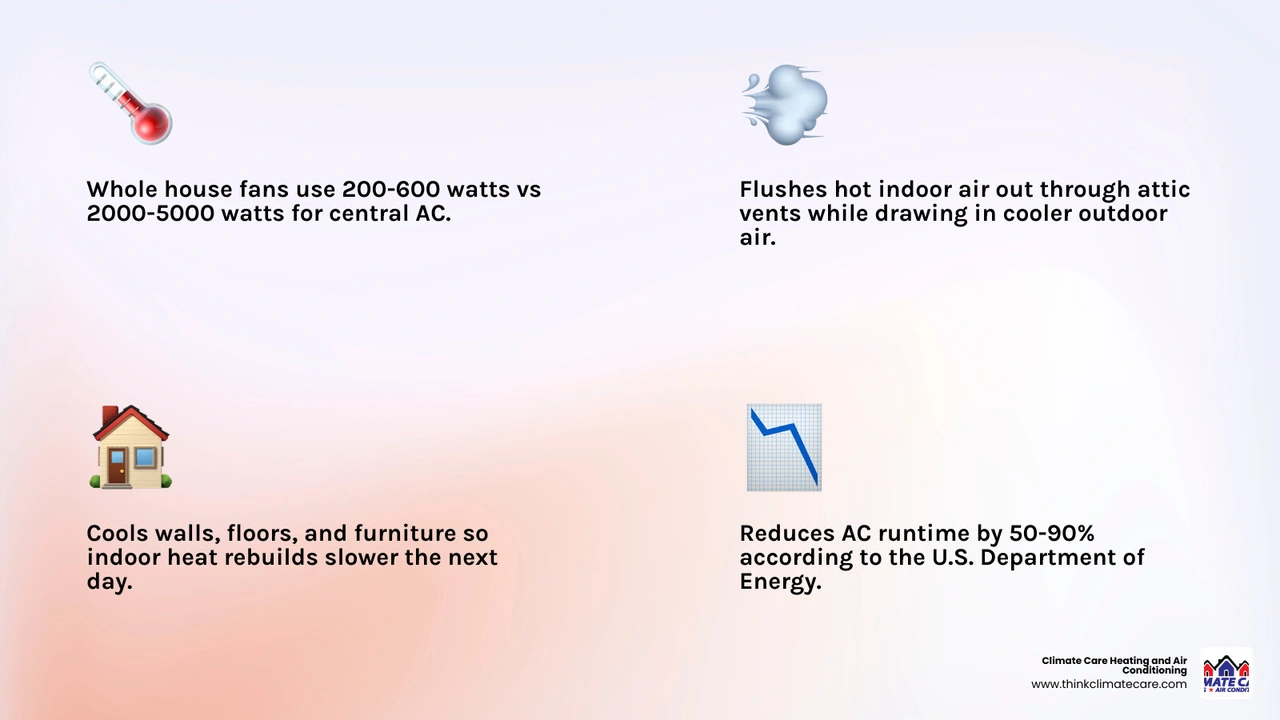
• Exhausts hot indoor air up through the attic and out through roof vents
• Draws in cooler outdoor air through open windows during evenings and mornings
• Cools the thermal mass of your home — walls, floors, and furniture — so heat doesn't rebuild as fast the next day
• Reduces AC runtime by 50–90%, according to the U.S. Department of Energy
• Uses a fraction of the energy — typically 200–600 watts compared to 2,000–5,000 watts for central AC
If you live in Manteca or anywhere in the Central Valley, you know summer heat is no joke. Daytime temperatures regularly push into triple digits, and your AC runs almost constantly just to keep up. That kind of demand drives up electricity bills and puts serious wear on your cooling system. A whole house fan gives your AC a much-needed break by handling the heavy lifting during the cooler parts of the day, so your system only needs to kick in during peak afternoon heat.
The result? Lower energy bills, less strain on your AC, and a more comfortable home — without replacing your entire HVAC setup.

When we look at the high cost of summer electricity in the Central Valley, the primary culprit is always the air conditioning compressor. A standard central AC unit acts like a heavy-duty mechanical heat pump, consuming vast amounts of electricity to squeeze heat out of recirculated indoor air.
By integrating a whole house fan into your home comfort strategy, you dramatically lower your dependence on this power-hungry process. Instead of leaving your AC on a 24-hour cycle, you can switch it off during the cooler hours of the morning and evening. The fan takes over, drawing in the fresh outdoor air for pennies on the dollar.
Because a whole house fan operates on a fraction of the power required by a compressor, this simple shift can reduce your monthly cooling energy consumption by up to 90%. Over a typical hot summer in Modesto or Stockton, this partnership keeps your home perfectly comfortable while preventing the high utility bills that usually arrive with peak summer heat. For a deeper look at these economic benefits, see our guide on How a Whole House Fan Reduces Cooling Costs.
The Science Behind How a Whole House Fan Reduces Your AC Workload
To understand why this system is so effective, we have to look at how heat behaves inside your home. Throughout a hot Central Valley day, solar radiation beats down on your roof. This heat transfers directly into your attic, where temperatures can soar between 120°F and 150°F. This trapped attic heat acts like an overhead radiator, constantly pushing warmth down through your ceilings and into your living spaces long after the sun goes down.
A whole house fan breaks this cycle by creating a powerful, high-volume airflow path:
1. Intake: When you open a few windows and turn on the fan, it pulls cool outdoor air directly into your living spaces.
2. Upward Draft: The fan draws this refreshing air up through the ceiling intake grille.
3. Exhaust: The hot, stale indoor air — along with the superheated air trapped in your attic — is forced out through your roof, gable, or soffit vents.
By replacing the entire volume of indoor air 15 to 20 times per hour, the fan replaces stale, hot air with crisp outdoor air in just minutes. This rapid air exchange prevents attic heat from radiating downward, lowering the ambient temperature of your home naturally. To learn more about how this system transforms home comfort, check out The Benefits of Whole House Fans.
Thermal Mass Cooling: How a Whole House Fan Reduces Your AC Workload Daily
One of the most overlooked aspects of home cooling is "thermal mass." Every physical object in your home — drywall, framing studs, hardwood floors, and furniture — absorbs and stores heat during the day. This stored heat acts like a battery, slowly radiating warmth back into your rooms even if your air conditioner has cooled the air itself. This is why your second floor can still feel stifling at 9:00 PM, even when the outdoor air has cooled down.
Whole house fans solve this through a process called "night flushing." By running the fan on a low speed overnight, you create a continuous, gentle breeze across these solid surfaces. This active airflow extracts the stored heat directly out of your home's structure.
When you cool the thermal mass of your home overnight, your walls and furniture act as a "cool battery" the next morning. When the daytime heat returns, it takes hours longer for your home to warm up. Your air conditioner won't need to turn on until much later in the afternoon, significantly reducing its daily runtime and extending its overall lifespan. Read more about utilizing this strategy in our article on Nighttime Cooling Benefits with Whole House Fans.
Comparing Whole House Fans, Attic Fans, and Ceiling Fans
Homeowners often confuse whole house fans with other residential fan options. While all three improve airflow, they serve entirely different purposes in managing your HVAC efficiency.
• Primary Purpose — Whole House Fan: Cools the entire home and attic by exchanging indoor air with outdoor air — Attic Fan: Exhausts hot air only from the attic space to reduce heat transfer — Ceiling Fan: Circulates indoor air to create a wind-chill cooling effect on skin
• Air Source — Whole House Fan: Fresh outdoor air pulled through open windows — Attic Fan: Air drawn through soffit or intake vents in the attic — Ceiling Fan: Recirculated indoor air
• Typical Wattage — Whole House Fan: 200 – 600 watts — Attic Fan: 40 – 300 watts — Ceiling Fan: 15 – 75 watts
• AC Workload Impact — Whole House Fan: High (reduces AC runtime by 50–90%) — Attic Fan: Moderate (reduces heat radiating from ceiling) — Ceiling Fan: Low (only cools people, does not lower air temperature)
While attic fans are excellent for protecting your roof and ceiling insulation from extreme heat, they do not directly cool your living spaces. Ceiling fans are perfect for localized comfort while you are in the room, but they don't lower the actual indoor temperature. A whole house fan is the only system of the three designed to cool the entire structure of your home. To explore modern, ultra-quiet options, read our specialized resource on QuietCool Cooling.
Maximizing Efficiency: Sizing, Ventilation, and Best Practices
To get the most out of your system and ensure you are safely reducing your air conditioner's workload, proper installation and operation are key. Simply putting a fan in the ceiling is only half the battle; the system must be tailored to your home’s specific layout and ventilation capacity. If you encounter draft issues or poor performance, troubleshooting with our guide on Fixing Airflow Problems with Whole House Fan can help get your system back on track.
Installation Requirements and Attic Ventilation Needs
A whole house fan cannot perform efficiently without proper exit paths. If your attic does not have enough venting, the fan will create back-pressure, forcing hot attic dust and air back down into your living spaces through ceiling cracks or light fixtures.
To prevent this, we calculate the Net Free Vent Area (NFVA) before every installation. The general building science standard is 1 square foot of net free vent area for every 750 CFM (Cubic Feet per Minute) of fan capacity.
Sizing the fan correctly is equally critical. To achieve the ideal 15 to 20 air changes per hour, we size systems based on your home's total square footage and ceiling height. A fan that is too small won't cool the thermal mass effectively, while an oversized fan without adequate venting will struggle to breathe. For help choosing the right configuration for your layout, explore the QuietCool Products and System Options.
Operational Tips for Maximum Efficiency
To maximize your energy savings in the Central Valley, timing is everything. Our region experiences a fantastic diurnal temperature swing — meaning that even after a 100°F day, our evening temperatures often drop comfortably into the 60s.
To run your system with peak efficiency:
• Wait for the Pivot Point: Do not turn on your fan until the outdoor air temperature drops below your indoor temperature (usually around 6:00 PM to 8:00 PM).
• Manage Your Windows: Open windows in the rooms you want to cool first. You only need to open them 3 to 6 inches. Ensure you have at least 4 square feet of open window area for every 1,000 CFM of fan airflow to prevent indoor depressurization.
• Never Run AC and the Fan Together: Operating both at the same time is a major waste of energy, as the fan will simply exhaust your expensive, air-conditioned air right out of the roof.
• Seal Up During the Day: Turn the fan off and shut your windows before the sun starts warming things up in the morning to lock in that crisp, overnight thermal mass cooling.
For more strategic tips on lowering your utility bills, check out our resource on QuietCool Energy Savings.
Conclusion
Integrating a whole house fan into your home comfort plan is one of the smartest, most eco-friendly upgrades you can make for your Central Valley home. By leveraging our naturally cool evenings in Manteca, Modesto, Stockton, and Sacramento, you can give your hard-working air conditioner a much-needed break, extend its lifespan, and slash your monthly utility bills.
At Climate Care Heating and Air Conditioning, we specialize in holistic HVAC care that keeps your home comfortable, healthy, and highly efficient. Whether you are ready to install a new, whisper-quiet system or need to optimize your home's attic ventilation, our licensed, local team is here to help.
Ready to breathe easier and save more? Discover how we improve indoor air quality with QuietCool Ventilation and IAQ, browse our comprehensive QuietCool Whole House Fan Guide 2026, or dive deeper into the financial benefits with our guide on Energy Savings with Whole House Fans.
To find the perfect setup for your home, visit our dedicated whole-house-fans page and schedule your professional consultation today!