How Much Energy Can a High-Efficiency HVAC System Save in Manteca?
How much does a high efficiency system save is one of the most important questions a Manteca homeowner can ask before upgrading HVAC equipment — and the short answer is: it can reduce energy use noticeably when the system is properly matched to the home.
Here is a quick breakdown of typical energy-use reduction by upgrade type:
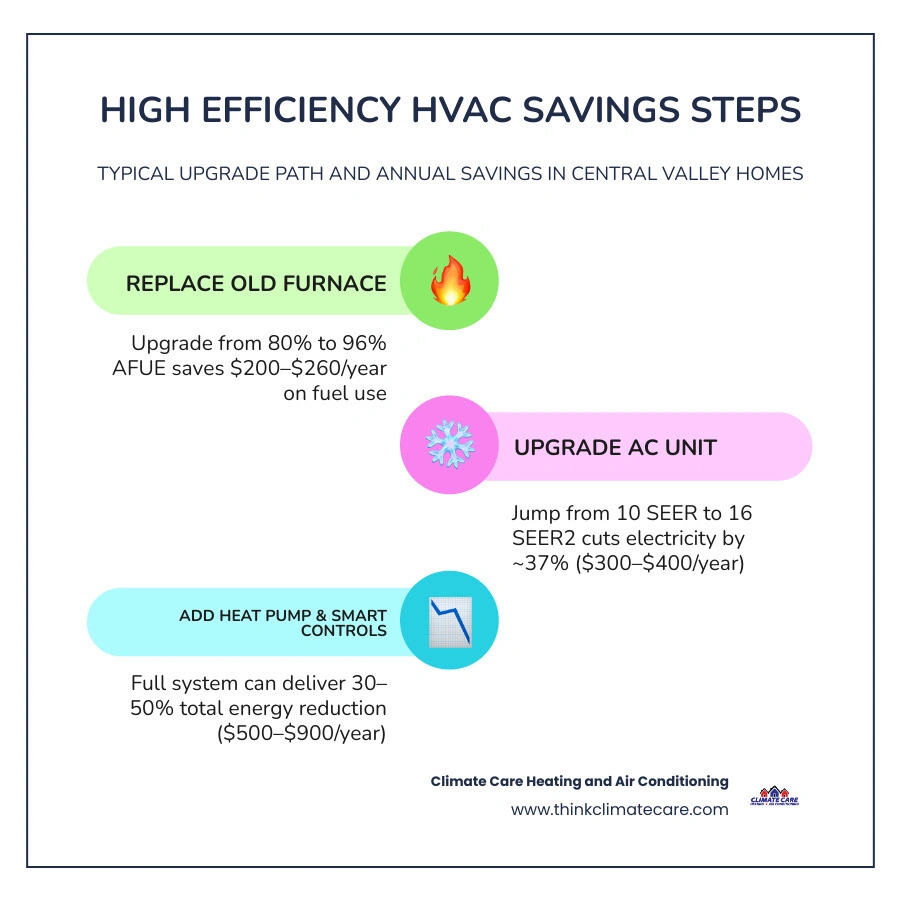
• Furnace: 80% to 96% AFUE — Efficiency Improvement: More fuel converted into usable heat — Potential Energy Savings: About 16–20% less fuel used for heating
• AC: 10 SEER to 16 SEER2 — Efficiency Improvement: Higher seasonal cooling efficiency — Potential Energy Savings: About 30–40% less electricity used for cooling
• AC: 14 SEER2 to 18 SEER2 — Efficiency Improvement: Higher seasonal cooling efficiency — Potential Energy Savings: About 20–30% less electricity used for cooling
• Air-source heat pump replacing older equipment — Efficiency Improvement: Efficient heating and cooling in one system — Potential Energy Savings: Significant reduction in total HVAC energy use
• Full system upgrade to modern high-efficiency equipment — Efficiency Improvement: Better equipment, airflow, and controls — Potential Energy Savings: Often 30–50% lower HVAC energy use when conditions are right
Heating and cooling account for a major share of household energy use. If your system is more than 10–15 years old, it may be running well below today’s efficiency standards — and using more energy than needed during hot Central Valley summers and cooler winter nights.
The good news? Upgrading to a modern high-efficiency system does not just reduce energy waste. It also improves home comfort, reduces humidity, runs quieter, and can support long-term reliability when installed and maintained correctly. The sections below break down how the numbers work, what affects your real-world savings, and how to decide if now is the right time to upgrade your system in the Central Valley.
For most homeowners in Manteca, Modesto, Stockton, Sacramento, Lodi, Tracy, Turlock, Lathrop, and nearby communities, the biggest efficiency gains usually come from AC installation and replacement, upgrading to a high-efficiency heat pump, sealing ductwork, and pairing the system with smart controls.
A high-efficiency system is especially valuable when your current unit:
• Runs constantly during summer
• Struggles to cool rooms evenly
• Uses more energy than expected even with normal thermostat settings
• Needs frequent AC repair or troubleshooting
• Is more than a decade old
• Uses outdated refrigerant
• Has poor airflow or leaky ducts
If you want a deeper side-by-side look at efficiency tiers, we recommend reading our standard efficiency vs high efficiency HVAC comparison.
Decoding Efficiency Ratings: SEER2, AFUE, and HSPF2
HVAC efficiency ratings can look like alphabet soup. SEER2, AFUE, HSPF2 - it sounds like a robot password. Fortunately, the ideas are simple.
• SEER2 — Applies To: Air conditioners and heat pumps — What It Measures: Cooling efficiency over a season — What Higher Means: Less electricity used for cooling
• AFUE — Applies To: Gas furnaces — What It Measures: Percent of fuel converted into heat — What Higher Means: Less fuel wasted
• HSPF2 — Applies To: Heat pumps — What It Measures: Heating efficiency over a season — What Higher Means: More heat delivered per unit of electricity
SEER2 stands for Seasonal Energy Efficiency Ratio 2. It measures cooling efficiency under updated testing standards that better reflect real-world duct resistance. A higher SEER2 rating means the system uses less electricity to cool your home.
AFUE stands for Annual Fuel Utilization Efficiency. A standard 80% AFUE furnace turns 80 cents of every fuel dollar into usable heat and loses the rest through exhaust. A 96% AFUE furnace turns about 96 cents into heat, wasting far less energy.
HSPF2 stands for Heating Seasonal Performance Factor 2. It applies to heat pumps and measures heating efficiency. Because heat pumps move heat instead of creating it by burning fuel, they can use dramatically less energy in the right climate.
In California’s Central Valley and Sacramento area, SEER2 and HSPF2 matter a lot because our systems often handle long cooling seasons and mild-to-moderate heating needs. A modern heat pump can be a strong fit because it provides both AC and heating in one efficient system.
For help spotting whether your current system is performing efficiently, see our guide on 5 signs your HVAC system is energy efficient.
How Much Does a High Efficiency System Save in the Central Valley Climate?
The Central Valley has a very different savings profile than colder parts of the country. Here, cooling is often the main event. In Manteca, Modesto, Stockton, Sacramento, Elk Grove, Lodi, and surrounding areas, summer heat can keep AC systems working hard for months.
That means high-efficiency cooling can make a noticeable difference.
Common savings patterns include:
• Replacing an older low-SEER AC with a modern high-efficiency system can reduce cooling energy use by roughly 20% to 40%.
• Moving from a 14 SEER2 system to an 18 SEER2 system can use about 28% less electricity for cooling.
• Switching from an aging furnace and AC setup to a high-efficiency heat pump can reduce energy use substantially, especially in homes with mild winter heating demands.
• Ductless mini-split systems can improve savings in homes where you only need to condition certain rooms, additions, garages, ADUs, or upstairs spaces.
In our region, the most practical upgrades are often:
1. High-efficiency AC replacement for homes with heavy summer usage
2. Heat pump installation for year-round heating and cooling efficiency
3. Ductless mini-splits for zoned comfort
4. Duct sealing and ventilation improvements
5. Smart thermostat upgrades
6. Regular maintenance and tune-ups to keep efficiency from sliding downhill like a shopping cart in a windy parking lot
You can learn more about choosing efficient equipment in our energy efficient HVAC guide.
How Much Does a High Efficiency System Save Over Its Lifespan?
A high-efficiency system may include advanced compressors, variable-speed motors, better controls, improved heat exchangers, and more sophisticated system design.
The real question is not only how much energy it saves today. It is how consistently it can help your home use less energy over the years you own the system.
Most HVAC systems last many years when properly installed and maintained. Over that time, savings can add up through:
• Lower HVAC energy use
• Reduced energy waste
• Fewer extreme temperature swings
• Better humidity control
• Less system strain from variable-speed operation
• Improved reliability with proper maintenance
• Possible added home value from modern HVAC equipment
Your results depend on your current system, home size, insulation, ductwork, energy rates, comfort habits, and the efficiency level you choose. In many cases, homeowners see the best balance from equipment that is carefully selected, professionally installed, and supported with routine maintenance.
For example, upgrading from very old equipment to modern efficient equipment usually creates much larger efficiency gains than replacing a fairly new system that is already performing well. In other words, going from old and tired to modern and efficient is where the magic happens.
A new system can also support resale appeal, especially when buyers see updated comfort equipment and efficient home systems. We explain that connection more in how a new HVAC system increases home value.
Key Factors That Determine Your Real-World Energy Savings
The rated efficiency on the equipment label is important, but your real-world savings depend on the whole home. A high-efficiency HVAC system connected to leaky ducts is like pouring gourmet coffee into a cracked mug. You may still get some benefit, but you are wasting more than you should.
The biggest savings factors include:
• Ductwork condition: Leaky ducts can lose 20% to 30% of conditioned air before it reaches your rooms.
• System sizing: Oversized systems short-cycle, waste energy, and do a poor job managing humidity. Undersized systems run constantly.
• Insulation and air sealing: A well-insulated home keeps cool air in during summer and warm air in during winter.
• Installation quality: Proper refrigerant charge, airflow setup, drainage, electrical connections, and commissioning all matter.
• Maintenance: Dirty coils, clogged filters, weak capacitors, and low refrigerant can reduce efficiency.
• Thermostat habits: Programmable and smart thermostats can help reduce unnecessary runtime.
• Indoor airflow: Poor ventilation, blocked registers, and restrictive filters can make even good equipment struggle.
This is why our approach at Climate Care Heating and Air Conditioning is holistic. We do not look only at the box outside. We look at system performance, ductwork, ventilation, indoor air quality, comfort goals, and long-term operating efficiency.
For practical ways to reduce energy waste now, visit practical HVAC energy-saving tips for homeowners.
Comfort, Humidity Control, and Indoor Air Quality Benefits
Energy savings are important, but comfort is where homeowners often feel the upgrade first.
High-efficiency systems commonly include two-stage or variable-speed technology. Instead of blasting on and off at full power, these systems can run longer at lower speeds. That helps create:
• More even temperatures from room to room
• Better humidity removal
• Quieter operation
• Fewer hot and cold spots
• More consistent airflow
• Better filtration because air circulates more steadily
In areas like Sacramento, Stockton, and Modesto, where summer comfort is not optional, better humidity control can make your home feel cooler without constantly lowering the thermostat. Even a small thermostat adjustment can reduce energy use when the system is controlling moisture well.
Indoor air quality can also improve when the system supports better filtration, ventilation, and airflow. Options may include upgraded filters, air purification, duct improvements, and ventilation solutions. This is especially helpful for households concerned about dust, allergens, wildfire smoke, pet dander, or stale indoor air.
For more on efficient, environmentally conscious comfort options, see our guide to eco-friendly HVAC solutions for a sustainable home.
When to Choose Replacement Over Repair for Older Systems
Repairing your HVAC system can make sense when the unit is newer, the issue is minor, and performance is still strong. But there comes a point where repeated repairs become a warning sign.
Consider replacement instead of repair when:
• Your AC, furnace, or heat pump is more than 10 to 15 years old
• Repairs are becoming frequent
• Energy use keeps rising without a clear reason
• Some rooms never feel comfortable
• The system runs loudly or cycles constantly
• The unit uses outdated refrigerant
• Major components are failing
• You want better comfort, efficiency, or indoor air quality
Older systems also lose efficiency over time, especially without regular tune-ups. A system that was considered efficient years ago may now fall well behind current SEER2, AFUE, and HSPF2 standards.
For Central Valley homeowners, heat pumps are worth considering during replacement because they provide both heating and cooling. In our climate, that can be a very practical path toward lower energy use and sustainable comfort.
We also provide AC repair in Manteca, AC troubleshooting in Modesto, heating and furnace service in Sacramento, ductwork and ventilation support in Stockton, ductless mini-split solutions, heat pump service, maintenance and tune-ups, emergency 24/7 HVAC service, and commercial HVAC support throughout Manteca, Modesto, Stockton, Sacramento, Lathrop, Tracy, Lodi, Turlock, and nearby communities.
Planning Your High-Efficiency HVAC Upgrade
A high-efficiency HVAC upgrade works best when the equipment, ductwork, airflow, thermostat controls, and home comfort goals are reviewed together. Availability of energy programs can change by program, equipment type, installation date, utility provider, and eligibility requirements, so it is important to confirm current details before choosing equipment.
In our service area, homeowners may be able to explore:
• California energy-efficiency programs
• Utility efficiency programs
• Heat pump programs
• Federal efficiency information where applicable
• Local electrification or efficiency programs
• Manufacturer program information when available
Helpful resources include:
• California Energy Rebates for HVAC Upgrades
• Federal Tax Credits for Heat Pump Upgrades
• PGE Rebates Central Valley Homeowners Guide
• How Climate Care Can Help Cut Your Tax Bill
Our team can help you understand which system types may qualify and what documentation may be needed. Since program rules can change, we always recommend confirming current details before installation.
Making the Switch to Sustainable Home Comfort
So, how much does a high efficiency system save? In many homes, the answer is enough to make a meaningful difference in energy use, especially when replacing older equipment in a hot Central Valley climate.
The best results come from matching the right equipment to the right home. That may mean AC installation and replacement in Manteca, AC repair and troubleshooting in Modesto, heat pump installation in Stockton, furnace service in Sacramento, ductwork and ventilation improvements, indoor air quality upgrades, or a ductless mini-split for a hard-to-cool room in Lathrop or Tracy.
At Climate Care Heating and Air Conditioning, we focus on whole-home HVAC care: performance, energy efficiency, comfort, indoor air quality, and environmental responsibility. Our licensed technicians support homeowners and businesses with maintenance and tune-ups, emergency 24/7 HVAC service, responsive support, and commercial HVAC systems throughout the Central Valley and Sacramento region.
If your system is aging, noisy, inefficient, or simply not keeping up, we can help you compare practical options and choose a solution built for long-term comfort.
Ready to explore your next step? Visit our HVAC services page to learn how we help homeowners and businesses throughout the Central Valley and Sacramento region stay comfortable year-round.